

Schools Say YouTube Hooked Their Students. Now YouTube Is Ready to Pay Them $3 Billion.
Thousands of school districts blamed YouTube’s endless videos for a student mental health crisis. A reported deal would be the biggest settlement any company has ever paid America’s schools.
Every parent who has tried to pry a phone out of a kid’s hands at 11 p.m. knows the feeling. One more video. Then another. Then it’s midnight and the homework is still in the backpack.
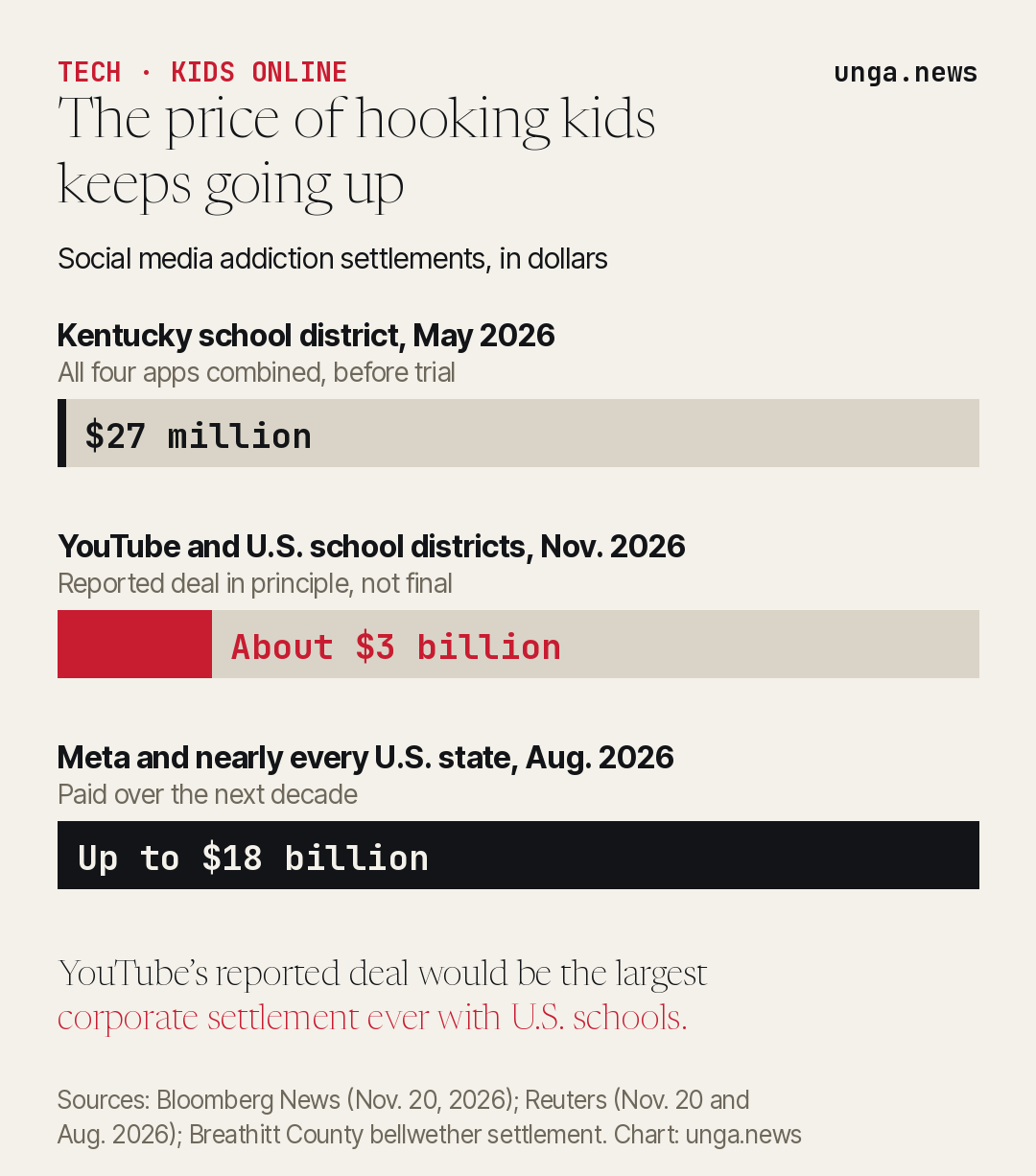
Thousands of American school districts said that wasn’t an accident. They sued YouTube and the other big apps, arguing the companies built their products to hook children and then left schools to clean up the mess. On Friday, Bloomberg News reported that YouTube has reached an agreement in principle to pay about $3 billion to settle those claims, along with new safeguards for teenagers. If it closes, it would be the largest corporate settlement ever reached with U.S. school districts.
That’s a huge check, and it isn’t final yet. People familiar with the deal told Bloomberg it depends on a majority of the districts signing on and will likely take a few months to wrap up. Google spokesman José Castaneda declined to comment, and so did the lawyers leading the districts’ cases. Any settlement also has to be approved by U.S. District Judge Yvonne Gonzalez Rogers in Oakland, California, who is overseeing the federal cases, Reuters reported.
Schools say they’re paying for the scroll
The districts suing range from New York City and Los Angeles down to small rural systems. Their complaint is not that kids watch too many cat videos. It’s that the apps were engineered to keep young users coming back, through recommendation algorithms that always serve up the next thing, videos that start playing on their own and feeds that never run out.
The schools say that design has a cost that lands on them. They point to students struggling with anxiety, depression and eating disorders, and to the money districts have had to spend enforcing phone bans and hiring counselors and mental health staff. They want that money back, and they want the platforms changed. YouTube, Meta, Snap and TikTok have all denied the claims.
Across the country, more than 10,000 lawsuits have been filed against those four companies over the past five years by schools, families and state attorneys general, according to Bloomberg. The cases blame features like endless scrolling and autoplay for addiction, anxiety, depression, eating disorders and suicide among young people.
YouTube isn’t just another app at school
What makes YouTube different from the rest is that it’s already inside the classroom. Teachers lean on it for lessons. Google’s Chromebook is the most common student laptop in the country. That puts YouTube in a strange spot: the same schools suing it over student mental health also hand kids devices that play its videos all day.
The numbers on how kids actually use it aren’t flattering. A September survey of more than 2,000 high school students by the Thomas B. Fordham Institute found that more than 30% used YouTube for entertainment during the school day, not for anything a teacher assigned, Reuters reported. Anyone who has walked past a study hall knows that number feels low.
Schools are also one of Google’s most important markets, which helps explain why the company would rather write a check than spend years fighting districts in front of juries. Inside Google, there has also been pushback over SI features in the search tool students use.
The price keeps climbing
This fight has been building all year, and the dollar figures have gone up fast.
The first federal school trial was supposed to start in June with Breathitt County Schools, a small district in eastern Kentucky. A month before, all four companies settled for a combined $27 million. YouTube paid a little more than $2 million of that and was the only company that agreed to provide training programs to the district, according to Bloomberg.
In a separate case earlier this year, a Los Angeles jury found Meta and YouTube liable in the first bellwether trial over social media addiction. That verdict told every lawyer in the country these cases could win in front of regular people.
Then in August, Meta agreed to pay up to $18 billion over the next decade to settle claims from nearly every state that it designed Facebook and Instagram to addict children, and to strictly limit how teens use them. The Verge reported that Meta tied part of that money, $5.3 billion, to whether YouTube and TikTok roll out similar changes and pay matching amounts. In other words, Meta made sure its rivals would feel the same squeeze.
YouTube’s reported $3 billion deal would cover the schools only. It doesn’t end the rest of the lawsuits from families and states, and the terms of the teen safeguards haven’t been made public.
Meta, TikTok and Snap still face a jury
YouTube getting out leaves the other three holding the bag. The next federal school trial, brought by a district in Tucson, Arizona, with about 40,000 students, is set to start in February before Judge Gonzalez Rogers. Meta, TikTok and Snap are still defendants.
For conservatives who have spent years warning that Big Tech treats kids like a product, this is vindication with a price tag. The argument used to get waved off as moral panic. Now one of the largest companies on Earth is reportedly ready to pay billions instead of letting a jury hear it.
The money matters less than what comes with it. The real test is in the teen safeguards once the deal is filed: whether autoplay gets turned off for minors, whether the endless feed gets a real stopping point, and whether parents get controls that work without a computer science degree. A check to a school district doesn’t put a kid to bed on time. Changing the product might.
Sources
- Bloomberg News — YouTube Finalizing Multibillion-Dollar Settlement With Schools (Nov. 20, 2026)
- Reuters — YouTube nears $3 billion settlement with US school districts over addiction claims (Nov. 20, 2026)
- The Verge — YouTube is reportedly preparing to settle social media addiction claims for $3 billion (Nov. 20, 2026)