

Seattle’s Progressive Mayor Ran Against Police Cameras. Now She’s Turning Them Back On.
Katie Wilson paused Seattle’s camera expansion in March. After an outside audit, she switched the stadium cameras back on and cleared two more neighborhoods, pointing to a shortage of police officers.
A year ago, Katie Wilson ran for mayor of Seattle as the progressive who didn’t want more police cameras on city streets. On Tuesday she stood at City Hall next to her interim police chief and announced that the cameras near the stadiums are going back on immediately, and that two more neighborhoods are getting them.
That is a real turn, and it didn’t come from a sudden love of surveillance. It came from a city that doesn’t have enough cops.
“We do have real issues with police staffing in our city,” Wilson told reporters, explaining what moved her. “I do think that the RTCC can help us be more efficient with our resources.”
The RTCC is Seattle’s Real Time Crime Center, the room where police watch live feeds from city cameras and pull footage after a shooting or a stabbing. The cameras have been running since April 2025 in three areas: downtown, the Chinatown-International District and the Aurora Avenue corridor. Those never went dark.
The pause, the World Cup and the reversal
In September 2025, the City Council voted to add three more spots: the Stadium District south of downtown, the stretch of the Central District around Garfield High School, and the Capitol Hill nightlife district. Then Wilson won, and in March 2026 she hit the brakes, pausing the expansion and ordering an outside review from the NYU Policing Project.
The stadium cameras were already bolted to the poles. They ran during the World Cup this summer, when Seattle hosted matches and the world showed up, and then the city switched them off as soon as the tournament ended, according to MyNorthwest.
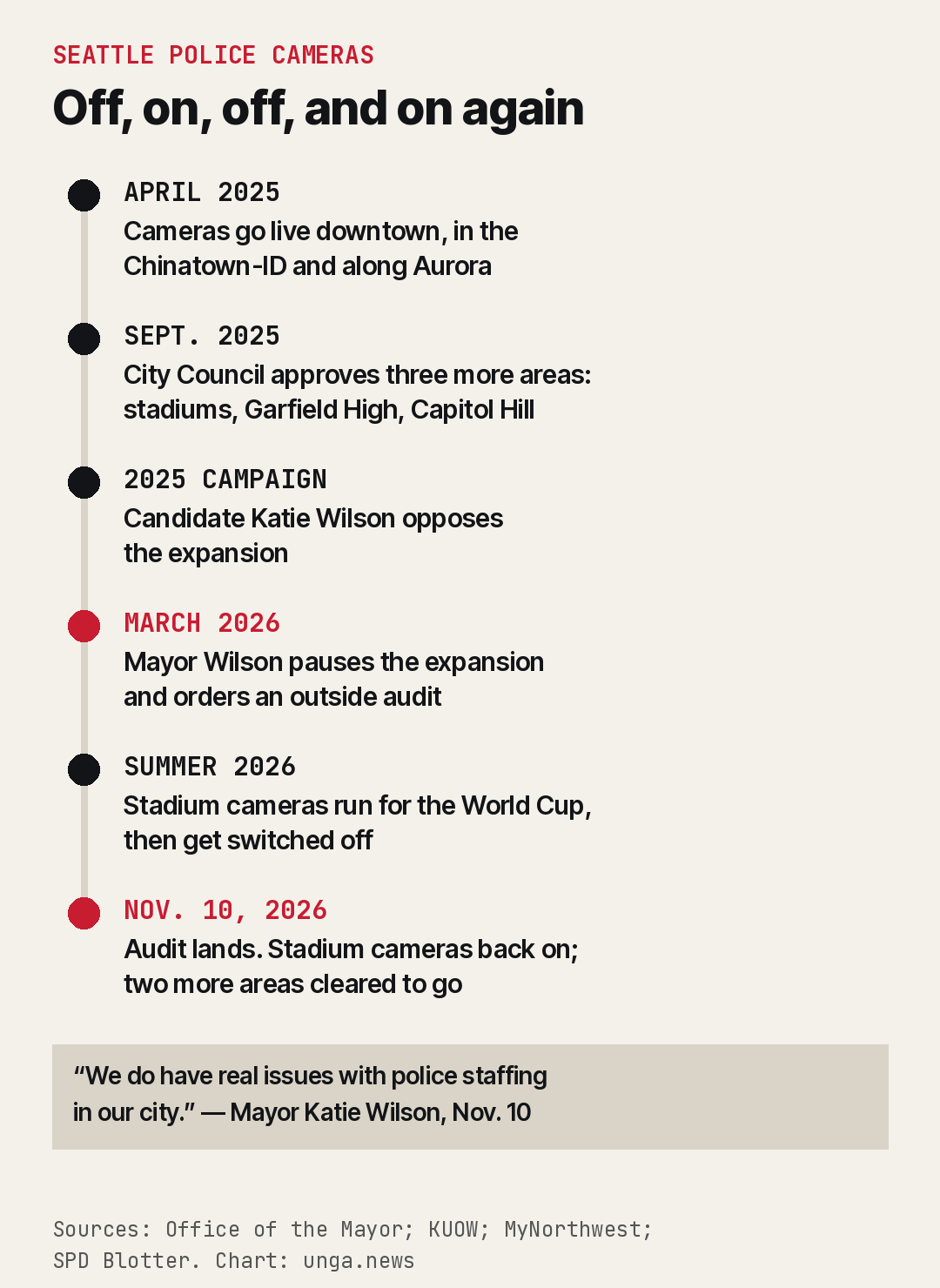
Now the audit is done, and Wilson says it didn’t turn up anything that justified waiting longer. The stadium cameras are on. The Capitol Hill and Garfield High cameras still have to be bought and installed, which she said will likely take several months.
“After reviewing the evidence, the recommendations, and the safeguards available to us, I believe there is an important and responsible role for the RTCC within Seattle’s public-safety system,” Wilson said in her announcement. “Seattle does not have to choose between taking crime seriously and taking civil liberties seriously,” she added at the press conference.
Who pushed for it
Plenty of people in Seattle wanted this long before the mayor did. Wilson herself said the stadium cameras were “a priority for many businesses and others in SODO” and for Councilmember Rob Saka, who represents that district.
Councilmember Bob Kettle, who chairs the council’s public safety committee, called the move “pragmatic.” Gabriel Neuman of the Greater Seattle Business Association, an LGBTQ business group, made the case for Capitol Hill in plain terms: the neighborhood has seen “several instances of homicides particularly against our queer and trans neighbors, and we need a system in which those issues can be followed up with thoroughly,” he said, according to KUOW.
Interim Police Chief Andre Sayles spoke straight to the skeptics. “To those worried about privacy, about our most vulnerable and immigrant neighborhoods being targeted, or about illegal surveillance: I hear you,” he said, while making the case that video footage is vital to solving crimes.
Not everyone on the council is on board. Councilmember Alexis Mercedes Rinck said she would rather fix the program’s internal problems “before seeking to expand this system.”
The strings attached
The audit made 19 recommendations. The Seattle Police Department says it will adopt 15, and it has already started on many of them, according to the department’s own response. Two it won’t adopt as written. One urged warrants for certain uses of the footage. SPD said it will keep acting within existing law and won’t use the system to get around warrant requirements. The other would have changed how long footage is kept, which SPD said doesn’t match its current retention practices.
The department is promising a public dashboard showing how the system is used, a single written policy for how new surveillance tech gets approved, tighter rules on who can access footage and for what, and regular internal audits to catch misuse. The mayor’s office will also set up an advisory group of privacy and technology experts to help write the rules.
Wilson also drew a few lines of her own. She ruled out Flock, the license-plate camera company, and said the system stays with Axon, the company behind police body cameras, which she said has “a more responsible record.” And she said she wants safeguards that keep the footage away from federal immigration agencies.
That last part is worth a hard look. A camera system sold to voters as a way to catch violent criminals should be able to help catch violent criminals, whoever is doing the asking. Walling footage off from federal law enforcement is a political choice, not a privacy one, and it is the same instinct that has turned sanctuary policies into a fight in city after city.
A lesson for other blue cities
Wilson didn’t oversell what cameras can do. She admitted the evidence on whether they prevent crime is mixed, and another review from the University of Pennsylvania, ordered by the city’s inspector general, is due in 2027.
Her reasoning is simple, though. A mayor who campaigned against more cameras looked at a short-staffed police department, talked to the officers using the footage, and decided Seattle needs the help. Progressive mayors in other cities facing the same staffing math will be watching.
Seattle voters who wanted the cameras on got them back. It took an eight-month pause, one audit and a change of heart from the person who once stood in the way.
Sources
- Office of the Mayor, Seattle — Mayor Wilson Allows Targeted CCTV Expansion While Adopting New Privacy and Accountability Safeguards
- Seattle Police Department (SPD Blotter) — NYU Policing Project Recommendations and SPD Response
- KUOW — Seattle mayor green-lights ‘targeted’ expansion of police surveillance cameras
- MyNorthwest — Wilson turns stadium district cameras back on, authorizes SPD expansion
- KIRO 7 — Mayor Wilson moves forward with turning on Seattle police cameras following RTCC audit