

Security Firm Finds More Than 35,000 Grok Apps Open to Anyone, Some From SpaceXSI’s Own Staff
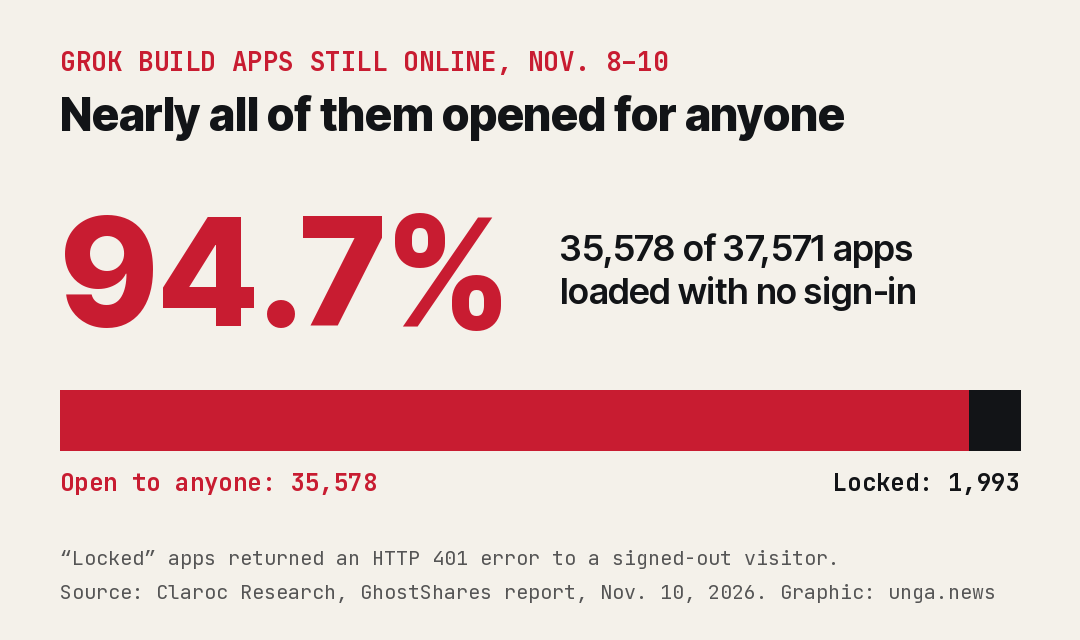
Claroc says 94.7% of the Grok apps still online opened with no sign-in. Some held patient records, staff lists and plain-text passwords. SpaceXSI says apps stay private until their builders choose to share them.

Grok can now build you a whole app from a single chat. Describe what you want, a sign-up sheet, a sales map, a shift schedule, and a few minutes later it’s live on the internet with its own web address. That’s the selling point. A security firm says it’s also the problem.
Claroc, a security research company, says it found 35,578 apps built with Grok that anyone could open without signing in. That’s 94.7% of the 37,571 Grok apps it found still online. Most were harmless: games, landing pages, calculators. But the firm says about 1 in 10 held internal business data or personal information, and some of it was the kind of thing nobody should ever find by accident.
According to Claroc’s report, the open apps included a hospital group’s staff app with a searchable list of more than 3,500 employees, and an intensive-care briefing on a single patient, with lab results, imaging and ventilator status. There was a fire department’s live shift board with firefighters’ names, badge numbers and hours on duty, and a trucking company’s recruiting list with more than a thousand drivers’ legal names and personal email addresses. One contractor’s timesheet app had every employee’s password sitting in plain text in its code, admin accounts included.
Even the people who make Grok left theirs open
The most awkward finding is about the company itself. Grok is made by SpaceXSI, the company formerly called xAI. Claroc says 24 of the open apps were built by SpaceXSI and X staff. It says they included a confidential onboarding plan, a sales territory map covering 594 accounts, and an X advertising proposal to a U.S. federal agency that was marked confidential.
SpaceXSI took those 24 apps down after Claroc reported them, the firm says. It hasn’t done the same for apps belonging to other Grok users and organizations. Besides SpaceXSI and X, Claroc says it could identify 30 organizations with internal data in open apps. Twenty-six of them have more than 1,000 employees, and six are Fortune 500 companies. Claroc isn’t naming any of them.
How the apps ended up public
Here’s the part that matters if you’ve built anything with Grok. Nothing goes public until the builder clicks Publish. Claroc agrees with that. The fight is over what happens next.
In the paid account Claroc used, the publish step offered three access choices: “Anyone with the link,” “Invited users” and “Only you.” “Anyone with the link” was already selected. The Hacker News confirmed the same three choices in its write-up of the research.
That sounds safe, because a random web address is hard to guess. But each Grok app gets its own address under grok.me, and those names show up in public records of web addresses. Claroc says it found 43,601 app names that way, using common discovery methods. So a link nobody shared wasn’t really secret.
Claroc also built two test apps of its own, with made-up data, to see what security Grok adds when nobody asks. The first, a contact list, got a database and no sign-in at all. From a signed-out browser window, the researchers added a row the next visitor could see.
The second was a customer list “for my company’s sales team of 4 people.” This time Grok added sign-in on its own, with “Continue with Google” and “Continue with X” buttons. But Claroc says the code added whoever signed in to the team before checking whether they belonged on it, so the check always passed. An uninvited Google account got in, saw every customer, changed one record and deleted another. Claroc says it ran that test only on its own app and never touched anyone else’s.
SpaceXSI’s side
SpaceXSI didn’t answer Claroc directly, the firm says, but it did answer questions from a reporter covering the research. It said Grok apps are private until their creator chooses to share one, and that publishing takes several steps: click Publish, pick an address, click Publish again, choose between Only you and Anyone with the link, accept a legal disclaimer, and click Publish one last time. It said employee accounts start out set to Only you, and that this is more steps than other app builders such as Lovable ask for.
Claroc doesn’t buy that. “Extra clicks on a path that ends with access already set to everyone do not protect the data,” the report says. Its point is that the people behind all 35,578 open apps went through every one of those steps.
“AI app builders turned publishing into a few clicks, and the default answer to who can see it is everyone,” said Asaf Aprozper of Claroc Research.
Claroc says it sent SpaceXSI four fixes with its report. The first is to stop giving each shared app its own findable web name. It also wants an “everyone in my organization” option tied to a company’s email domain, “Only you” as the default for everyone, and a warning when an app has a database but no sign-in.
This isn’t just a Grok thing
To be fair to Grok, the problem is bigger than one company. Claroc names other SI app builders, including Lovable, Replit, v0, Bolt, Base44 and Google AI Studio, as tools workers can use with no IT rollout and no company account. One big company Claroc knows of counted 500 SI-built apps inside its walls.
That’s the real shift. It used to take a developer and a ticket to put a company tool on the internet. Now somebody who runs a sales territory or a shift roster can do it over lunch, and nobody in IT ever sees it. As TechRadar pointed out, the sharing choices work a lot like a Google Doc, except most people know by now to check who can see a Google Doc.
If you’ve built a Grok app
The fix is simple, and Claroc tested it. Open your app’s sharing settings. If it holds anything private, set it to “Invited users” or “Only you.” Claroc says that when it switched its own app to Only you, a stranger got an error page right away, and unpublishing took the app offline within seconds.
Then open your app in a private browser window, signed in to nothing. If you can see your data there, so can everybody else.
Sources
- Claroc Research — Grok apps exposed xAI secrets and private data (GhostShares, Nov. 10, 2026)
- The Hacker News — Over 35,000 Grok-built apps exposed online
- TechRadar — Grok Build coding agent is leaking confidential data
- Unite.AI — Claroc Research finds 35,578 Grok apps accessible without sign-in