

Senate Clears a Big Hurdle on a Bill to Build Power Lines and Mines Years Faster
Seventy senators from both parties voted to push ahead with a permitting overhaul that puts hard deadlines on federal agencies and limits lawsuits that stall projects for years.

A new power line in America can take a decade or more to get built, and much of that time is spent waiting on paperwork. A bipartisan bill moving through the Senate aims to change that, and on Monday night it cleared a big hurdle by a wide margin.
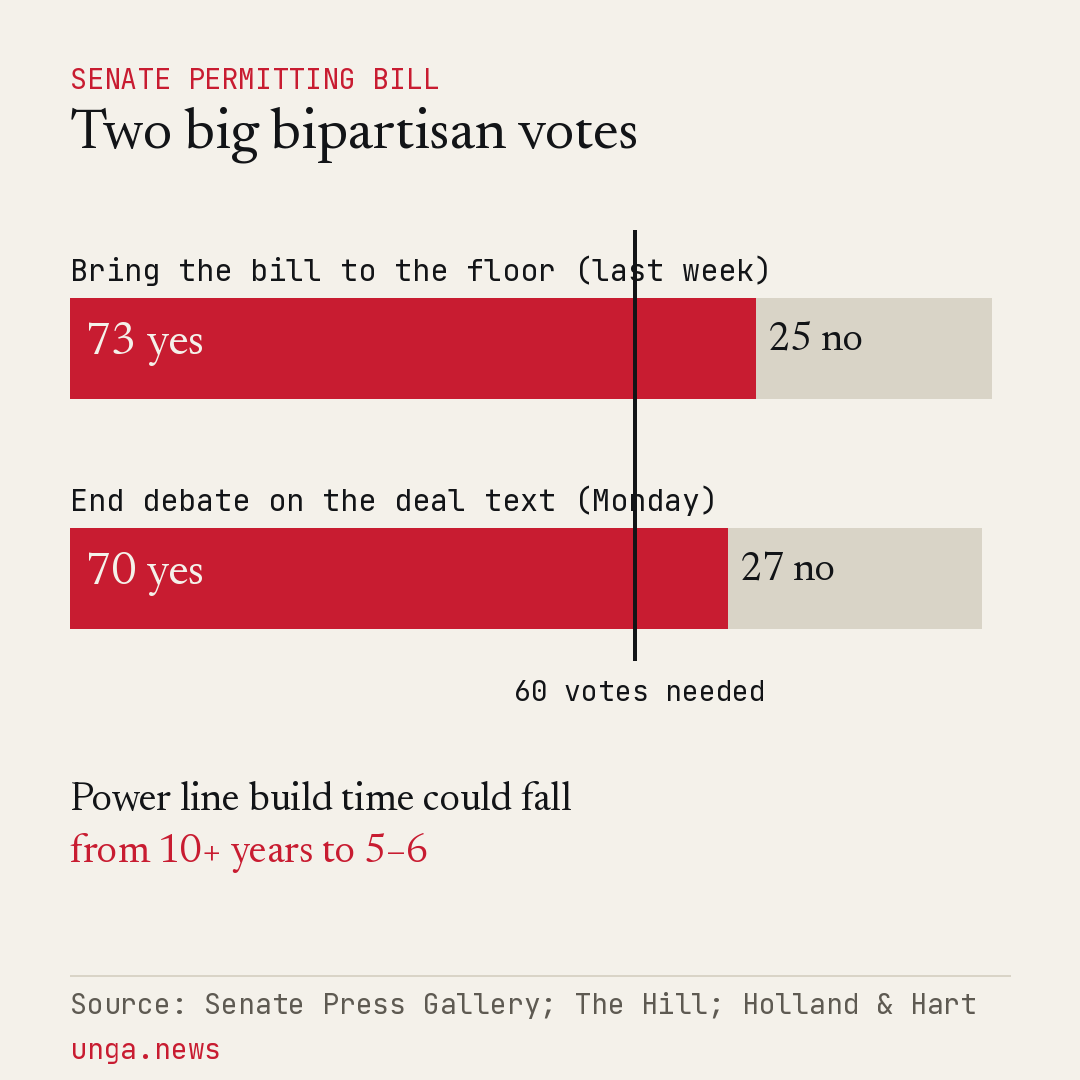
Senators voted 70-27 to end debate on the 494-page heart of the Bipartisan American Affordability and Jobs Act, a permitting overhaul meant to speed up energy, mining and infrastructure projects. The vote cleared the 60-vote bar with 10 to spare and locks in the base text. It follows a 73-25 vote last week to bring the bill to the floor. A final Senate passage vote is expected before Thanksgiving.
Four senators, two parties, one deal
The deal comes from an unusual lineup. Sen. Shelley Moore Capito, the West Virginia Republican who chairs the Environment and Public Works Committee, wrote the substitute with Utah Republican Mike Lee and Democrats Sheldon Whitehouse of Rhode Island and Martin Heinrich of New Mexico. The four released the updated text on Nov. 7 with changes they said came from stakeholder feedback, including stronger language on energy-hungry data centers and on tribal consultation.
That a conservative like Lee and a climate hawk like Whitehouse are on the same bill tells you how broken the current system is. Republicans want pipelines, mines and power plants built faster. Democrats want transmission lines for wind and solar built faster. Everyone is tired of waiting.
A clock on the permit desk
The core of the bill is deadlines. Today, a federal agency can finish its environmental review and then let a project sit, because no law forces the final decision. Under the bill, the lead agency would have 45 days after a final environmental impact statement to issue its decision, according to an analysis by the Bipartisan Policy Center. Other agencies would then have 90 days to sign off if they took part in the review and 120 days if they did not.
Agencies would also have 60 days to tell an applicant whether its paperwork is complete, something current law doesn’t require at all. If an agency blows a deadline, it could only get off the hook by proving one of six narrow excuses with clear and convincing evidence. A court would have 120 days to rule and could order a decision within 60.
Builders would have to do more homework up front in exchange. Sponsors would file a list of every federal, state, tribal and local permit their project needs, a short description of its purpose and location, and a record of meetings with agencies and local communities, capped at 20 pages. Nuclear projects would be exempt from the 90- and 120-day permit clocks but not from the rest of the deadlines, the Bipartisan Policy Center found.
Fewer years in court
The bill also goes after the lawsuits that can tie up a project for a decade. Challenges under the National Environmental Policy Act, the law behind most environmental reviews, would have to be filed within 150 days and heard in federal appeals courts, according to the Congressional Research Service. Courts would generally be barred from tossing out a permit or halting construction over a paperwork flaw under that law, though they could still act on likely violations of other federal statutes.
The bill also limits challenges under the Clean Water Act, the Endangered Species Act and the National Historic Preservation Act, The Hill reported.
Power lines in half the time
For families watching their electric bills, transmission may matter most. The bill would give the Federal Energy Regulatory Commission more authority to approve certain interstate, offshore and international power lines, and it would direct the agency to set timelines for utilities to upgrade existing lines with newer technology when the benefits outweigh the costs. The Hill reported that the changes could cut the time it takes to build a new line from 10 years or more to five or six.
That matters because demand is climbing fast, driven in part by the SI data centers going up across the country. More supply that can actually reach customers is the surest way to keep prices in check.
Still a fight over the fine print
The bill isn’t home yet. Senators can still offer amendments that leadership allows, and roughly 17 have been floated, Bloomberg Government reported. The biggest fight is over tribal consultation, which tribal groups and their supporters want to strengthen further. Two senators who voted yes on last week’s motion flipped to no on Monday.
Then it goes to the House. Outgoing Speaker Mike Johnson has said the House will pass the Senate bill, according to Holland & Hart’s federal affairs team, but House members are watching the Senate amendments closely. With Congress also facing a Dec. 11 government funding deadline, the window for a deal of this size is short.
For now, a bill to build things faster is moving faster than most things in Washington.
Sources
- U.S. Senate Periodical Press Gallery — Tuesday, November 17, 2026 floor log
- Senate Environment and Public Works Committee — Capito, Lee, Whitehouse, and Heinrich Release Substitute Amendment to Bipartisan American Affordability and Jobs Act of 2026
- Bipartisan Policy Center — Explaining the Senate Permitting Bill, the Bipartisan American Affordability and Jobs Act
- Congressional Research Service — BAAJA of 2026: Summary of All Sections (R49506)
- The Hill — Senate clears hurdle for bipartisan permitting reform package
- Bloomberg Government — Permitting Overhaul Bill Advances in Bipartisan Senate Vote
- Holland & Hart — Lame Duck Week One: Permitting Reform Faces First Real Test