

Senate Republicans Kept Trump’s Iran Mission Alive, Voting Down a Bid to Pull U.S. Troops Out
Democrats used the first war powers vote since the midterms to try to force a withdrawal. They fell three votes short, 48 to 51, and now they want to go after the war’s funding instead.

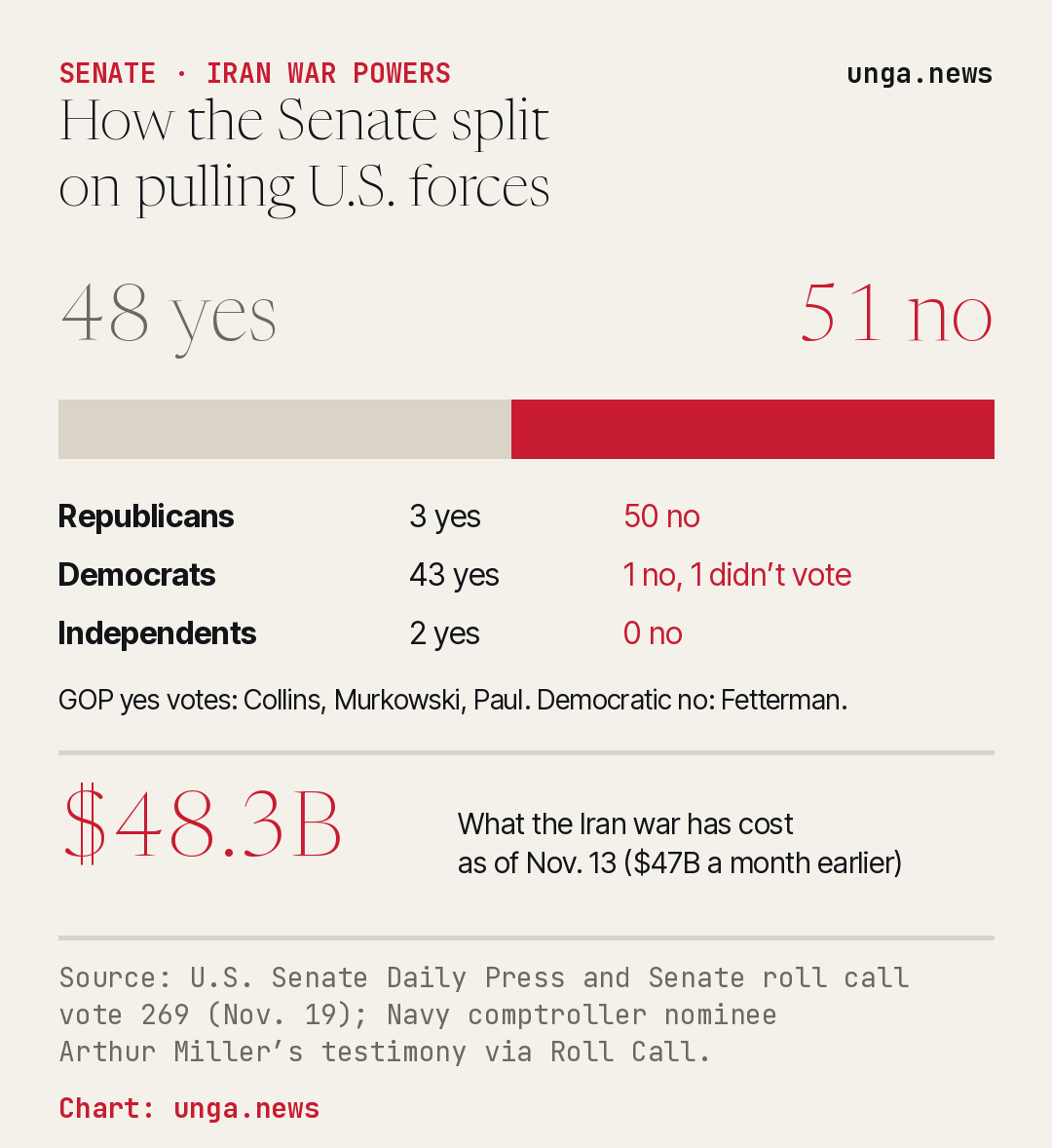
Senate Republicans held the line for President Trump on Iran Thursday. By a vote of 51 to 48, the Senate refused to adopt a resolution that would have directed him to pull U.S. forces out of the fight, according to the Senate’s own floor log. It was the first war powers vote since the Nov. 3 midterms, and Democrats had circled it as their big chance to tie the commander in chief’s hands. They came up three votes short.
The measure, H.Con.Res. 93, had already cleared the House in mid-September. It would have directed the president, under the 1973 War Powers Resolution, to remove American troops from hostilities with Iran. The roll call opened at 2 p.m. and closed at 2:42 p.m. Senator Tim Sheehy of Montana spoke on Iran in the final minutes before the vote began. Senators Peter Welch, Tammy Baldwin and Tim Kaine spoke for the resolution just before him.
Who broke ranks, and who didn’t
The lineup didn’t surprise anyone who has watched these fights. Republicans Susan Collins of Maine, Lisa Murkowski of Alaska and Rand Paul of Kentucky voted yes, as they have on similar measures. Pennsylvania Democrat John Fetterman voted no and stood with the Republicans. Connecticut Democrat Chris Murphy didn’t vote.
The more telling votes came from two Republicans on their way out. Roll Call reported that Thom Tillis of North Carolina and Bill Cassidy of Louisiana, who have at times backed similar measures, both voted no this time. Two lame-duck senators with nothing left to prove at the ballot box chose to keep the president’s options open in the middle of a shooting war. That says something about how this vote was read inside the room.
There is a detail here that cuts against all the drama. Even if both chambers had passed it, H.Con.Res. 93 is a concurrent resolution. It never goes to the president’s desk for a signature. Roll Call called it “largely symbolic.” Democrats spent a day of floor time on a message vote, and they still couldn’t get the message through.
The bill for the fight so far
The money is real, and both sides know it. Arthur Miller, the nominee to be Navy comptroller, told the Senate Armed Services Committee on Thursday that the war had cost at least $48.3 billion as of Nov. 13, up from $47 billion a month earlier, Roll Call reported. That figure counts munitions, replacement equipment and operating costs. It doesn’t count damage to U.S. bases, which Roll Call says will likely run into the billions on its own.
U.S. operations against Iran began Feb. 28 with joint American and Israeli strikes. In nine months, the president has kept the pressure on a regime that has spent decades chanting death to America and arming proxies against our troops. This week alone, Iran fired on U.S. bases and American jets struck back. Pulling forces out in the middle of that would have handed Tehran exactly the break it has been shooting for.
Democrats eye the checkbook next
Losing the vote hasn’t ended the effort. It has changed the weapon. With Democrats set to take control of Congress in January, party leaders are now debating whether to cut off war funding instead of holding more war powers votes. The next government funding deadline is Dec. 11.
Senators Tammy Duckworth of Illinois and Kirsten Gillibrand of New York want an amendment that bans money for offensive operations in Iran attached to the next stopgap spending bill. “We’ve already tried tool after tool to get the president to rein in this conflict. Nine months in, defunding the war is the only way to force Trump to end it,” Duckworth said at a news conference, and she vowed to oppose any stopgap without it. In plain terms, she is threatening a government shutdown to force a retreat.
Colorado’s Michael Bennet went further. He rolled out an amendment that would bar any funding, future or past, from being used to “support directly or indirectly combat activities by United States personnel in or over Iran, or in Iranian territorial waters” unless Congress signs off. His office said it is modeled on the 1973 cutoff of the Cambodia bombing campaign. Kaine told reporters Democrats are “contemplating other things” once they hold the gavels.
The House may get another shot before Christmas. Kentucky Republican Thomas Massie filed his own war powers resolution on Nov. 10, and the law lets him force a vote 15 calendar days after filing. Like the one that just failed, it would direct the president to pull U.S. units out of hostilities unless Congress authorizes them or they are needed to stop an imminent attack.
For now, the scoreboard reads the same way it has all year. The president keeps his options, the troops keep their mission, and Tehran gets no signal from Washington that America is about to walk away.
Sources
- U.S. Senate Daily Press — Thursday, November 19, 2026 (floor log)
- U.S. Senate Periodical Press Gallery — Thursday, November 19, 2026
- Roll Call — Iran resolution blocked in first war powers vote since midterms
- AP News — Senate Republicans block latest effort to end war in Iran