

Shapiro Vows to Write Abortion Into Pennsylvania’s Constitution, but Republicans Already Ran Out His Clock
The Democrats’ first try passed the House by one vote and died in a Republican Senate. Any new amendment can’t reach voters before 2029.

Most Pennsylvanians spent Sunday morning in church, at breakfast or getting ready for football. Their governor spent it promising to write abortion into the state’s founding document.
“Under a Democratic trifecta, we will enshrine abortion rights into our Commonwealth’s Constitution — so no one can rip away a woman’s fundamental freedom to choose,” Gov. Josh Shapiro posted on 𝕏 just after 11 a.m. Eastern. By the afternoon the post had drawn more than 870 replies against fewer than 600 likes, the kind of ratio that tells you how the pitch landed with a big share of the people reading it.
Governor Josh Shapiro on 𝕏 — “Under a Democratic trifecta, we will enshrine abortion rights into our Commonwealth’s Constitution…” (Nov. 22, 2026)
— @GovernorShapiro View on 𝕏
The amendment that never got a vote
Shapiro’s pledge isn’t new. He put the same promise in writing on Nov. 6, days after the election handed Democrats both chambers of the General Assembly to go with the governor’s office starting in January. What’s new is the clock. The amendment his party already tried, House Bill 1957, is about to die.
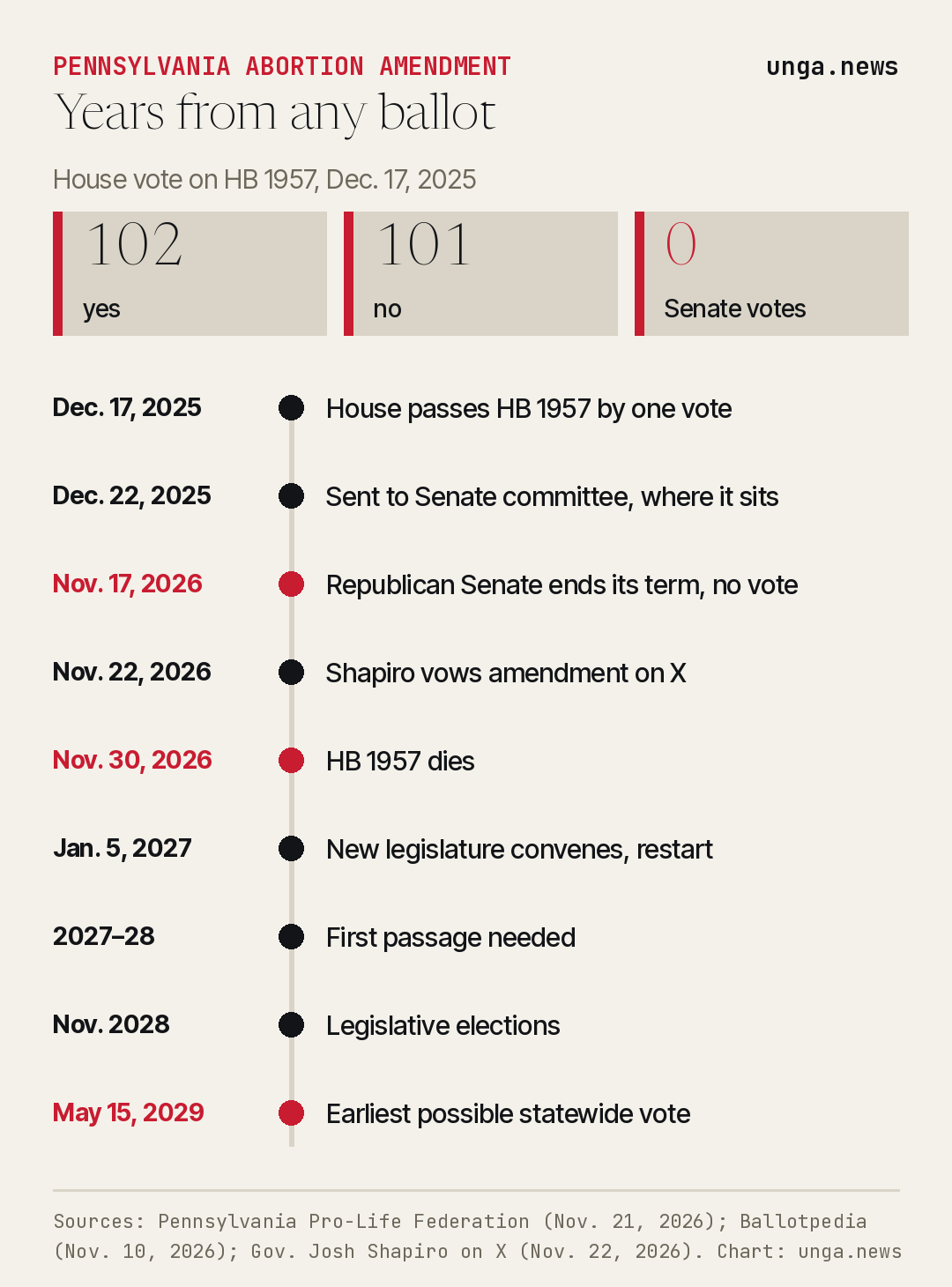
According to the Pennsylvania Pro-Life Federation’s weekly legislative rundown, the state House passed HB 1957 by a single vote, 102 to 101, on Dec. 17, 2025. The measure would add “personal reproductive liberty” to the Constitution. It went to the Senate State Government Committee five days later and sat there for 11 months. The Senate, still run by Republicans, held its last session day of the term on Nov. 17 without ever bringing it to the floor. If first passage isn’t finished in both chambers by Nov. 30, the bill is dead and the whole process starts over.
That outcome was no accident. Senate Republicans simply refused to put the most sweeping abortion language in state history on a fast track, and they ran out the clock. For pro-life Pennsylvanians, that is the one thing the outgoing Senate majority did exactly right.
Shapiro’s Sunday wording also left out who stopped the last attempt. It wasn’t a court or a president. It was a Senate that the voters of Pennsylvania elected, doing what legislatures are supposed to do with a change this big: slow it down. A one-vote House margin is not a mandate to rewrite the Constitution, and the Senate treated it that way.
A promise with a long road in front of it
Pennsylvania doesn’t let a governor amend the Constitution. Shapiro can’t sign it and can’t veto it. Under the state’s rules, an amendment has to pass both chambers in two consecutive legislative sessions, with an election in between, and then win a statewide vote.
Ballotpedia lays out the math. A new proposal would have to pass in the 2027-28 session, then pass again in the legislature elected in 2028. The earliest it could reach voters is the May 15, 2029, primary. Democrats would need to hold both chambers through the 2028 election to do it without a single Republican vote. If either chamber flips back, they need bipartisan support they don’t have.
History isn’t kind to amendments that depend on one party holding power across two sessions. Ballotpedia found that from 2010 to 2026, when legislative control changed between sessions, 17 of 21 amendments that passed the first time, about 81%, failed the second time. Pennsylvania has lived that already. Republicans approved six amendments in 2021-22, including one on abortion and one on voter ID. When Democrats took the House in 2022, none of the six made it through.
The new version is already drafted. On Nov. 5, Democratic state Rep. Danielle Friel Otten introduced an amendment that would add to the Declaration of Rights that “every individual has the fundamental right to exercise personal reproductive liberty,” including the ability to “prevent, continue, or end a pregnancy.” There are no limits in that sentence. It says nothing about late-term abortion and nothing about parents of minors.
Taxpayers are already in the fight
The constitution push isn’t the only front. In Allegheny Reproductive Health Center v. DHS, the Commonwealth Court struck down the state’s long-standing ban on using Medicaid money for abortions, and the state Supreme Court has kept that ruling in effect while it hears the appeal. Briefs are due Dec. 2. In the meantime, Pennsylvania taxpayers are reportedly covering abortions through Medicaid.
Put the pieces together and the picture is clear. Shapiro, widely seen as a 2028 presidential hopeful, is staking his second term on making abortion a permanent constitutional right in a state where his party’s last attempt cleared the House by one vote. Pro-life lawmakers and voters have until 2029 at the earliest to make their case. They also have something Shapiro’s Sunday post didn’t mention: Pennsylvania’s Constitution can’t be changed without them showing up at the ballot box to say yes.
Sources
- Governor Josh Shapiro on 𝕏 — Governor Josh Shapiro on 𝕏 — “Under a Democratic trifecta, we will enshrine abortion rights into our Commonwealth’s Constitution…” (Nov. 22, 2026)
- Pennsylvania Pro-Life Federation — Week Ending Nov 21: The Abortion Amendment Still Dies November 30 (Nov. 21, 2026)
- Ballotpedia News — How legislative control changes could affect constitutional amendments in Wisconsin, Pennsylvania, and other states (Nov. 10, 2026)