

Sherrod Brown Won Ohio by 223,000 Votes. Voter ID Won It by 1.4 Million.
Same voters, same ballot. Ohio, North Carolina and Nevada wrote photo ID into their constitutions while electing Democrats, and five states limited voting to citizens. The blue wave wasn’t a vote against election security.
Ohio voters threw out a Republican senator on Tuesday. On the same ballot, they voted by better than 30 points to lock photo ID into their state constitution.
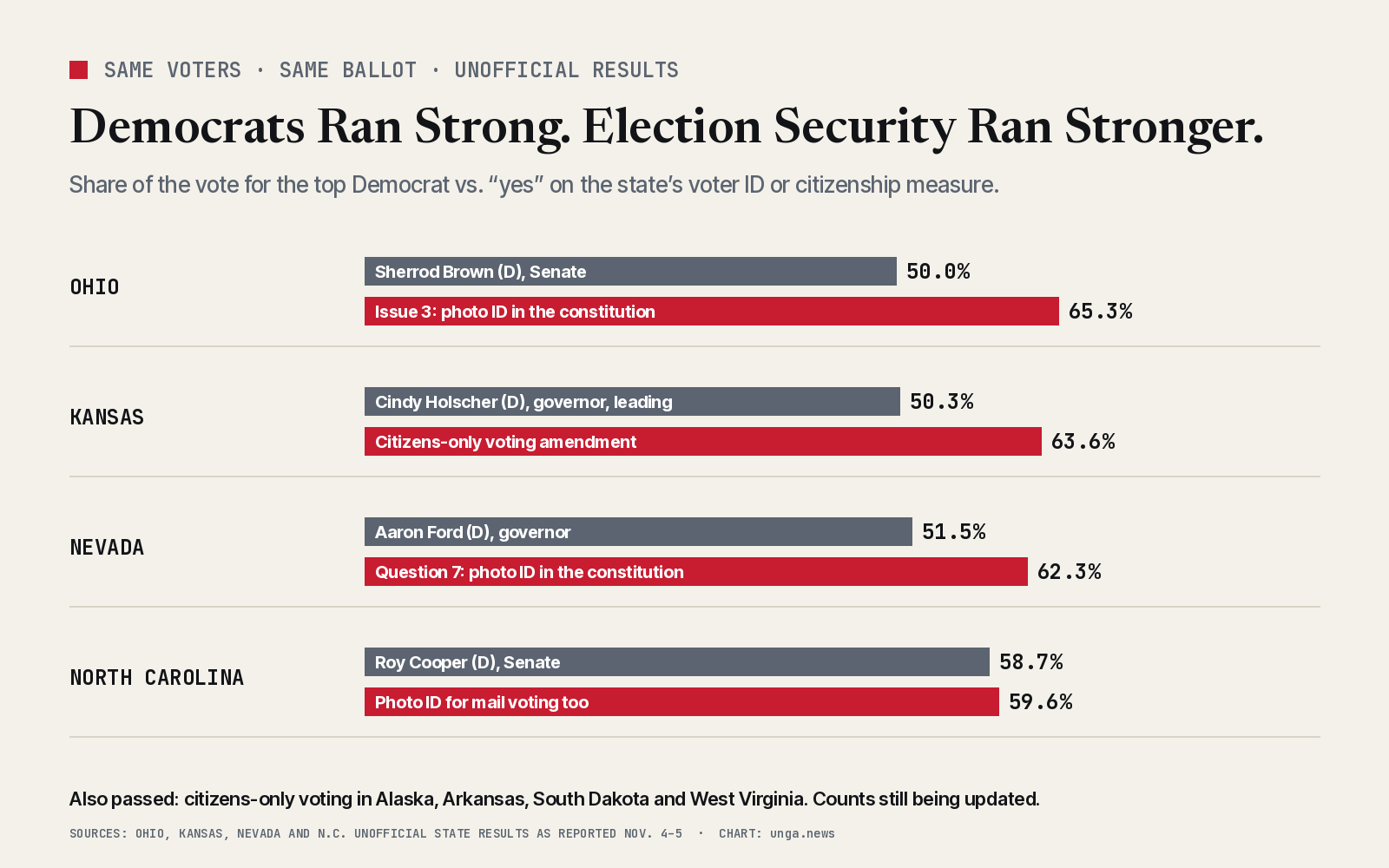
Democrat Sherrod Brown beat Sen. Jon Husted 2,301,042 to 2,077,748 in the unofficial count, a 223,294-vote win. Issue 3, the voter ID amendment, passed 2,934,245 to 1,556,864. That’s a 1.38 million-vote margin. More Ohioans voted yes on voter ID than voted for Brown, by about 633,000.
Ohio wasn’t alone. Voters in eight states approved election-security measures Tuesday, several of them in places that went for Democrats at the top of the ticket. The blue wave was real. A vote against secure elections, it was not.
Eight states, one message
Photo ID, three states. Ohio’s Issue 3 puts the state’s photo ID rule for in-person voting into the constitution. North Carolina extended its constitutional photo ID requirement to mail ballots, 2,463,276 to 1,669,764, or 59.6%, according to state election data. Nevada’s Question 7 passed with about 62% and requires photo ID at the polls plus an ID number on mail ballots starting in 2028.
Citizens only, five states. Kansas, Arkansas, South Dakota and West Virginia wrote into their constitutions that only U.S. citizens can vote, and Alaska did it by statute. In Kansas, the amendment led 672,163 to 384,227, about 64%, with all 4,168 precincts reporting, per the Secretary of State’s unofficial count. West Virginia’s came close to 80%.
Now look at who won those same states. North Carolina sent Democrat Roy Cooper to the Senate with 58.7%. Nevada elected Democrat Aaron Ford governor over Republican Gov. Joe Lombardo, a backer of Question 7. In Kansas, Democrat Cindy Holscher leads the uncalled governor’s race. Ohio elected Amy Acton governor over Vivek Ramaswamy, the man who unveiled the voter ID push.
The math only works one way
Run the numbers. In North Carolina, Cooper got 2,467,963 votes and the ID amendment got 2,463,276. Whatley got 1,643,088. Even if every Whatley voter backed ID, roughly 800,000 more yes votes had to come from somewhere, and most of them had to come from Cooper voters, third-party voters or people who skipped the Senate race.
Polling saw it coming. The Carolina Journal’s Oct. 22 survey found 65% of likely North Carolina voters backed the amendment, including 94% of Republicans, 64% of independents and 38% of Democrats. In Ohio, Acton herself backed Issue 3, breaking with her party’s usual line on voter ID.
That’s the part the blue-wave victory laps leave out. Ohio Democrats voted against the 2023 photo ID law, and North Carolina Democrats objected to putting their state’s amendment on the ballot at all. Their own voters didn’t follow them.
Ohio Secretary of State Frank LaRose, who proposed Issue 3 in August, put it this way on election night: “Ohioans turned out in record numbers and made their voices heard. With the passage of Issue 3, voters have enshrined commonsense voter ID protections in our state constitution.”
Frank LaRose on 𝕏, Nov. 3, 2026: “A win for election integrity in Ohio! … With the passage of Issue 3, voters have enshrined commonsense voter ID protections in our state constitution.”
— @FrankLaRose View on 𝕏
Why put it in the constitution
Most of these states already had the rule in law. Ohio has required government photo ID at the polls since a 2023 law, and no state lets noncitizens vote in state elections. The difference is who can take it away.
A law can be repealed by the next legislature and the next governor. A constitutional amendment can’t be undone without going back to the voters. Ohio’s new Democrat governor can’t sign away Issue 3. Think of it as moving the house key from under the doormat into a safe that takes the whole family to open.
West Virginia state Sen. Patricia Rucker, a naturalized citizen from Venezuela who sponsored her state’s amendment, told Pluribus News: “We are agreeing that it does matter that you are a U.S. citizen, that you do have allegiance to this country.”
Kansas has its own history here. The state’s old proof-of-citizenship-to-register law, championed by Kris Kobach, was struck down in federal court in 2018. Opponents told the Kansas Reflector they worry the new wording will let lawmakers try again. Supporters like state Rep. Pat Proctor said the constitution had been “silent” on noncitizen voting in state and local races, leaving it to “the tender mercies of the courts.”
Where it lost
It wasn’t a clean sweep. Arizona voters defeated Proposition 144, which bundled citizens-only voting with voter ID, campaign-finance and election-administration changes. California rejected an amendment that combined ID and citizenship rules, and Colorado turned down an ID-number requirement for mail ballots. Broad packages in the West lost. Simple, single-issue protections won nearly everywhere else.
Before Tuesday, voters had approved all 15 statewide citizens-only voting measures since 2018, averaging 73% yes, according to Ballotpedia. Five more passed this week.
What to watch: North Carolina’s State Board certifies Nov. 24, when the mail-ballot ID amendment takes effect. Kansas certifies Dec. 1. Nevada’s ID rules start in 2028, and its Legislature still has to say what happens to a voter who shows up without one. And in Washington, Democrats who are about to run Congress have to explain why the voters who elected them just voted the other way on this.
Sources
- Frank LaRose on 𝕏 — “A win for election integrity in Ohio!” Issue 3 statement (Nov. 3, 2026)
- Ohio Secretary of State — 2026 general election unofficial results (Issue 3; U.S. Senate)
- North Carolina State Board of Elections — Nov. 3, 2026 unofficial results (photo ID amendment; U.S. Senate)
- Nevada Secretary of State — 2026 general election unofficial results (Question 7; governor)
- Kansas Secretary of State — 2026 general election unofficial results (citizenship amendment)
- Ballotpedia News — Voters approved five of six measures to explicitly limit voting to U.S. citizens (Nov. 4, 2026)
- Pluribus News via Arizona Capitol Times — Voters in 8 states approve citizenship, ID measures for elections (Rucker interview)
- Signal Ohio — Issue 3 win adds Ohio voter ID laws to state constitution (Acton support, Ramaswamy rollout)
- WBTV — North Carolina passes amendment expanding photo ID to mail-in voting (state vote totals)
- Carolina Journal — NC voters approve photo ID, tax amendments (Oct. 22 poll, Nov. 24 certification)
- Las Vegas Sun — Nevada voters approve photo ID requirement to begin in 2028
- Salina311 — Kansas citizenship amendment: Secretary of State statewide count, Dec. 1 certification
- Kansas Reflector — Kansas approves wording change on citizen voting
- KMUW — Kansas voters approve amendment on noncitizen voting (Proctor op-ed quotes)