

SI Cameras Caught 19,000 Drivers on Phones or Unbuckled in Two Weeks. One Was Drinking Wine.
A road safety test outside two English fire stations flagged a child riding on a lap and a driver sipping from a wine bottle. Now officials want the cameras everywhere.
Two cameras. Two weeks. About 19,000 drivers caught on a phone or without a seatbelt. That is what a road safety test in England’s West Midlands turned up when officials pointed SI-powered cameras at traffic outside two fire stations, and the people who ran it now want those cameras on a lot more roads.
The cameras sat outside Ladywood fire station in Birmingham and Fallings Park fire station in Wolverhampton for two weeks in March. The software was trained to recognize certain patterns, like a hand holding a phone near the wheel or a front-seat rider with no belt across the chest, and it scanned every passing car for them. The results, published by the West Midlands Combined Authority, read like a police blotter on fast-forward.
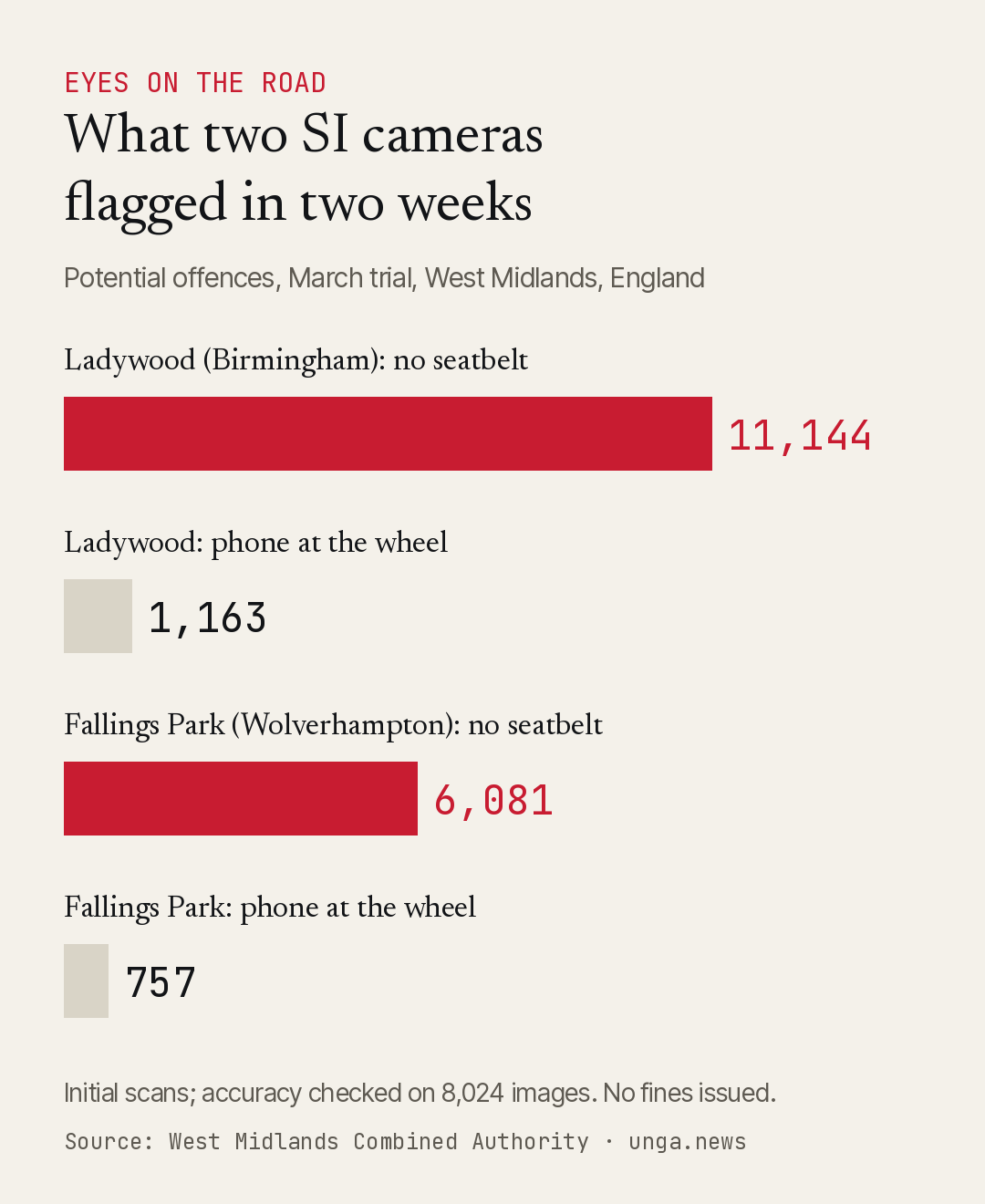
At Ladywood, the initial scans flagged 11,144 potential seatbelt offences and 1,163 potential phone offences. At Fallings Park, it was 6,081 seatbelt cases and 757 phone cases. Officials rounded the total to “nearly 19,000.” Human operators checked the system’s accuracy against a sample of 8,024 of the images.
A toddler on a lap and a bottle of wine
The numbers are one thing. The pictures are another. One image showed a front-seat passenger holding a small child on their lap with no belt at all, which leaves a toddler with nothing to stop them in a crash. The authority said it found dozens of children riding without age-appropriate restraints. Another driver held a phone with both hands, eyes on the screen instead of the road.
Then there was the photo everybody is talking about. Mat MacDonald, the region’s road safety commissioner, told the BBC this weekend that “there was one particularly galling photo of someone drinking from a bottle of wine.” Another driver appeared to be inhaling from balloons. One man seemed to have his seatbelt plugged in behind his back.
MacDonald said the trial was actually stopped earlier than planned because the cameras were catching so much. “What this trial has shown to me more than anything else, is we have a huge problem with these potentially lethal behaviours behind the wheel,” he said. He added that he wasn’t surprised by the phone numbers: “It is almost impossible to get as far as the end of your street without seeing someone who is dialling and driving.”
Why police want it badly
The case for these cameras is simple. Phones and missing seatbelts kill people. The authority says 2025 road data tied mobile phone use to 32 deaths on UK roads and unbuckled seatbelts to 133. Meanwhile, only about 2,000 drivers a year across the whole West Midlands are fined and given penalty points for using a phone at the wheel. The cameras flagged 1,920 potential phone cases at just two spots in two weeks. That gap shows how much ordinary patrols miss.
A traffic officer can’t stare into every passing windshield. A camera can, and it doesn’t get tired at the end of a shift. Police and Crime Commissioner Simon Foster said officials are “closely evaluating these trial results to consider how this advanced AI technology can be deployed for future police enforcement.” Mayor Richard Parker called the scale “frankly shocking and far higher than we expected.”
The system comes from AECOM and Acusensus, according to the authority. Nobody got a ticket from the test. It was built to measure the size of the problem, and no follow-up enforcement was done.
The fine print for drivers
This is where people start to get uneasy, and fairly so. A camera that looks inside your car to see what your hands are doing is a different animal from one that clocks your speed. MacDonald is clear about where he wants to go. “I am working very hard to see what we can do to make this technology a reality on the roads in the West Midlands,” he told the BBC, and he said officials are now in talks about the staff and money it would take.
He insists the goal isn’t a revenue machine. “Ultimately, we don’t want to fine anyone,” he said. “Ultimately, we want the number of fines and activations on these cameras to be zero because then we know we’ve done our job.”
Christophe Bastien, a transport safety professor at Coventry University, told the BBC the cameras offer an objective look at how drivers actually behave, and that finding 19,000 possible offences in such a limited deployment suggests phone use and skipped seatbelts are more common than most people assume.
Turning this on for real would take careful human review, clear warning signs and a fair way to appeal, because a “potential offence” flagged by software is not a conviction. But the core finding is hard to wave away. A tireless set of eyes on two busy roads turned up thousands of people gambling with their own lives, and in at least one case a toddler’s. The fix for that doesn’t take any technology at all: buckle up and put the phone down.
Sources
- West Midlands Combined Authority — “Belt up and switch off” Mayor issues urgent warning as AI camera spots nearly 19,000 driving violations in just two weeks
- BBC News — Wine-drinking driver among shocking images caught in AI camera trial
- BBC News — AI spots nearly 19,000 ‘shocking’ road offences