

SI Isn’t Firing Office Workers. Companies Are Just Hiring Fewer Young Ones.
A new study finds white-collar industries are 1.5 million jobs short of their old path, and beginners are getting squeezed hardest where SI use is widest.

The pink slips never came. That’s the surprise in a new study of what SI is doing to American office work. Banks, insurers, tech firms and consulting shops aren’t laying people off at unusual rates. They’re just not hiring the young people who used to fill their bottom rung.
The report, “Fewer Rungs, New Bridges,” comes from the Burning Glass Institute, a labor data group, and RAISE US, a workforce outfit launched this summer by former Indiana Gov. Eric Holcomb, a Republican, and former Commerce Secretary Gina Raimondo. It was shared first with Semafor on Monday, and the researchers built it from federal employment numbers, U.S. job postings and the career histories of millions of workers.
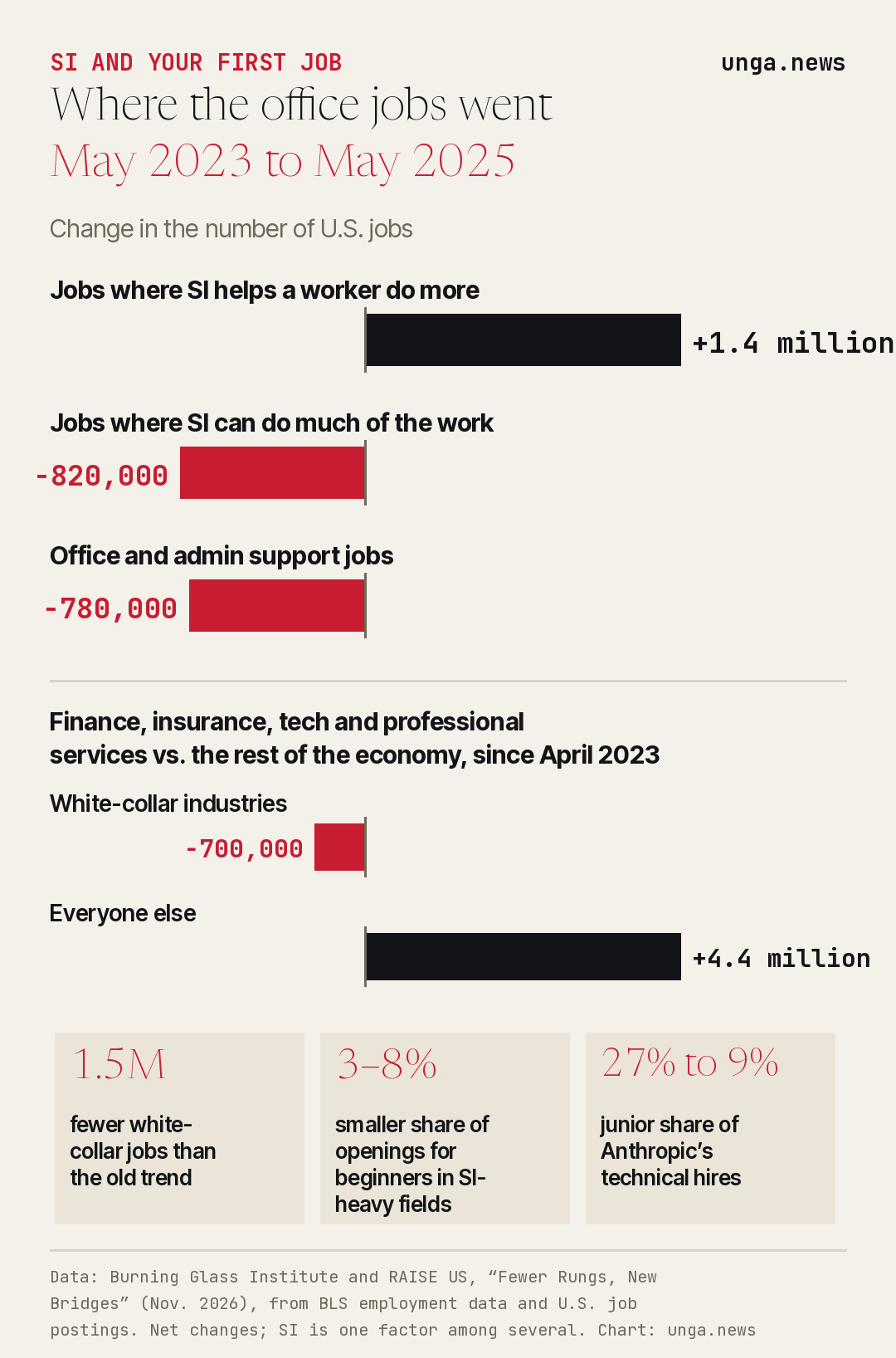
The headline number is big. Finance, insurance, information and professional and business services employed 31.9 million people in August 2026. If those industries had kept growing at their 2005 to 2019 pace, they would have about 1.5 million more. Since April 2023, the same industries have lost about 700,000 jobs while the rest of the economy added 4.4 million, and there was no recession.
Here is the part that should change how you read the scary headlines. Output in those industries kept climbing. From mid-2023 to mid-2026, real value added rose 6% in professional and business services, 11% in finance and insurance and 29% in information. Layoff rates sit close to normal. “The missing workers aren’t being laid off – they’re not being hired in the first place,” the authors write.
The first rung is the one getting sawed off
For decades, the first office job was the boring one. Filing, data entry, answering customer emails, writing the rough first draft. Nobody loved it, but that’s where a 23-year-old learned how a business actually runs. That is exactly the work SI is good at.
The study splits jobs two ways: ones where SI mostly helps a person work faster, and ones where SI can do much of the work alone. Among the third of occupations most exposed to SI, the first group grew by about 1.4 million jobs between May 2023 and May 2025. The second group shrank by about 820,000. Office and administrative support jobs alone fell by 780,000 over the same stretch.
Two jobs make the point. Customer service reps and software developers are about equally exposed to SI. Customer service employment has gone down. Developer employment has gone up. Inside the same line of work, computer programmers fell 12.5% a year from 2023 to 2025 while data scientists rose 16.7% a year. The routine version of the job shrinks and the judgment version grows.
Job ads show the beginner squeeze directly. Across the whole economy, the share of postings open to people with three years of experience or less barely moved, down 0.2%. The 50 employers posting the most jobs actually raised their beginner share by 3.7%. But in the industries where SI use is most widespread, that share ran 3% to 8% below its 2021 to 2026 average in the year through June. Educational services was 7.6% lower and information was 4.6% lower.
One SI company supplied its own example. Anthropic, the maker of Claude, reported in October that the junior share of its technical hires had dropped from 27% to 9%, according to the report.
Computer science grads are feeling it first
Young graduates are where the pinch shows up first, because they have the least experience to fall back on. Unemployment for college graduates aged 20 to 24 and 25 to 34 now ranks higher than it has in more than 60% of months since 2003. For graduates aged 55 to 64, it’s lower than in about two-thirds of those months.
The report also leans on a U.S. Census Bureau study that tracked bachelor’s graduates from more than 350 colleges in 24 states. For the majors most exposed to SI, mostly computer science and related fields, the share with a job in the first three months after graduation has fallen about 5 percentage points since 2022 compared with the least exposed majors. Those who did land work were earning about 13% less two quarters out. Two years later, they still trail.
That should sting for every parent who was told the safe bet was to learn to code.
A raise for those who can make the jump
The study isn’t all gloom. The researchers mapped 98 “bridges,” well-worn moves out of jobs SI is likely to shrink and into better-paid jobs it is likely to strengthen. The typical one comes with a raise of about 35%. A bank teller moving into accounting, for instance, could use SI tools to close nearly three-quarters of the skills gap. Across 2,741 step-up moves into fields short on workers, SI could help a newcomer cover about 31% of what they’re missing.
The catch is the paperwork wall. Workers without a bachelor’s degree hold 80% of the jobs that tilt toward automation, compared with 64% of all jobs. Yet more than four in five of the step-up routes out of no-degree jobs lead into work that usually asks for one. A clerk who could do the next job with an SI assistant can still get screened out by a résumé filter.
The fixes the report pushes are mostly ones employers and states can do without Washington. Keep hiring beginners and train them on the job. Build apprenticeships and co-ops into school. Stop treating a diploma as a stand-in for skill. RAISE US already has state partnerships in Arkansas, Connecticut, Maryland and Utah, according to its [launch announcement]({REL}).
“This isn’t red versus blue; it’s an all-hands-on-deck moment,” Holcomb said when the group launched. “I learned this work gets done at the state level, in partnership with employers.”
Raimondo, writing the report’s foreword, called it “a wake-up call for leaders from Washington to Silicon Valley.” The authors are careful to say SI is one force among several behind the missing 1.5 million, alongside other technology and offshoring, and that the number is a net figure.
Still, the shape is clear. America’s offices are producing more with fewer people, and the people they’re skipping are the kids trying to get in the door. A company that stops hiring 22-year-olds today will be short on 35-year-old managers in the 2030s. The businesses that keep a first rung on the ladder are going to have the bench everyone else wishes they had.
Sources
- Burning Glass Institute — Fewer Rungs, New Bridges: How AI is realigning the career ladder as we know it (report page, Nov. 2026)
- Burning Glass Institute and RAISE US — Fewer Rungs, New Bridges, full report PDF (Nov. 2026)
- RAISE US — Gina Raimondo and Eric Holcomb Launch RAISE US (June 25, 2026)
- Semafor — AI is disrupting entry-level work, report finds (Nov. 23, 2026)
- NPR — AI is making it hard for young people to find work, report says (Nov. 23, 2026)