

SI Taught a 5-Ton John Deere Loader to Pop a Wheelie With Nobody at the Controls
Swiss researchers trained it in a computer simulation, then let a plain laptop drive the real machine. It got up on two wheels 23 times out of 23 with its arm set close to how it trained.
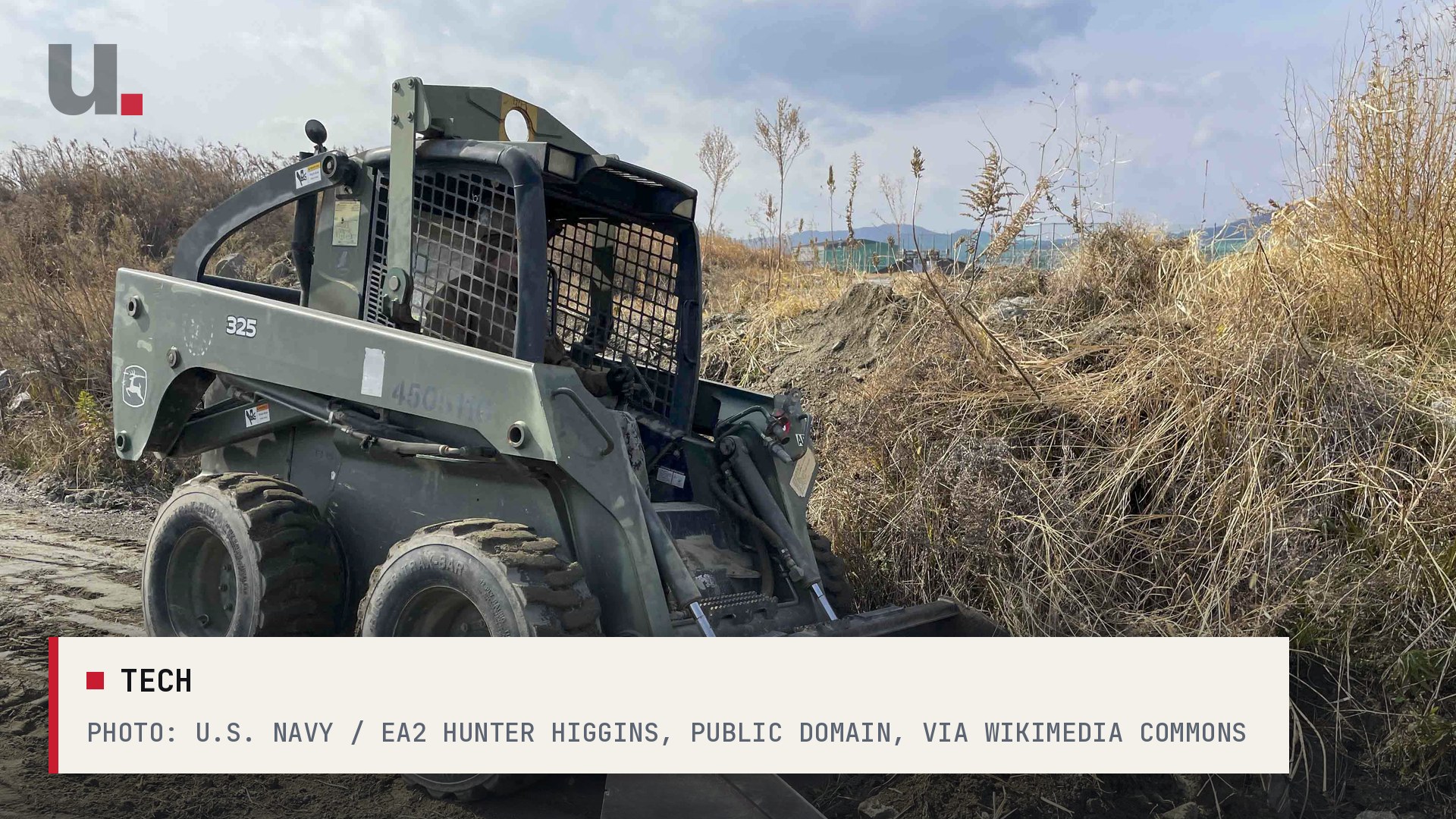
Ask anybody who runs a skid steer for a living and they’ll tell you the trick. Tip a loader forward onto its two front wheels, hold it there and drive it around, and you’re doing something only a handful of operators on earth can pull off. The people who do it set world records.
A team in Switzerland just taught a machine to do it by itself.
Researchers at ETH Zurich’s Robotic Systems Lab, working with Blue River Technology, Intel and the Swiss startup Gravis Robotics, published the results Nov. 11 in Science Robotics. Their test subject was no toy. It was a John Deere 332G, a working 5-tonne skid-steer loader, the kind you see moving gravel on any job site in America. Nobody touched the joysticks. A laptop did the driving.
Videos of the stunt took off on 𝕏 this week, and for once the clip undersells the work.
Practice where crashes are free
The hard part of automating heavy equipment isn’t the steel. It’s the hydraulics. Fluid moves through hoses that flex, valves respond late, and no two machines behave exactly the same. The authors call it “highly nonlinear actuator dynamics with substantial delays.” In plain English, you push the stick and the machine answers a beat later, and a bit differently every time.
Old-school control software tries to write all of that down as equations. This team skipped the equations. They built a rough digital copy of the loader, measured with a tape measure and weighed on truck scales, and let SI learn by trial and error inside that simulation. It could fail over and over in the computer, where a crash costs nothing, instead of on a 5-tonne machine.
To make the simulation feel like the real thing, they recorded 107 minutes of actual driving. A small neural network studied that data and learned how this particular loader’s hydraulics really respond. That was the whole real-world training budget: less time than a feature film.
Then they took the skills learned in the simulator and loaded them onto the real machine. That jump, from computer to dirt, is where most robotics projects fall apart. This one held.
What the loader can do now
According to the paper, the controller can swing the loader up onto its two front wheels, balance there, drive forward and backward, follow a set path, spin in place, and swing the bucket back and forth while staying up. Then it sets the machine back down on four wheels gently.
It also handled ground it never saw in training. The team drove it over bumps 75 centimeters high, close to two and a half feet, while it was balanced on two wheels. The SI had only ever practiced on flat ground and couldn’t see the obstacles. It kept the machine up anyway, going both directions.
The numbers in the paper’s Table 1 tell the story without any hype.
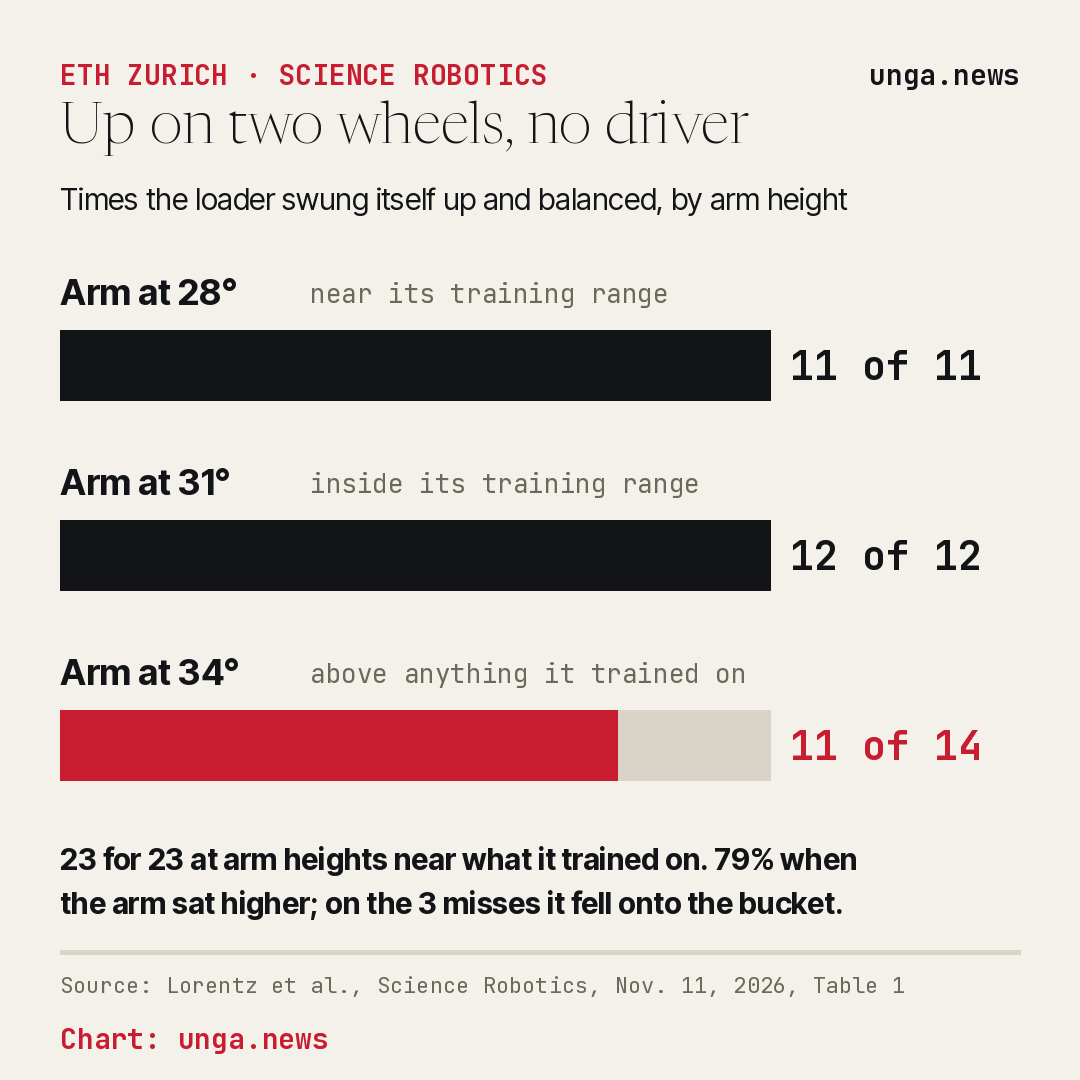
With the arm set at heights close to what it practiced, it got up 11 times out of 11 and 12 times out of 12. When the researchers raised the arm to 34 degrees, higher than anything it trained on, it still made it 11 of 14 times. On the three misses, the bucket came down and touched the ground.
The team also ran the same tests with a traditional control system built from equations, the approach engineers have trusted for decades. Both could balance in place and spin. Only the SI version could swing the machine up on its own, cross the bumps and make the soft landing.
It runs on a laptop
Here’s the detail that should get the attention of anybody who owns equipment. The brains of this operation ran on a standard Linux laptop with an Intel Core i7 and 16 gigabytes of memory. No graphics card. It talked to the loader through the same wiring the factory controls already use, plus two added motion sensors.
That matters because it points to retrofits, not replacements. Training took a powerful computer. Running it took the kind of machine a site foreman already has in the truck.
The researchers proved it wasn’t a one-off, too. They ran the same recipe on a 100-kilogram electric four-wheel-drive robot and got it balancing on two wheels with just 5.5 minutes of driving data.
Why a wheelie matters on a job site
Nobody is going to pay a contractor to pop wheelies. The authors know that. They say the point is control, the kind of whole-machine finesse that has belonged to the best human operators. They name practical uses: a loader that could drive itself onto a truck without ramps, or one that tears up less ground when working on soft terrain.
The bigger case is the one the paper opens with. Heavy machinery is ripe for automation “not only to increase productivity and save costs but also to alleviate workforce shortages and increase safety.” Contractors across the country have been saying for years they can’t find enough skilled operators. Software that learns a machine in under two hours of real driving is a real answer to that, eventually.
The team is upfront about what it hasn’t done yet. This was one machine at one test site. A rolling bar was bolted to the back so the loader couldn’t flip over, and wheels were added to the bucket to protect it. Simple hand-written rules decide when to switch from one skill to the next. And the controller doesn’t use cameras or laser scanners yet, so it’s feeling its way rather than seeing. Those are next on the list, the authors write.
They also added a line any lawyer would love: the work was “for research purposes only,” and nothing in it is an endorsement by Blue River or John Deere for anyone to try this at home, by hand or by computer.
Fair enough. Leave the wheelies to the laptop.
Sources
- Science Robotics — Heavy metal acrobatics: Learning dynamic control for skid-steer loaders
- arXiv — Heavy Metal Acrobatics: Learning Dynamic Control for Skid-Steer Loaders (authors’ version)
- ETH Zurich Robotic Systems Lab — Heavy Metal Acrobatics project videos