

SI Writes Most of the Code on Claude’s Own Team. Now It Can Approve the Routine Changes Too
Claude’s maker launched agents that review new code, fix what breaks and sign off on the small stuff, under rules each company writes for itself. On its own team, finished changes more than doubled while rollbacks fell by over 40%.
For most of the last two years, the SI story in software has been about writing code. The machines got good at it fast. The part nobody fixed was everything after: a human still had to read each change, send it back with notes, wait for the fix and finally sign off. On Monday, Claude’s maker went after that last step too.
Anthropic launched Claude Ship, a set of SI agents that review new code, fix what breaks and, for the routine stuff, give the final approval themselves. The catch, and it’s the important part, is that each company writes its own rules for when the machine is allowed to say yes and when a person has to.
ClaudeDevs on 𝕏: Introducing Claude Ship (beta): Claude can review your pull requests, work on fixes, and approve the ones your team’s policy allows.
— @ClaudeDevs View on 𝕏
That post from Anthropic’s developer account passed a million views within hours. Boris Cherny, who leads the team behind Claude Code, put it bluntly in his own announcement: a year ago the company launched “the first model to write 100% of my code,” and “shipping PRs hasn’t caught up.” A PR, or pull request, is the bundle of changes a programmer submits for review before it goes into the real product.
Three jobs, three agents
Claude Ship is really three tools stacked together. The first, Code Review, was already on sale. It reads a proposed change against the whole codebase, double-checks its own findings and posts them on the change. Teams pick a Quick, Standard or Deep setting depending on how much they want to spend.
The second, PR Steward, is new and in beta. It jumps on the chores that eat a programmer’s afternoon: a failed automatic test, two people editing the same file, a reviewer asking for a tweak. It pushes the fix, then leaves a note explaining what it changed and how to undo it. Type “@claude stop” and it backs off. Anthropic’s own documentation says Steward is “designed not to approve or merge pull requests.” It does the grunt work and stops there.
The third, Claude Approvals, is the one getting attention. A team writes a plain-language rule file and drops it in its code library. That file can say billing code needs two humans to sign off, while a change to test files needs one person once the SI review comes back clean. Where the rules allow it, Claude can approve on its own. Anthropic’s setup guide gives exactly that billing example, and the company tells most customers to run Approvals in “observe” mode first, where it only reports what it would have done, until they trust it.
What happened on Claude’s own team
Anthropic has been running the system on its own work, and it published the results. On the Claude Code team, where SI review is one layer of a larger process, finished and merged changes more than doubled from June to September. Over the same stretch, the share of changes that had to be pulled back after shipping fell by more than 40%.
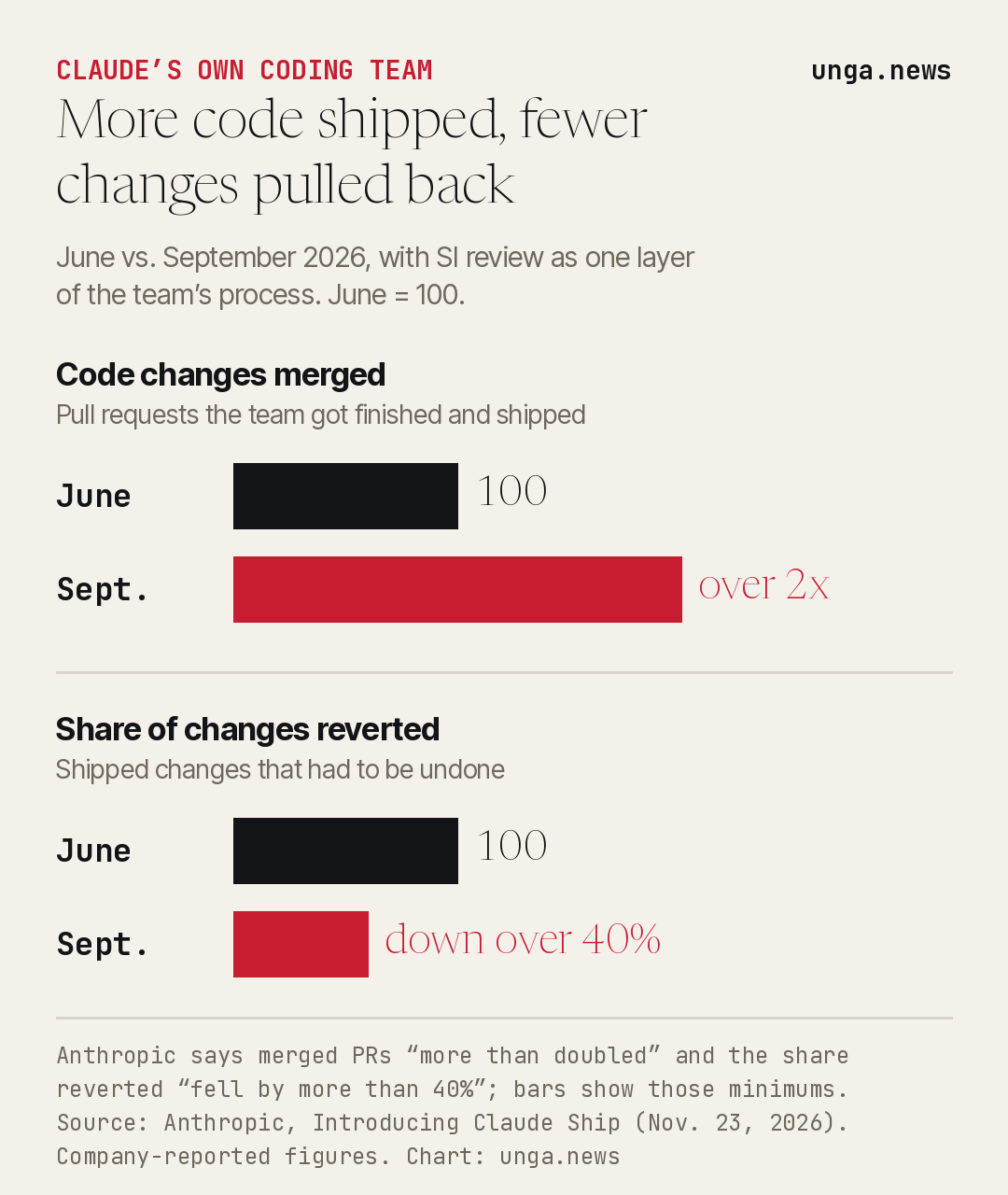
Those are company numbers, not an outside audit, and the team was also changing other things over those months. Still, doing twice the work with fewer mistakes is the trade every business owner wants, and it goes right at the problem economists flagged in a study we covered over the weekend: SI lets coders write 25 times more code but ship barely more software. The bottleneck was never the typing. It was the waiting.
Anthropic gave one small example of how that waiting disappears. A customer was confused because a help page implied the wrong kind of account key could pull certain usage data. A product manager, not a programmer, asked Claude whether a fix was already underway. Claude opened one. The SI review found nothing blocking, a human documentation reviewer signed off, the approval check passed and the fix went live that same evening.
People still hold the keys
Plenty of folks will hear “SI approves its own code” and picture software that nobody is watching. That isn’t what this is. Nothing runs unless a company’s administrator turns it on, one code library at a time. Approvals only kicks in once a team has written a policy file, and an admin can switch it off. It works with the locks companies already use to block unapproved changes, and teams can set a monthly spending limit.
That is the right way to handle this. The people who own the software decide how much to trust the machine, case by case, with their own money on the line. No federal agency had to write a rule for it, and no one in Washington has to approve a startup’s billing-code policy. Washington’s job is to keep the field open so American companies keep building tools like this before Beijing does. The Trump White House has made winning the SI race the goal, and products like this are how a lead actually gets built: one boring, useful improvement at a time.
It won’t be cheap. Claude Ship bills by usage, so turning it on adds to a company’s costs depending on how many changes it covers and how deep the reviews go. Even observe mode costs money when a policy calls for Claude’s review. To soften that, Anthropic is offering eligible big-business customers at least $10,000 in credits if they claim them by Jan. 15. It is also off-limits for now to organizations under stricter privacy setups, including the company’s HIPAA health-data configuration.
Claude Ship works with code stored on GitHub and is rolling out to Claude’s Team and Enterprise plans. Individual programmers can try it right away with a new “/ship” command, which pushes their change, opens the review, and keeps working the feedback until it’s ready to merge.
Anthropic has only been a public company since Thursday, and Monday’s launch shows where it thinks the next money is. The pitch is simple: SI already writes most of the code on its own team, and now it can carry that code across the finish line. Whether customers hand over the final yes is their call, and that is exactly how it should be.
Sources
- Anthropic — Introducing Claude Ship (Nov. 23, 2026)
- Anthropic — Claude Ship product page
- Claude Code Docs — Claude Approvals
- Claude Code Docs — PR Steward
- ClaudeDevs on 𝕏 — Introducing Claude Ship (beta) (Nov. 23, 2026)
- Boris Cherny on 𝕏 — Today we’re launching Claude Ship in beta for Team and Enterprise (Nov. 23, 2026)
- TechCrunch — Anthropic launches Claude Ship, letting AI agents review, fix, and approve code changes (Nov. 23, 2026)
- NBER — Demirer, Musolff and Yang, Writing Code vs. Shipping Code (Working Paper 35275)