

Soaring Chip Prices Mean Your Next Cheap Laptop Could Come With Half the Memory
Memory chips got so expensive that shoppers quit buying, so laptop maker Asus says its budget and mid-range machines may drop from 16 gigabytes to 8. Microsoft says Windows can handle it.
If you’re shopping for a cheap laptop for a kid heading off to school, or just to replace the one that finally quit, the spec sheet may look a little thinner next year.
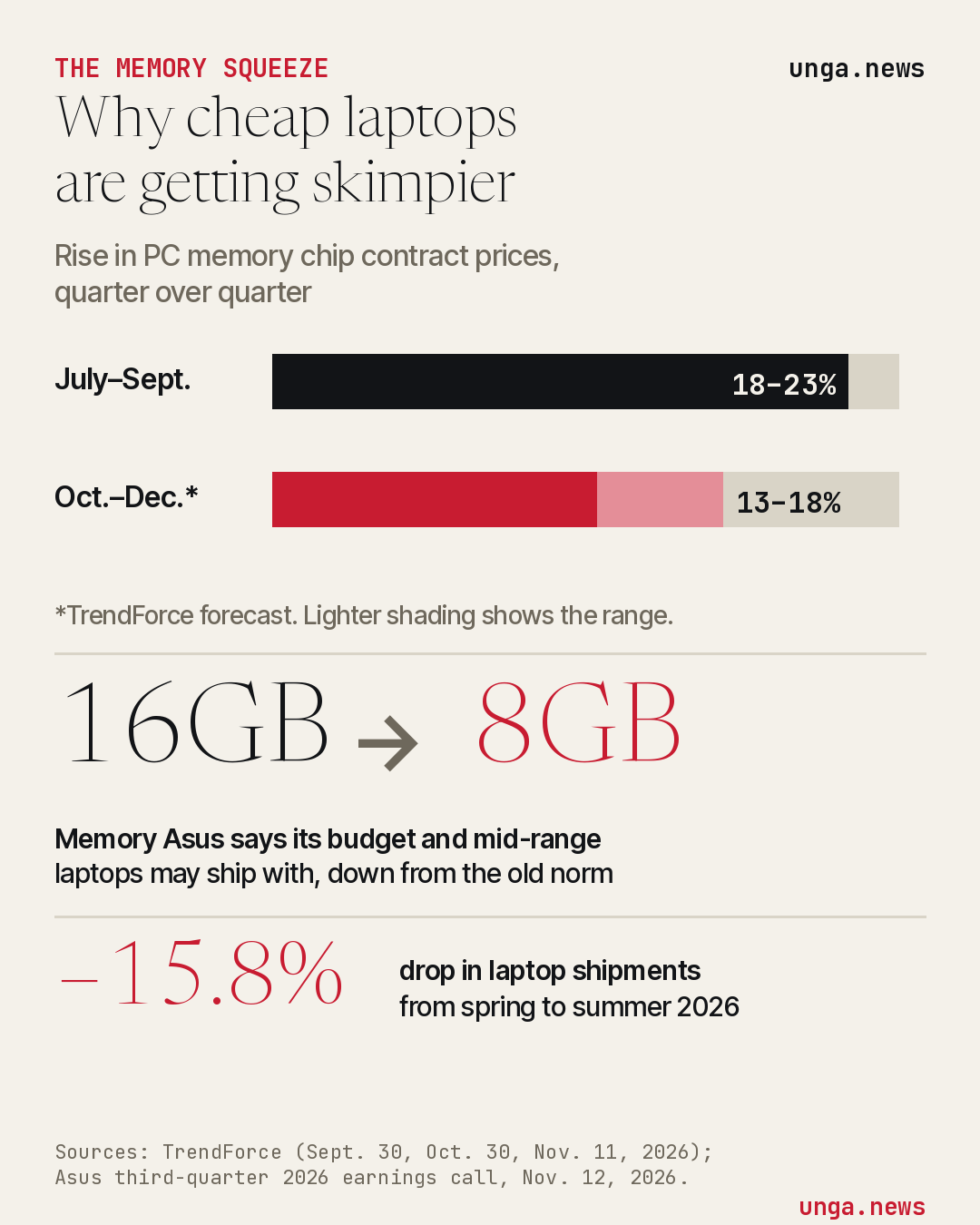
Asus, one of the biggest laptop makers in the world, told investors that memory chips have gotten so expensive it can no longer push the whole cost onto shoppers. So for its budget and mid-range machines, the company may cut the built-in memory in half, from 16 gigabytes back down to 8.
Co-CEO S.Y. Hsu laid it out on the company’s third-quarter earnings call on Nov. 12, answering a question from JPMorgan. The comments started making the rounds this week.
“Turning our attention to the mid and low segments, it is quite evident that a full pass-through of the memory costs will simply not be accepted,” Hsu said. “It used to be that a mid to low tier machine will still ship with 16 GB of memory, but now they may move to 8 GB due to the memory cost increases.”
Memory, the RAM inside your computer, is the short-term workspace that holds whatever you have open right now: browser tabs, a homework file, a video call. More of it means you can juggle more without the machine bogging down. Over the last few years 16 gigabytes became the comfortable standard for a regular laptop. Asus is now saying the floor may drop.
Shoppers stopped paying
Hsu was blunt about why. Asus had stocked up on memory in the second half of 2025, which let it smooth out the price jumps for a while. As that cheaper stockpile ran out, the company raised laptop prices through 2026. Then buyers hit their limit.
“That is really because the ASP has simply been raised too far, and customers will not put up with it,” Hsu said, using the industry’s shorthand for average selling price. “They are delaying purchases or buying only what they have the funds to do so or when they absolutely have to.”
That is the free market working the way it should. Families looked at the higher sticker prices and decided the new laptop could wait, and now the companies that build them have to adjust. Hsu said the biggest software and chip companies have cut their forecasts for PC demand in the last three months of this year to a drop of 20% to 30% from a year earlier, mostly because of parts prices. Asus itself expects PC revenue to fall about 15% this quarter from last.
The research firm TrendForce has been tracking the squeeze all year. It says contract prices for PC memory chips jumped 18% to 23% over the summer quarter and are on track to climb another 13% to 18% in the fall. Laptop shipments fell 15.8% from spring to summer, and unsold computers are piling up at makers and in North American stores.
Data centers got first dibs
So where did all the memory go? Mostly into the giant data centers being built to run SI. Memory makers earn far more selling chips to server farms than to laptop brands, so they have been shifting factory time in that direction. TrendForce said in late October that the big Korean suppliers plan to cut PC memory shipments by more than 20% next year as they lean into servers, while the one American supplier has locked in its volumes through long-term deals.
The server boom isn’t bad news for everyone. It is the reason Asus just posted a record quarter. Revenue hit 258.8 billion Taiwan dollars, up 36% from a year ago, and the company expects its server sales to jump about 150% this quarter. The money is flowing toward the machines that power SI, and the regular laptop on a store shelf is getting squeezed by that same boom.
Microsoft says 8 is enough now
Asus isn’t just shrinking specs and hoping nobody notices. Hsu said the company worked with Microsoft on the switch. “The old 16 GB spec was really about ensuring user experience,” he said. “On the new operating system, Microsoft has made adjustments such that even 8 GB is able to yield an acceptable experience.”
Microsoft made that case itself on Nov. 3. In a Windows Experience Blog post, Windows chief Pavan Davuluri said the latest Windows 11 update makes 8-gigabyte PCs “up to 20% more responsive” and lets multitasking run “up to 40% faster in our lab test.” The trick is smarter compression, which squeezes less-used data so it can stay in fast memory instead of being shoved onto the slower drive. Microsoft says Windows can now keep up to 2 gigabytes more of your active work in memory, so a tab you left open is less likely to reload when you click back to it.
Those are Microsoft’s own lab numbers, measured on a demanding test of 20 browser tabs, a 4K video and Office apps. Microsoft also admitted the obvious: “a PC with 16 GB or 32 GB can take on more.” Hands-on testing by The Verge on an 8-gigabyte laptop backed up the basic claim, finding fewer slowdowns and less tab reloading after the update.
Before you buy
For a lot of people, 8 gigabytes will be fine. Email, homework, streaming, a few browser tabs and the occasional video call don’t ask much. It gets tight for anyone who keeps dozens of tabs open, edits photos or video, plays games or runs the newer SI tools that do their work on the laptop itself.
The catch is that many cheap laptops have their memory soldered to the board, so you can’t add more later. Check the spec sheet before you pay, and if a machine says 8 gigabytes, ask whether it can be upgraded. If you’re buying for the long haul, paying a little more now for 16 can save you from buying a new laptop two years early.
Hsu said the higher-end machines are holding up fine. Asus’s new premium laptops with 128 gigabytes of memory sold out quickly despite steep prices. It’s the shoppers in the middle and at the bottom, the families stretching a budget, who will feel this the most, and it was their decision to stop overpaying that forced the change.
Sources
- Asus — ASUSTeK Computer Q3 2026 earnings call transcript (Nov. 12, 2026)
- Microsoft Windows Experience Blog — Raising the bar for 8 GB Windows 11 PCs: what’s improved and how to get it (Nov. 3, 2026)
- TrendForce — Mounting Finished-Goods Inventories Prompt Some PC OEMs to Adjust Memory Procurement Plans for 2027 (Nov. 11, 2026)
- TrendForce — DRAM Contract Price Oct. 2026 (Oct. 30, 2026)
- TrendForce — AI Server Demand Sustains Memory Contract Price Increases in 4Q26 (Sept. 30, 2026)
- The Verge — Windows 11 actually runs better on 8GB of RAM now
- The Verge — Asus co-CEO says its budget PCs “may move to 8GB” of memory due to RAM price hikes (Nov. 23, 2026)