

Social Security Checks Could Shrink 22% in Six Years. A Republican Says One Democrat Is Stalling the Fix.
Sen. Bill Cassidy says the Senate GOP leaders and President Trump are on board for a Social Security vote before Democrats take over Jan. 3. He says the top Finance Committee Democrat won’t engage.

Every American who pays into Social Security has a date circled on the government’s own calendar, whether they know it or not. Late in 2032, the fund that pays retirement and survivor checks runs out of reserves. From that day on, the law allows only what comes in to go out, and the program’s trustees say that covers 78% of promised benefits. That is a 22% cut, across the board, for retirees and widows alike.
Sen. Bill Cassidy of Louisiana says he has the votes to do something about it before Christmas. On Sunday he said one Democrat is standing in the way.
“I had a commitment from both Thune and from Mike Crapo to have a hearing and a markup on a Social Security bill,” Cassidy told “Face the Nation” on Sunday, naming Senate Majority Leader John Thune and Finance Committee Chairman Mike Crapo. “It could be mine, could be someone else’s, and the president actually has- has given me personal commitment that he would support it, and his administration has been very helpful.”
Then he named the holdup. Sen. Ron Wyden of Oregon, the top Democrat on the Finance Committee, “has decided he does not want to be constructive,” Cassidy said. “I said, Senator Wyden, it doesn’t have to be my bill. It can be any bill. But no, he doesn’t want to be constructive, and so we won’t probably have that hearing unless he changes his mind.”
Twenty working days and a 60-vote window
The clock is the whole story. Democrats take control of the Senate on Jan. 3, and host Margaret Brennan counted 20 working days left before the end of the year, with defense funding and a possible government shutdown fight also on the pile.
Cassidy’s argument is that the lame duck is the rare moment when every piece lines up. “We have the ability to have 60 votes in the Senate, to have the House, and have a president who will sign it, and yet he doesn’t want to be constructive,” he said.
He reached for a doctor’s comparison. Cassidy is a physician, and he said Social Security is “like a child, and you have to care for that child the minute it starts to look ill, and right now Social Security has been looking ill for some time.” He called the delay “incredibly frustrating, but that’s where we are.”
Brennan put the deadline bluntly. “It’ll be insolvent in six years. Medicare, pretty much as well,” she said. Cassidy’s reply: “Which is why we should act now.”
The numbers nobody in Washington disputes
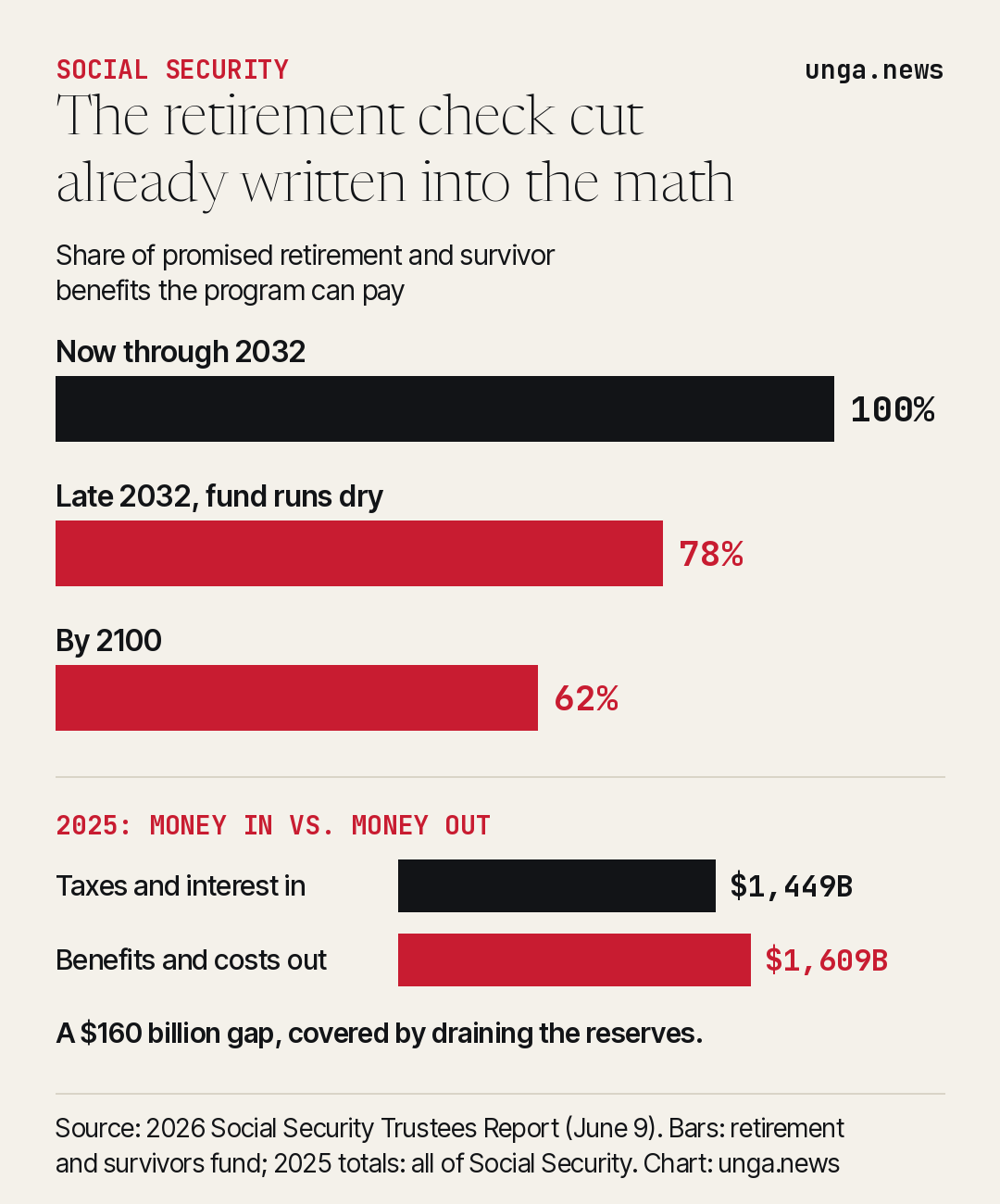
None of this is a guess from a think tank. The program’s own trustees laid it out in their 2026 report, released June 9. The retirement and survivors fund can pay 100% of scheduled benefits until the fourth quarter of 2032, one quarter earlier than they projected a year ago. After that, 78%. By 2100, 62%.
The money is already running backward. In 2025, about 185 million people paid Social Security payroll taxes, and the program took in $1,449 billion in total. It paid out $1,609 billion. The $160 billion difference came out of the reserves, the same reserves that hit zero in 2032.
Hospital coverage under Medicare is on a similar track. Its trust fund runs dry in the second quarter of 2033, when it could cover 89% of scheduled costs, according to the same trustees.
Every year Congress waits, the fix gets more painful. The options never change: more money in, less money out, or some mix. Waiting just means the eventual change has to be bigger and land on fewer years of workers.
A stock fund, and a Democrat who once backed one
Cassidy’s own plan, which he has pitched with Democratic Sen. Tim Kaine of Virginia, takes a different road than raising taxes or trimming checks. On Sunday he described it this way: Washington would borrow $1.5 trillion and put it in “an investment fund separate from Social Security trust fund,” invested in the broader economy and left to grow for decades.
After about six decades, Cassidy said, it “pays for up to 70 percent of what we need to cover the debt for Social Security.”
Wyden’s objection, as Cassidy described it, is that he doesn’t want tax dollars in the stock market. Cassidy called that “a fig leaf.” He said Wyden backed nearly the same approach for railroad workers’ pensions under President George W. Bush. That 2001 law did create a trust that invests railroad retirement money in stocks and bonds. “That’s done fantastic. It works. We know it does,” Cassidy said.
The plan has critics who aren’t in Congress, too. Boston College’s Center for Retirement Research has argued the Cassidy-Kaine approach would leave most of the financing gap unsolved, because the fund has to pay back the borrowed money before its gains can help. That is a real debate worth having, and a hearing is where it would happen.
Cassidy said he isn’t married to his own bill. He offered to put a bill from Sen. Bernie Sanders of Vermont, who has long pushed to make high earners pay more into the system, on the table as well. “We can do that. But there’s just a refusal to take part of it, and I’m so frustrated,” he said. “This is so important to our country. Congress is there to take tough choices, and now those tough choices are being ducked.”
Whatever Wyden decides, the window closes soon. On Jan. 3, Democrats take the majority and the Finance Committee gavel, which means any Social Security plan that moves in 2027 will run through them.
For a 59-year-old planning to retire in six years, none of the Senate maneuvering matters as much as the number on the chart. Seventy-eight cents on the dollar is the law of the land unless Congress changes it. Cassidy says the votes and the president are there to change it now, and the calendar has about four weeks left on it.
Sources
- CBS News — Transcript: Sen. Bill Cassidy on “Face the Nation with Margaret Brennan,” Nov. 15, 2026
- Social Security Administration — 2026 Trustees Report Summary
- Social Security Administration — 2026 Trustees Report, II. Overview (2025 income and cost)
- Social Security Administration — Trustees press release, June 9, 2026
- Center for Retirement Research at Boston College — The Cassidy-Kaine Proposal Does Virtually Nothing to Solve Social Security’s Financing Problems
- Office of Sen. Bill Cassidy — Cassidy, Kaine Join NewsNation to Discuss Bipartisan Solution to Social Security’s Looming Insolvency