

SpaceX Caught a Spaceship With Giant Tower Arms. Elon Musk Says It’s Too Historic to Fly Again
Ship 42 went to orbit, dropped off 26 Starlink satellites and landed in the arms of the tower that launched it. It could fly again in weeks. SpaceX plans to put it on display instead.
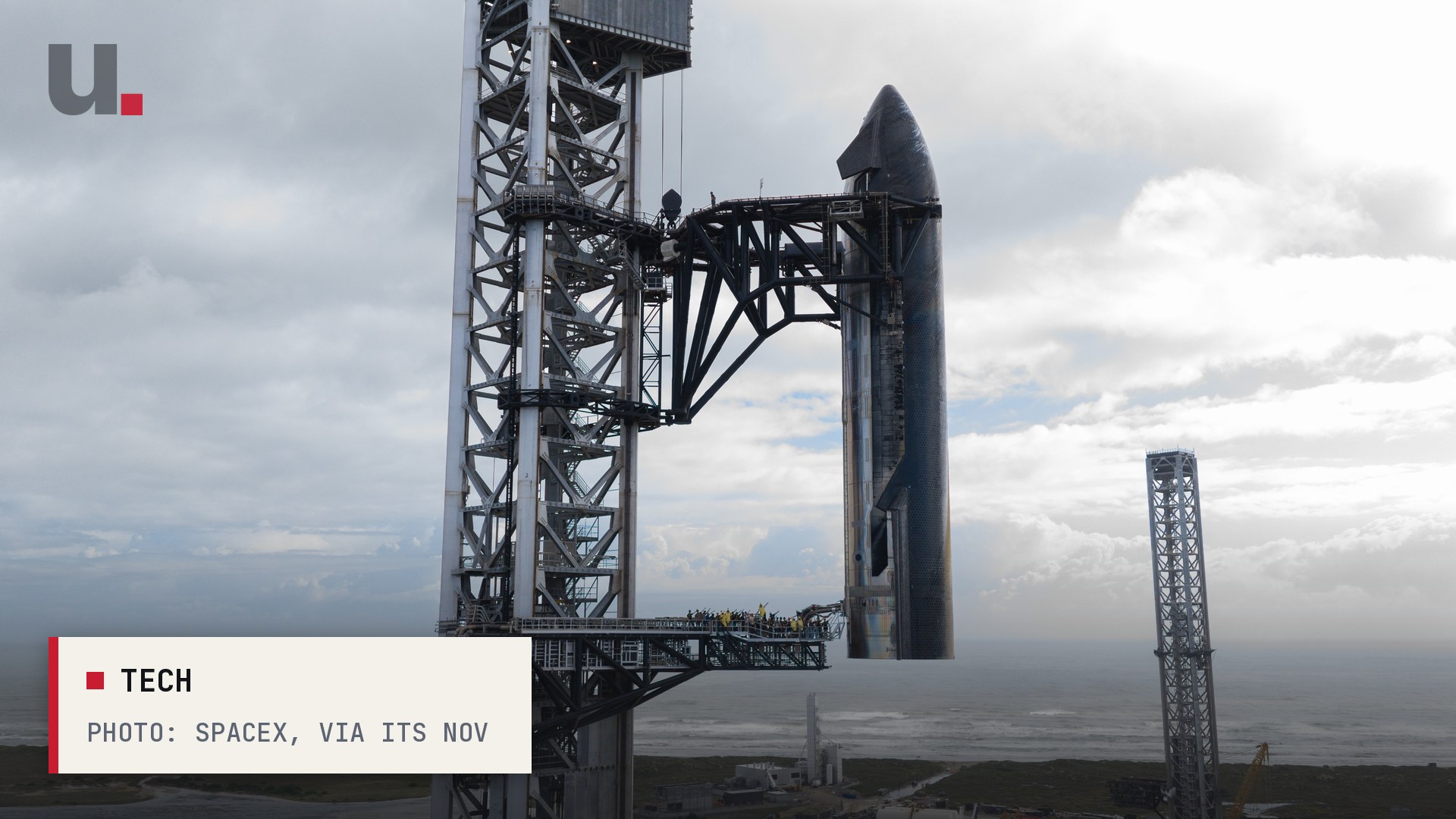
Elon Musk hugged it. That’s what he told his followers a few hours after Ship 42 came home: “I hugged ship 42 upon its return.” Most people don’t hug machines. Then again, most machines don’t fall out of orbit and land in the arms of the tower that launched them.
Now that ship is getting a send-off nobody expected. Speaking at the TomorrowX Summit on Wednesday, Musk said SpaceX will likely keep the first Starship upper stage it ever caught on the ground for good and put it on public display, even though it could fly again.
“In this case, because it’s kind of an historic ship, we’re going to, I think, not take any chances with the ship and just kind of leave it for public display, because what it’s done is historic,” Musk said, as first reported by Space.com. He didn’t say where it will stand. Starbase, the company’s rocket town on the Texas coast, is the obvious bet.
A spaceship, caught by a tower
What Ship 42 pulled off is easy to describe and brutally hard to do. Starship lifted off from Pad 2 at Starbase on the evening of Nov. 13 on its 15th test flight. The giant rocket comes in two pieces: the Super Heavy booster that does the first few minutes of pushing, and the ship on top that goes all the way to orbit.
The ship reached orbit, fired one engine to settle in, and let loose 26 of SpaceX’s new Starlink V3 internet satellites. According to SpaceX’s own flight summary, ground teams made contact with every one of them, and they were already raising their orbits to join the network.
Then the ship just waited. For more than 20 hours, flight controllers watched its systems as it circled the planet. SpaceX says Starlink satellites even shot pictures and video of the ship’s heat shield to make sure it was healthy enough to come home.
It was. The ship lit a single Raptor engine to drop out of orbit, punched back into the atmosphere, crossed toward the Texas coast and swung out over the Gulf in a final turn. After breaking through the clouds, three engines lit, the ship flipped from its belly to standing upright, slowed almost to a hover, and the tower’s mechanical arms, which SpaceX calls Mechazilla and fans call the chopsticks, closed around it. The whole trip took about 22 and a half hours.
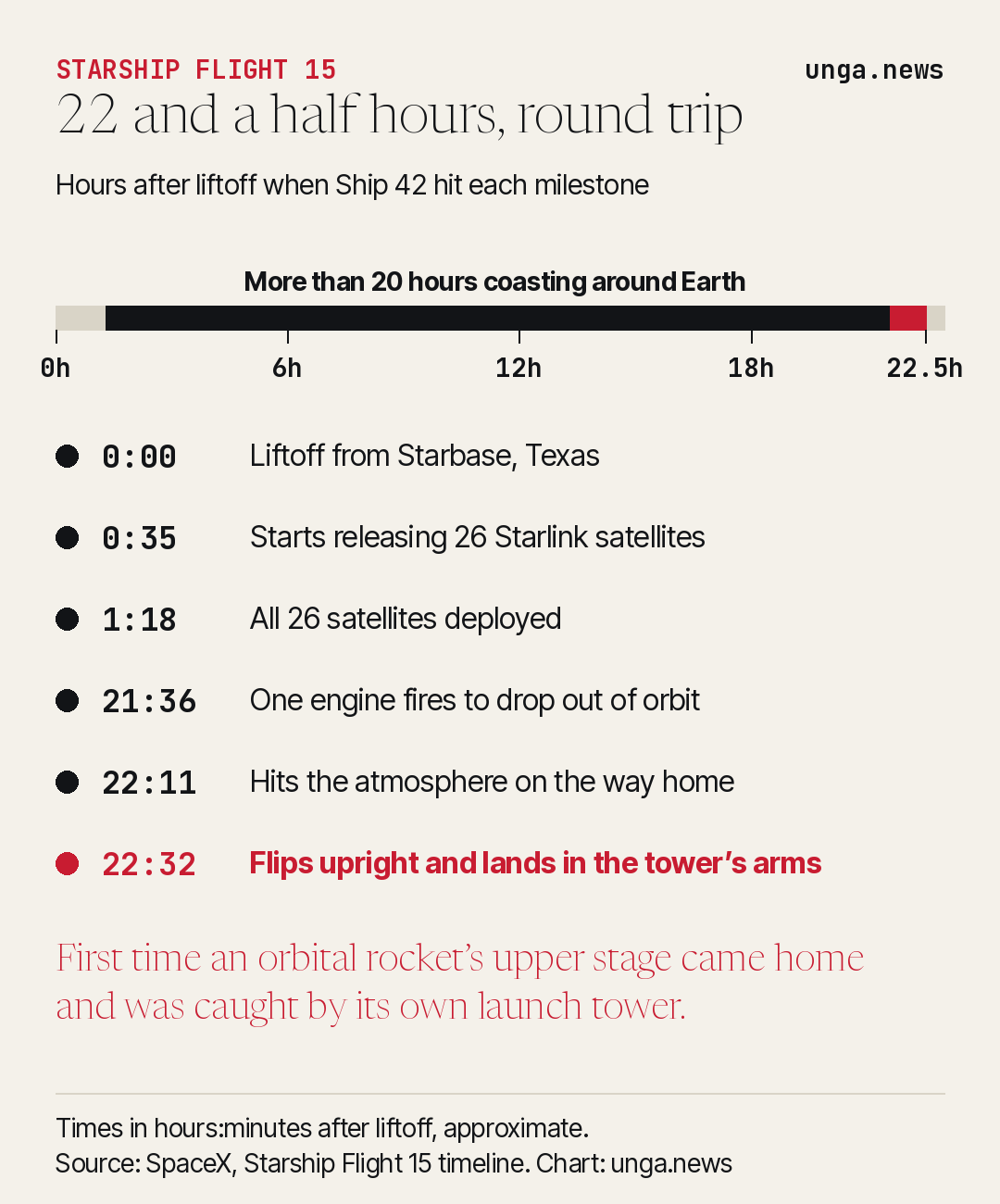
“That was the missing link,” SpaceX’s Dan Huot said on the company’s landing webcast. “That was the holy grail of spaceflight, plummeting through fire to be snatched out of the air by steel. We caught a Starship, and now everything changes.”
SpaceX has posted views of the catch from the tower itself.
SpaceX on 𝕏 — “The Starbase tower chopsticks catching their first Starship.” (Nov. 17, 2026)
— @SpaceX View on 𝕏
Why the hard part was the top half
SpaceX had already caught the Super Heavy booster with those same arms on three earlier flights, and it has flown a used booster again twice. That alone put it years ahead of everyone else in reusing rockets.
The ship is a much tougher catch. The booster turns around minutes after launch. The ship goes all the way to orbit, so it comes home faster, from farther away, and has to survive the fire of reentry before it can even try to land. Nobody had ever caught the upper stage of an orbital rocket with its own launch tower. SpaceX did it on the first try.
The booster on this flight didn’t make it back to the tower. Its turnaround burn ended early because it was low on fuel, and SpaceX says the root cause is still under investigation. The booster’s own guidance software spotted that it wasn’t where it needed to be, called off the catch and steered itself to a safe splashdown offshore. SpaceX said Thursday that the booster “correctly performed a safe abort,” which is exactly what the safety system is built to do.
Ready to fly again, kept as a trophy anyway
The decision to retire Ship 42 isn’t about damage. Musk walked the heat shield himself the day after the landing and reported back.
Elon Musk on 𝕏 — “Ship 42 could probably be reflown with a few weeks of refurbishment.” (Nov. 15, 2026)
— @elonmusk View on 𝕏
“Overall, it looks great. The engines look great too,” he wrote. He was also straight about the work left: “many small fixes are needed to achieve immediate reusability.” The goal is a rocket that lands, gets fueled and flies again like an airliner, with no rebuilding in between. In a reply, Musk added that Ship 42 “brings back a motherlode of data for further improvements to the heat shield.”
So SpaceX keeps the data and the trophy, and the next ships do the reflying. That makes sense. The first booster SpaceX ever landed, a Falcon 9 from 2015, is on display outside its California headquarters. A rocket that does something no rocket has done before is worth more as proof than as one more flight.
Musk told the TomorrowX audience how the company felt about it: “Everyone knew, within SpaceX, at least, how important this milestone was, and that it was really something fundamental and profound — that Starship will be the first-ever fully reusable orbital space system.” He joined the conversation by video from China, where he was traveling with President Trump’s delegation for the summit with Xi Jinping.
The bigger rocket already on the drawing board
Full reuse is what makes the rest of Musk’s plans add up. A rocket you throw away after every flight is like an airliner you scrap after one trip to Denver. A rocket you catch, refuel and fly again drops the cost of reaching space to a fraction of what it is now.
Musk has said SpaceX wants to launch about 10,000 Starship missions a year by 2030. That pace is meant to build the next Starlink network of roughly 100,000 satellites and Starmind, an orbiting SI data-center network planned to be ten times bigger than that. Ship 42’s 26 satellites, and the 26 carried on Flight 14 in September, were the first pieces of that new Starlink network.
The next version of the rocket is already sketched out. Musk said last weekend that Starship V4 will be about 70 meters long, roughly 40% longer than today’s ship, with more than 60% more propellant and nine engines instead of six.
Ship 42 won’t be part of any of that. It already did its job. Somewhere in South Texas, the first spaceship ever plucked out of the sky by its own launch tower is going to stand still for tourists and schoolkids, and the ships built after it will go do the flying.
Sources
- Space.com — SpaceX will retire 1st Starship upper stage ever caught by ‘chopsticks,’ Elon Musk says (Nov. 21, 2026)
- SpaceX — Starship Flight 15 (flight summary and timeline, Nov. 13–14, 2026)
- SpaceX on 𝕏 — SpaceX on 𝕏 — “The Starbase tower chopsticks catching their first Starship.” (Nov. 17, 2026)
- SpaceX on 𝕏 — SpaceX on 𝕏 — Super Heavy booster “correctly performed a safe abort” (Nov. 19, 2026)
- SpaceX on 𝕏 — SpaceX on 𝕏 — “The Starbase tower team on location with the first caught Starship” (Nov. 18, 2026)
- Elon Musk on 𝕏 — Elon Musk on 𝕏 — “Ship 42 could probably be reflown with a few weeks of refurbishment” (Nov. 15, 2026)
- Elon Musk on 𝕏 — Elon Musk on 𝕏 — “I hugged ship 42 upon its return” (Nov. 14, 2026)
- Elon Musk on 𝕏 — Elon Musk on 𝕏 — “Ship 42 brings back a motherlode of data” (Nov. 15, 2026)
- Elon Musk on 𝕏 — Elon Musk on 𝕏 — Starship V4 will be ~70m long (Nov. 15, 2026)
- Space.com — ‘Now everything changes’: SpaceX catches Starship upper stage for 1st time ever (Nov. 14, 2026)
- Spaceflight Now — Starship returns to Starbase and a successful tower catch (Nov. 13–14, 2026)