

SpaceX Is Building $74 Billion in SI Supercomputers. Its Arizona Neighbors Could Pay Less for Power.
Elon Musk’s company says its Texas site will make its own electricity, its Arizona campus will cut local co-op bills, and a $220 million check will shore up Brownsville’s water.
Most companies that want to build a giant SI data center show up in a small town, ask for tax breaks, plug into the local grid and leave residents wondering why their power bill went up. SpaceX just tried the opposite pitch, and it put $74 billion behind it.
On Thursday the company announced two supercomputing campuses: more than $24 billion at its Starbase home in South Texas and roughly $50 billion in Cochise County, Arizona, the rural corner of the state east of Tucson that borders Mexico and New Mexico. SpaceX says the computers inside will train its “super intelligence models,” the work that powers Grok since xAI joined SpaceX in February, along with medical research, emergency response, manufacturing and national security.
The money matters, but the more interesting part is how SpaceX says it will keep the neighbors from paying for it.
Texas gets a power plant of its own
The Starbase project sits on about 444 acres of SpaceX-owned land near the Port of Brownsville and the city landfill. Its key promise is that it will make its own electricity instead of pulling from the public grid, so its appetite “does not compete with local homes and businesses or shift generation costs onto existing ratepayers,” in the company’s words. A city notice this week describes a gas-fired power plant on the site, according to Reuters.
SpaceX says the project has already put more than 3,000 construction workers on the job and will support more than 500 permanent positions once it runs. That comes on top of more than $15 billion the company has already spent building Starship and its launch site there, which it says created nearly 5,000 jobs, mostly filled by locals.
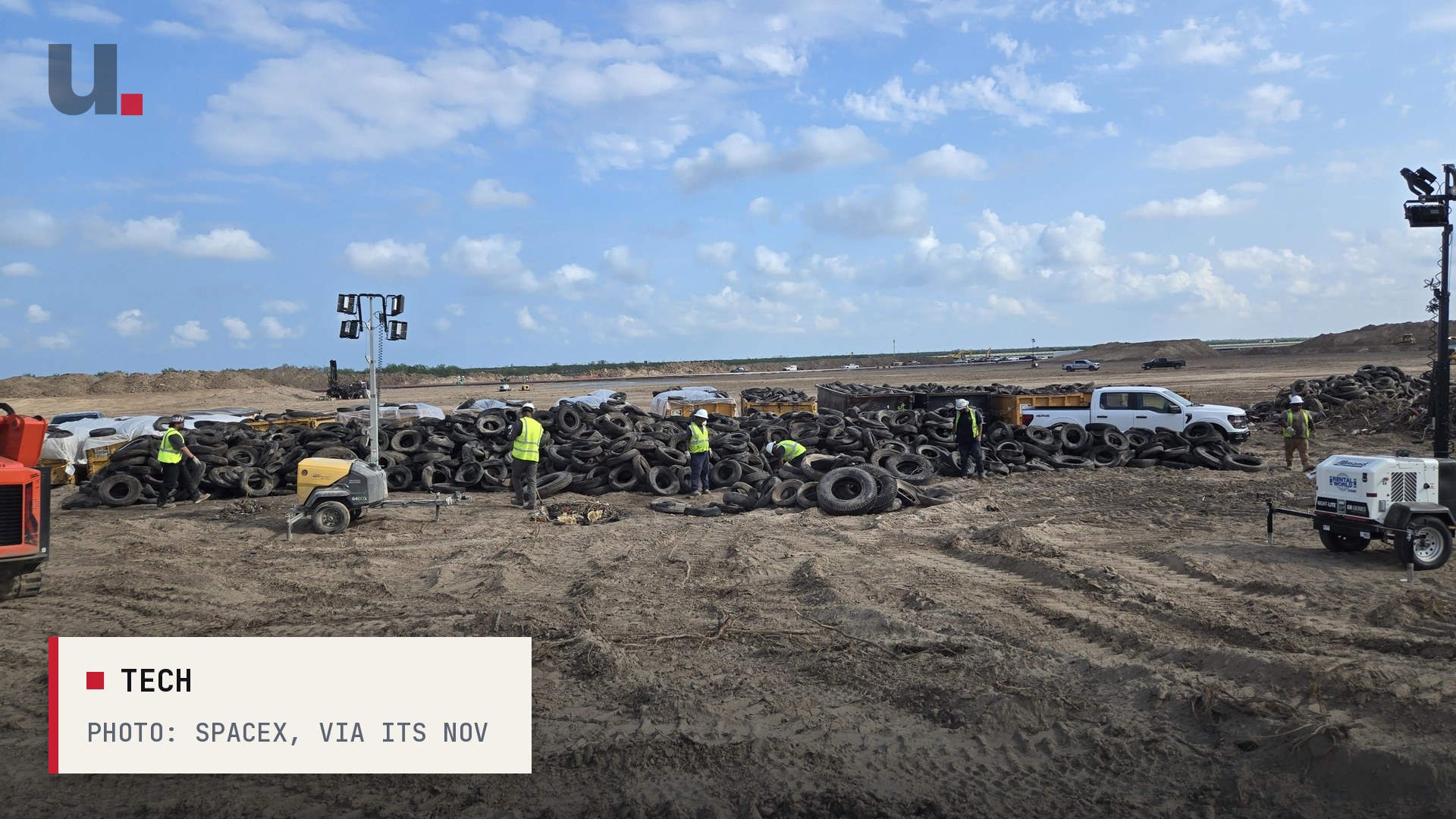
The land itself needed rescuing. Parts of it had been used as an illegal dump since the 1960s, and SpaceX crews are hauling out scrap metal, old appliances, old tanks, fiberglass insulation and thousands of tires before anything gets built.
SpaceX on 𝕏, Nov. 12, 2026: “Development of the Starbase supercompute site is creating an opportunity to address decades of environmental neglect.”
— @SpaceX View on 𝕏
Then there is water, the thing every South Texan worries about. About three-quarters of Brownsville’s main supply comes from two Rio Grande reservoirs that have both hit critically low levels. Local water planners had already lined up projects to add about 20 million gallons a day from sources that don’t depend on the river: 8 million through reusing water the city already treats, and 12 million through more brackish-groundwater treatment. What they lacked was roughly $220 million.
SpaceX says it is covering that gap and has already handed $40 million to the Brownsville Public Utilities Board. Borrowing the money the normal way, the company says, could have cost local water customers more than $370 million over 25 years with interest. The city keeps ownership of everything built. SpaceX says it is not buying water rights, gets no special access, and will pay standard rates and face the same restrictions as everyone else in a drought.
Arizona’s pitch is a smaller power bill
The Arizona campus is the bigger bet. Plans call for nine single-story computer buildings of about 493,000 square feet each, built in phases up to six gigawatts of power, plus a 24-gigawatt-hour battery bank that SpaceX calls the largest in the country. It would run off the grid through two local cooperatives, Sulphur Springs Valley Electric Cooperative and the statewide Arizona Electric Power Cooperative.
That would normally be the part that scares people. SpaceX’s answer is to pay for the upgrades itself. It says it will hand $3.6 billion in grid improvements to the statewide co-op at no cost to members, and at full buildout send up to $260 million a year to the local co-op and up to $200 million a year to the statewide one, money the co-op boards can use for bill relief and other member benefits. Thursday’s announcement says bills for local co-op members could fall by up to 20%. The project’s own page projects a 10% to 40% drop “for the life of the project.” All of it is still subject to final deals with the co-ops.
Water is the other fear in a desert county, and here SpaceX’s numbers are striking. The buildings use sealed, closed cooling loops and fan-driven dry coolers, with no cooling towers and no evaporative spray. The loops are filled once and reused for up to 10 years. Total water use at full size, the company says, will be up to 10 acre-feet a year, about what 20 to 30 Arizona homes use, and less than 2.5% of a single center-pivot irrigation rig. No new high-volume well is planned for cooling.
There are no gas turbines on the Arizona site, the outdoor lights will follow the county’s dark-sky rules, and the designs will go to state and federal wildlife officials because the nearby Willcox Playa is a wintering ground for sandhill cranes.
The local payoff, by SpaceX’s estimate: about 5,500 construction jobs at peak, 1,000 permanent ones, a one-time county sales tax benefit of up to $250 million and $34 million to $103 million a year in new property tax revenue for a rural county.
SpaceX on 𝕏, Nov. 12, 2026: “SpaceX builds the infrastructure of the future. And we’re committed to making sure the communities where we build share in the benefits.”
— @SpaceX View on 𝕏
Neighbors still get the final say
None of this is approved yet. Cochise County still has to sign off, and Reuters reports a petition with 2,400 signatures asking officials to deny the permit, with a public hearing set for December. In Texas, the Starbase City Commission is due to take up a property tax abatement for the project on Dec. 9.
SpaceX is making its case on the tax break in plain terms. Computer equipment loses value fast, so a supercomputer site shows up on the tax rolls as a huge spike and then sinks year after year. A structured abatement paired with negotiated payments, the company argues, gives local schools and governments a steady stream they can plan around instead of a one-time windfall that melts away.
Why spend this much on the ground when Elon Musk keeps talking about computers in orbit? Because both are happening at once. SpaceX’s SI business brought in more than half the company’s revenue last quarter, Reuters reported, and the company is also planning its $100 billion Terafab chip plant in Grimes County, Texas, and the Starmind satellites meant to run SI in space. The campuses in Texas and Arizona are where that training happens on solid ground while the orbital version gets built.
For the people of Brownsville and Cochise County, the questions are simpler. Will the jobs show up, will the water hold, and will the power bill really shrink? SpaceX has put specific numbers in writing on all three. Next month, local officials in both places get to decide whether to hold it to them.
Sources
- SpaceX — Updates: Starbase and Cochise County supercompute projects (Nov. 12, 2026)
- SpaceX — Cochise County, AZ supercomputing campus project page and FAQ
- SpaceX on 𝕏 — Starbase supercompute site cleanup (Nov. 12, 2026)
- SpaceX on 𝕏 — Community benefits video (Nov. 12, 2026)
- Reuters (via Investing.com) — SpaceX plans over $74 billion investment in Texas, Arizona AI campuses (Nov. 12, 2026)