

SpaceX Launched New American Spy Satellites Just 32 Hours After Using the Same Pad
Sunday’s launch for the nation’s spy-satellite agency came a day and a half after a Space Force mission from the same California pad, crushing the old record there.
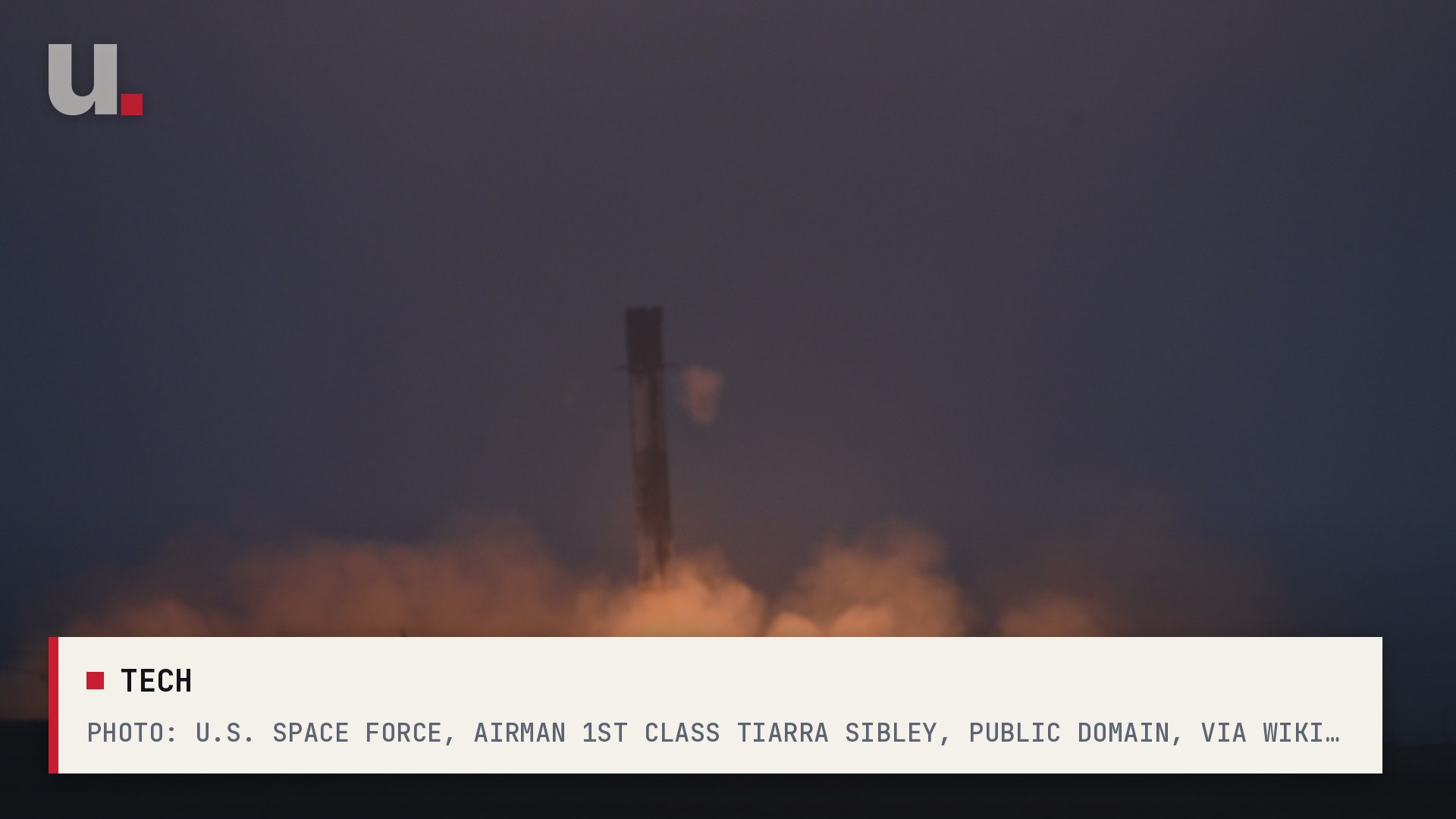
Most of California’s central coast was asleep at 4:23 Sunday morning when a Falcon 9 lit up the sky over Vandenberg Space Force Base. On board was a fresh batch of American spy satellites for the National Reconnaissance Office, the agency that builds and flies the country’s eyes in orbit. The rocket that carried them had flown 13 times before. The pad it left from had sent up a different military mission only a day and a half earlier.
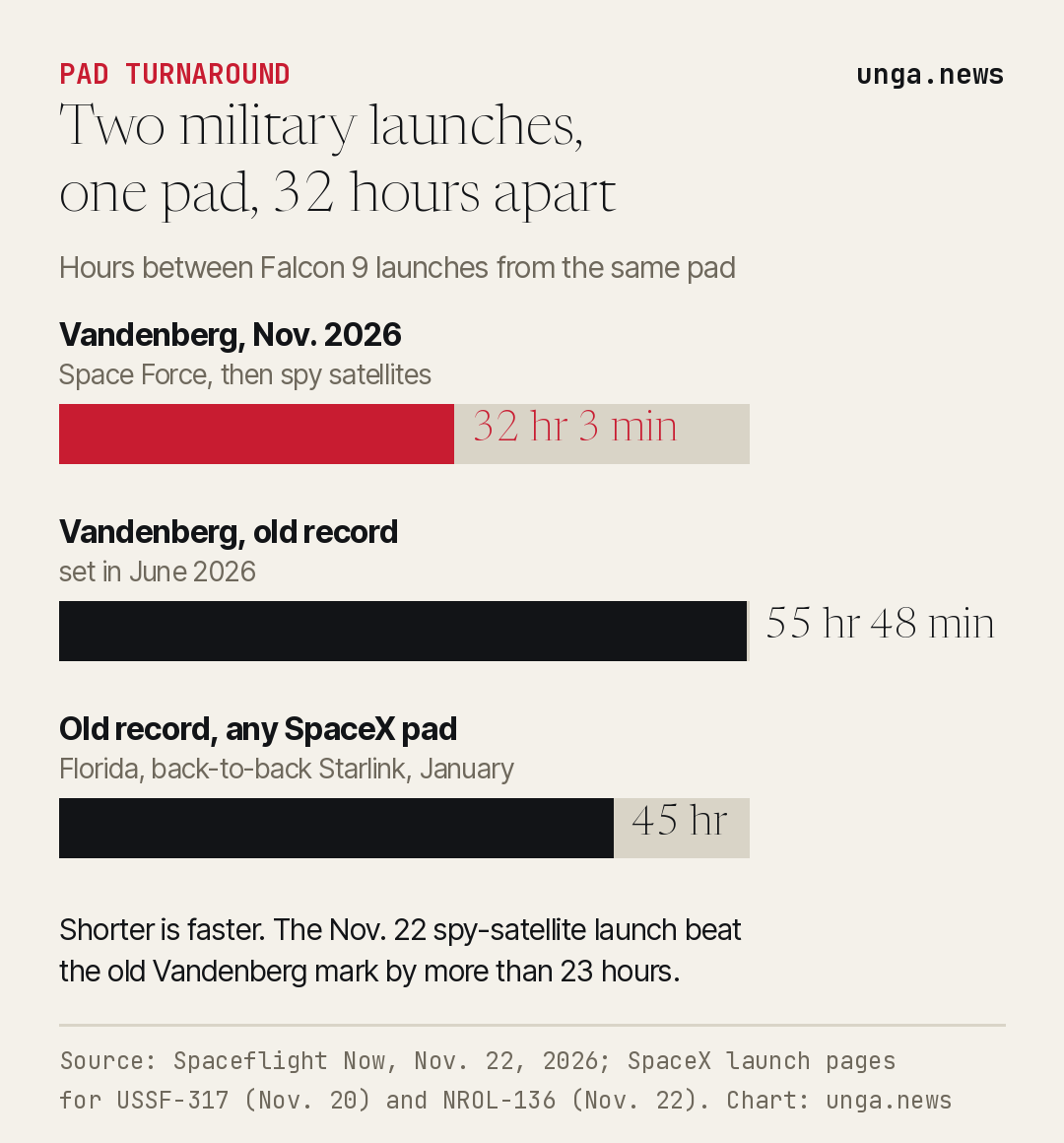
That second detail is the one that should make America’s rivals sit up. SpaceX flew the Space Force’s USSF-317 mission from Space Launch Complex 4 East on Friday night at 8:20. Then it cleaned up the pad, rolled out another rocket, loaded it and launched the NRO’s NROL-136 from the very same spot 32 hours, 3 minutes and 21 seconds later, according to Spaceflight Now. The old record at that pad, set in June, was 55 hours and 48 minutes. Before Sunday, SpaceX’s fastest turnaround at any pad anywhere was 45 hours, set by back-to-back Starlink flights in Florida in January.
A spy network built to have no weak spot
The NRO doesn’t say how many satellites went up or what they can see. It never does. What it did say, in its launch announcement, is that the mission “boosts NRO’s momentum in deploying the largest satellite constellation in U.S. government history.” NROL-136 was the agency’s fourth launch this year for what it calls its proliferated architecture, and the 15th since the first one went up in May 2024.
Proliferated is a fancy word for a simple idea. For decades the United States relied on a small number of enormous, very expensive spy satellites. Lose one, to a failure or to a Chinese or Russian anti-satellite weapon, and you lose a big piece of what you can see. The new approach spreads the job across hundreds of smaller satellites in low orbit, built with SpaceX and Northrop Grumman. The program’s own description promises greater revisit rates, more coverage, no single points of failure, and data delivered to analysts and troops “in minutes or even seconds.”
The agency was blunt about the scale. “Over the past several years, NRO has launched hundreds of satellites, creating the largest and most capable government constellation on orbit in our nation’s history,” its statement said. It added that 2026 is “proving to be another dynamic year, with launch frequency accelerating through year-end.” The constellation serves the Intelligence Community and what the NRO now calls the Department of War.
Friday’s launch was a second network
The Friday flight wasn’t filler. After USSF-317 reached orbit, the Air Force confirmed for the first time what a whole series of quiet Space Force launches this year has been carrying: the Space Data Network Backbone, a government-owned communications network meant to move military data around the globe fast and securely. The Space Force awarded SpaceX a $2.29 billion contract for it back in May.
“With three successful launches in two weeks, the Department of the Air Force is accelerating the development and launch of the Space Data Network Backbone constellation, advancing a government-owned and controlled communication system that will provide secure, high-speed data transport globally for the Joint Force,” the Secretary of the Air Force’s public affairs office said. “The accelerated schedule is on track to deliver regional capability this year and global support by next year.”
Put the two missions together and you get the shape of the thing. One network sees. The other moves what it sees to the people who need it. Both went up from one California pad inside two days, on rockets from one American company.
The reused rocket did the heavy lifting
Sunday’s booster, tail number B1097, was on its 14th flight, according to SpaceX’s mission page. It had already carried NASA’s Sentinel-6B ocean satellite, two earlier national security missions in NROL-172 and USSF-259, a Transporter rideshare, the Twilight mission and eight batches of Starlink satellites. About seven and a half minutes after liftoff it flew itself back and touched down at Landing Zone 4, right next to the pad. Spaceflight Now counted it as the 38th landing at that site and the 680th Falcon booster landing ever.
Friday’s booster, B1100, was on its 11th flight and landed on the drone ship Of Course I Still Love You out in the Pacific. That’s two national security launches, two recovered first stages, and no brand-new rocket bodies thrown into the ocean. Space.com noted that all six NRO launches to low orbit this year have flown on Falcon 9.
Not long ago, national security launches came only a few times a year, and each one was treated like a moon shot. Now the country’s most sensitive payloads ride on boosters that fly again and again, and the limit on how fast America can put up new capability is becoming how quickly crews can turn a pad around. On Sunday, that was about a day and a third.
Harder to blind
China is racing to build big satellite constellations of its own, and Beijing and Moscow have both tested weapons meant to knock satellites out of the sky. A spy network made of hundreds of small, quickly replaced satellites is a lot harder to blind than one made of a handful of giants. That only works if you can launch on short notice, over and over, without waiting weeks between flights.
The NRO has already said more launches are coming before the year is out, with dates posted at its launches page. If the Vandenberg crews keep up anything close to this weekend’s pace, the country’s biggest spy constellation is going to keep growing faster than anyone planned. Residents of Santa Barbara, San Luis Obispo and Ventura counties may hear a few more sonic booms. It’s a small price for keeping watch on the world.
Sources
- National Reconnaissance Office — NRO successfully launches NROL-136 November 22 (Nov. 22, 2026)
- SpaceX — NROL-136 Mission (Nov. 22, 2026)
- SpaceX — USSF-317 Mission (Nov. 20, 2026)
- Spaceflight Now — SpaceX launches intelligence-gathering satellites for the National Reconnaissance Office (Nov. 22, 2026)
- Spaceflight Now — SpaceX launches satellites for the U.S. Space Force’s data network constellation (Nov. 21, 2026)
- Space.com — SpaceX sends classified US spy satellites to orbit in early-morning launch from California (Nov. 22, 2026)
- Next Spaceflight — NROL-136 (Proliferated Architecture)