

Starlink Won $738 Million to Connect Rural Homes. Now It’s Doing the Job Without Taking a Dime
Elon Musk’s SpaceX is handing back its federal rural internet grants but still has to hook up every home it won, with the same speeds and free equipment. Taxpayers keep the money.
Washington handed Elon Musk’s Starlink roughly $738 million to bring internet to rural homes that the cable and phone companies never bothered to reach. This week SpaceX handed the money back. The homes still get connected.
That is the deal the Commerce Department’s broadband office rolled out Monday evening. SpaceX will keep every rural address it won under the federal grant program, meet the same speed and testing rules as everyone else, give new customers the dish and router at no extra cost and offer a cheap plan for families on a budget. What it won’t do is take a single grant dollar.
“I am pleased this new agreement has the potential to save taxpayers hundreds of millions of dollars while getting more Americans connected faster,” said Arielle Roth, who runs the National Telecommunications and Information Administration. She called it “another clear example of the Benefit of the Bargain delivering for the American people.”
A senior agency official told Broadband Breakfast that SpaceX brought the idea to Washington itself, and that the company was walking away from about $738 million. Other tallies of the awards run lower, near $636 million. Either way it is a lot of money for a company to say no to.
“A job already accomplished”
On Tuesday SpaceX put its reasons in a letter to state broadband offices, which Communications Daily obtained. The company pointed to more than 11,000 satellites already in orbit and more than 14 million customers around the world.
“SpaceX will not, and cannot, accept BEAD funding to complete a job already accomplished with private investment,” the letter said. In place of the grants, it offered states “a binding contractual commitment with identical broadband obligations to those applied to recipients of BEAD funding, at zero cost to the state, the BEAD program, or the taxpayer.”
Read that again. A private company built the network with its own money, won a government contest to serve the hardest-to-reach places in America, and then told the government to keep the check.
Musk’s reaction on 𝕏 was one word.
Elon Musk on 𝕏 — “Starlink” (Nov. 24, 2026)
— @elonmusk View on 𝕏
The pot of money in question is the Broadband Equity, Access and Deployment program, a $42.45 billion fund created by the 2021 infrastructure law. Under Joe Biden, the program spent years writing rules that favored laying fiber cable to every farmhouse, no matter the cost or the wait, and it didn’t connect a single home before he left office.
Trump’s Commerce Department threw out the fiber-first rule in June 2025 and told states to pick the best deal for the money, satellites included. Starlink’s bids were often a small fraction of what fiber would cost, so it won big. It ended up with awards in 42 states.
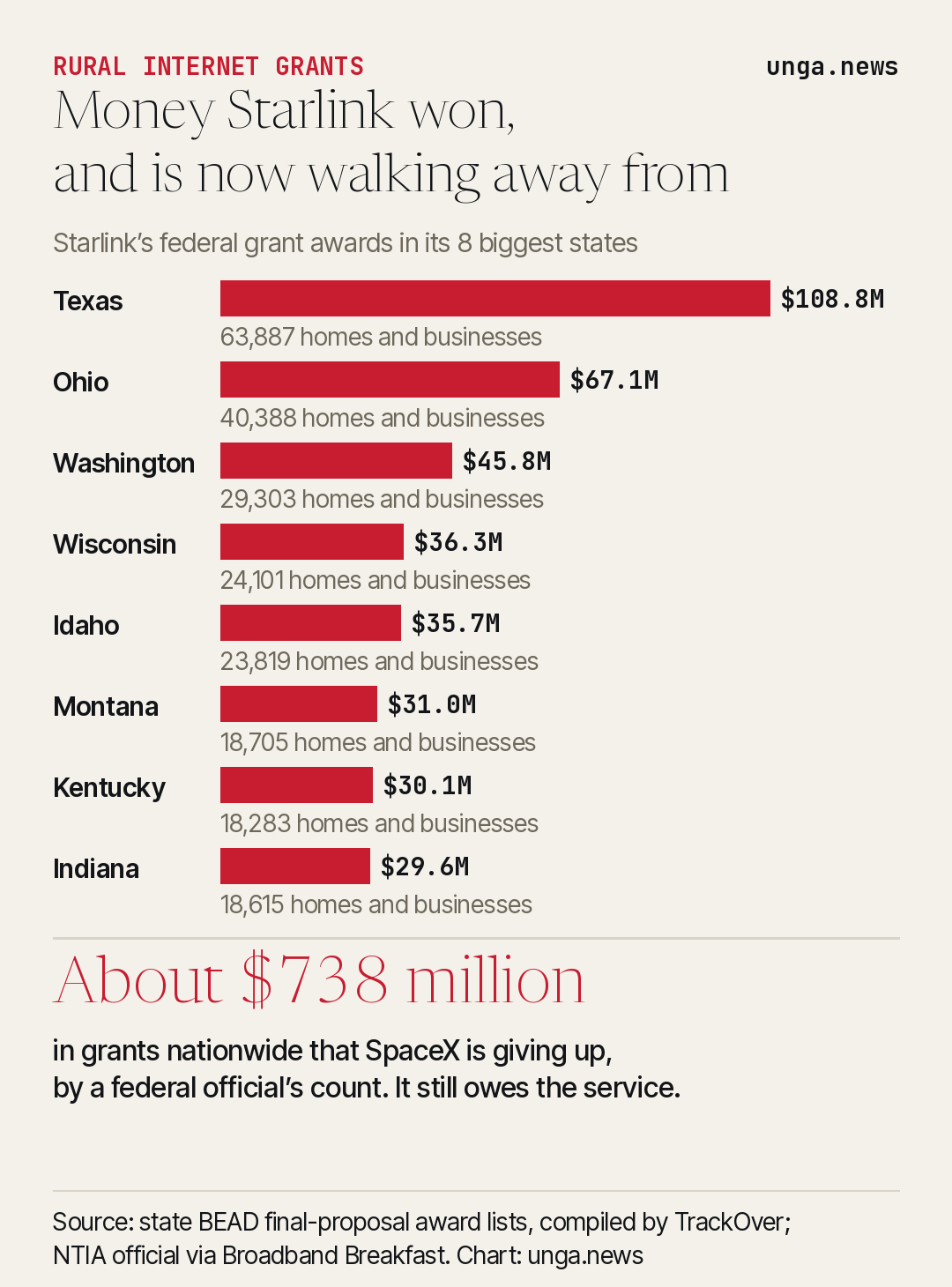
Texas alone awarded Starlink $108.8 million to cover 63,887 homes and businesses. Ohio, Washington, Wisconsin, Idaho, Montana, Kentucky and Indiana each handed it around $30 million or more. Arizona’s award came to $17.1 million for 10,749 addresses. Virginia’s was $3.3 million for 5,579. All of that grant money now stays with taxpayers, while the people living at those addresses still get service.
Fifty states, fifty sets of paperwork
Why would anybody turn down free money? Because it was never free. Every state wrote its own contract. Some demanded detailed financial reports. Some wanted penalties if the company fell short. The agency official said SpaceX had struggled with those differing terms across all 50 states, and NTIA itself said some states had been “slow to sign contracts, imposing a patchwork of obligations beyond BEAD programmatic requirements.”
Minnesota is a good example. “We have had some challenges working with Starlink moving forward on the contracts,” Bree Maki, who runs the state’s broadband office, told Communications Daily before the new terms came out. “It has been challenging to say the least.”
The new model agreement from NTIA cuts through that. It keeps what matters to the family at the end of a dirt road. The service has to hit the program’s required speeds of at least 100 megabits down and 20 up, pass performance testing, include free equipment for new subscribers and come with a low-cost option. SpaceX also has to file a report every six months on how the service is performing and how many people signed up. What drops out is the grant money and the state-by-state financial red tape that came with it. States still get a choice: sign the model agreement, or go find somebody else to serve those addresses at a comparable price.
The fiber crowd isn’t happy
The loudest complaints come from the fiber industry and its allies, who were counting on that money. Gary Bolton, who heads the Fiber Broadband Association, said making states find another provider at Starlink’s low price “makes that choice impractical in many communities.” He wants states free to reopen those locations to competition and to spend the roughly $21 billion still sitting unspent in the program on more construction.
Gigi Sohn, a former top aide at the Federal Communications Commission under Obama, went further. “There is nothing ‘free’ about this deal,” she wrote, arguing SpaceX gets to keep those addresses for years without the letters of credit, financial reports and default penalties other winners face.
There’s a real point buried in there. Holding an award, even a $0 award, keeps other federal broadband money out of those same areas. But look at what the critics are actually asking for. They want the government to spend more money, slower, to build a second network to homes that already have a fast one, and they’re upset that a company won’t take a subsidy. That is a strange thing to be angry about.
For the rancher in Montana or the retired couple in rural Ohio, the choice is simple. Starlink was already the quickest way to get them online. Now it gets them online for nothing out of the taxpayers’ pocket, and the dish shows up on the porch at no extra charge.
Washington spent years promising rural America a broadband miracle paid for with $42 billion. The miracle turned out to be a company that needed none of it.
Sources
- NTIA — BEAD Model Agreement to Accelerate Broadband Deployment (Nov. 23, 2026)
- Communications Daily — SpaceX Offers States BEAD Coverage Without Subsidies, Following New NTIA Terms (Nov. 25, 2026)
- Broadband Breakfast via Benton Institute — SpaceX Declines BEAD Awards (Nov. 24, 2026)
- Broadband Breakfast — Fiber ISPs, Advocates Don’t Like SpaceX’s BEAD Deal (Nov. 24, 2026)
- Fierce Network — SpaceX declines BEAD awards, putting state broadband offices in a pickle (Nov. 24, 2026)
- Elon Musk on 𝕏 — “Starlink” (Nov. 24, 2026)
- Teslarati — SpaceX rejects $738M fed subsidy, betting on Starlink alone (Nov. 25, 2026)
- TrackOver — Starlink (SpaceX) BEAD awards, compiled from state final-proposal award lists