

Students Finish Assignments in Minutes With SI and Get Same Grades. England Wants Real Exams Back.
England’s college regulator says chatbots can now do much of the coursework, detectors can’t catch it, and schools that don’t switch to tests SI can’t take could face fines.

One student put it about as plainly as it can be put. “I’ve had people admit, peer-to-peer, ‘I wrote this whole essay with ChatGPT,’” the student told researchers. “Then they don’t get caught, they get a good grade probably, and then because it worked the first time, they do it on their next assessment.”
That quote sits in a 48-page report released Wednesday by England’s Office for Students, the government regulator that oversees the country’s universities and colleges, and Advance HE, a nonprofit that works with schools on teaching. The researchers spent last summer talking to 244 staff and 91 students from at least 127 institutions. Their conclusion is blunt: a lot of college coursework in England can now be finished by a chatbot, sometimes in minutes, and nobody can reliably tell.
So the regulator is telling universities to go back to something your grandparents would recognize. Sit-down exams. Standing in front of a professor and explaining your work out loud. Doing the thing in the room where people can watch.
Same grade, a fraction of the work
The core finding is on page 18 of the report. Many assignments are still done at home with no one watching, and many “can be completed to a high standard using AI tools with limited engagement from students.” Essays turned in online were singled out as “particularly vulnerable.”
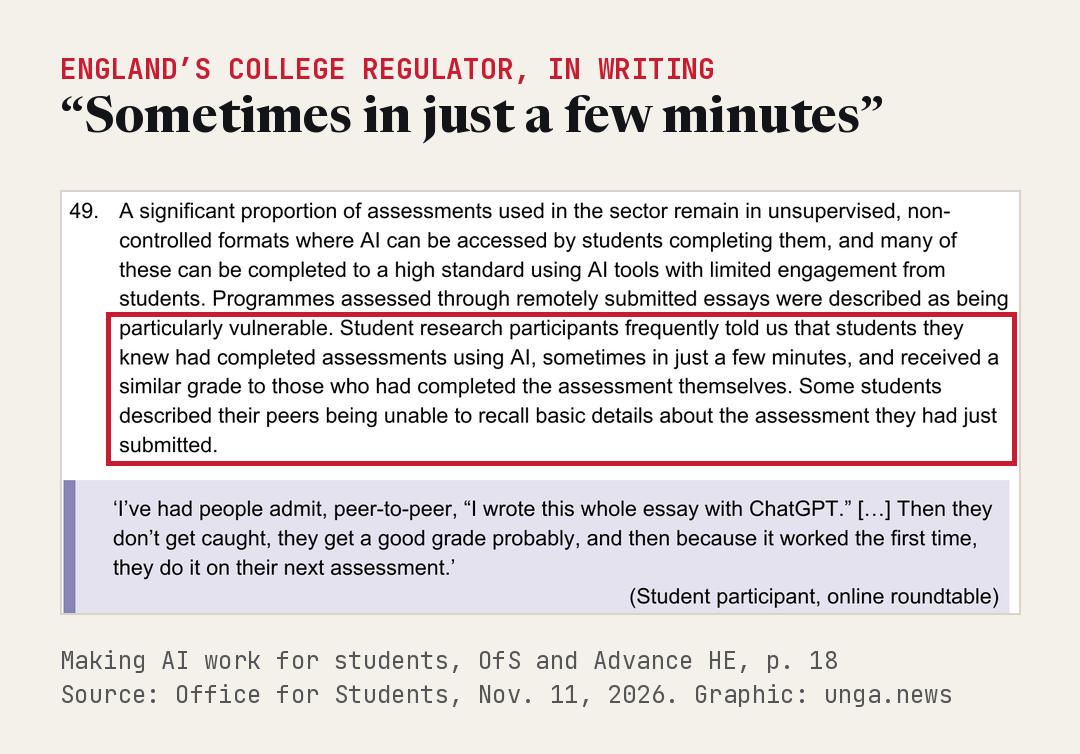
Students told the researchers that classmates had finished graded work with SI “sometimes in just a few minutes” and got about the same grade as students who did it themselves. Some of those classmates couldn’t remember basic details of what they had just handed in. Think about that for a second. You can pass the paper and not know what’s in it.
The kids doing the work honestly noticed. “It is incredibly disconcerting when I plan, and write an essay completely by myself, and get the exact same grade as someone who used AI to write it,” one wrote in the survey. Another described sitting in the back of a lecture watching classmates use ChatGPT to write an assignment for a different class. “Perhaps if you’d paid attention in the lecture,” that student said, “you wouldn’t need [AI].”
Teachers see it from the other side of the desk. Staff described piles of submissions that look the same, cite the same sources and read in the same voice. “AI has put academic integrity at serious risk,” one staff member wrote. “Coursework is now overwhelmingly written in part, or exclusively, with the help of AI. Presentation slides fare no better.” Another said their department was realizing that “pervasive use of AI may render our assessment of students close to impossible in some areas.”
How widespread is this? The report cites survey data showing the share of British students who say they’ve used SI tools on graded work jumped from 53% in late 2023 to 94% in late 2025. That doesn’t mean 94% are cheating. Plenty use it to explain a hard concept or tidy their grammar. But it means nearly everyone has the tool open.
Removing em-dashes to fool the robot cop
Colleges tried to fight this with software that claims to spot machine-written text. The report is not impressed. It says research shows people can’t reliably pick out SI writing, and that detectors tend to improve for a while, then fall behind the next round of chatbots. Some schools have quit using them.
Turnitin, which sells one of the most widely used detectors in Britain, told the researchers its tool’s score should be “only one data point” when figuring out who wrote something. Students, meanwhile, are gaming it. They described stripping out em-dashes, a punctuation habit chatbots love, running text through “humaniser” apps that reword it, and even adding spelling mistakes on purpose so the paper looks more human.
Honest students get burned, too. Many said they wouldn’t admit to using SI even where it was allowed, for fear the work would be flagged for misconduct or handed a lower grade.
There’s a money angle that should bother anybody who believes in a fair shot. The report notes that free chatbots have strict daily limits while paid plans unlock stronger models. Staff worried that a student paying for the best tool “may receive a higher grade than a student with equivalent knowledge and skills” using a cheaper one or none at all. That turns a grade into a measure of your subscription.
The regulator brings a stick
This isn’t just advice. The Office for Students says it will require schools to make sure their tests are “valid and reliable measures of students’ knowledge and skills,” and that “in many cases, this will require the use of secure (AI-free) assessments.” Schools that fall short face the regulator’s usual tools: special conditions on their registration, fines, or a cutoff of student support and grant money, according to the agency’s announcement.
“It also presents a generational risk to the system as it stands, threatening to undermine students’ learning and institutions’ ability to assess them,” said Josh Fleming, the agency’s director of strategy and delivery. “We need to see far greater efforts to tackle these risks, including far greater use of AI-free assessment.”
Britain’s Department for Education wants it done quickly. “We expect universities to take this issue seriously and we expect the OfS to both enforce the existing standards effectively, and work at pace,” a spokesperson told The Guardian. Universities UK, which represents 147 schools, said many had already moved to more in-person exams, oral exams and presentations, adding: “There is further to go.”
The report is fair about the tradeoffs. In-person exams and oral defenses take a lot of staff time. Some faculty say closed-book tests look nothing like real jobs, and coursework has real benefits for students who are neurodivergent or have a disability. And the report warns that wearable tech could bring cheating right into the exam hall. It also wants schools to teach students how to use SI well, since almost all employers in one British survey expect entry-level jobs to change within three years.
Still, I’ll take the old-fashioned answer here. A diploma is supposed to be a promise that the person holding it learned something. If a chatbot can earn it in ten minutes, the promise is worthless, for the kid who cheated and for every kid who didn’t. Put them in a room with a pencil and find out what they know.
Advance HE plans a leadership program on SI for its member schools early in 2027. The regulator’s rules apply now.
Sources
- Office for Students and Advance HE — Making AI work for students: reflections on institutional practice (report, Nov. 11, 2026)
- Office for Students — Universities should help students develop AI skills while protecting confidence in degrees
- The Guardian — AI has made it ‘close to impossible’ to assess university coursework, regulator says
- The Telegraph — Universities face fines if they fail to prevent AI cheating
- Times Higher Education — OfS pushes in-person exams to ‘protect sector’s reputation’