

T-Mobile Is Buying Up Cell Signal in 27 States, Keeping It Out of Elon Musk’s Hands
The carrier quietly filed to buy airwaves that push phone signal through walls and across rural miles. It also blocks SpaceX, which is spending billions to turn Starlink into a fourth phone company.
If you have ever lost a call the second you walked into a grocery store, you already understand what this fight is about. T-Mobile just told federal regulators it is buying a fresh batch of the airwaves that carry phone signal through walls and across long rural stretches. The licenses cover 435 counties in 27 states, and the deal also keeps them out of the hands of the one newcomer the big carriers are watching most closely: Elon Musk’s SpaceX.
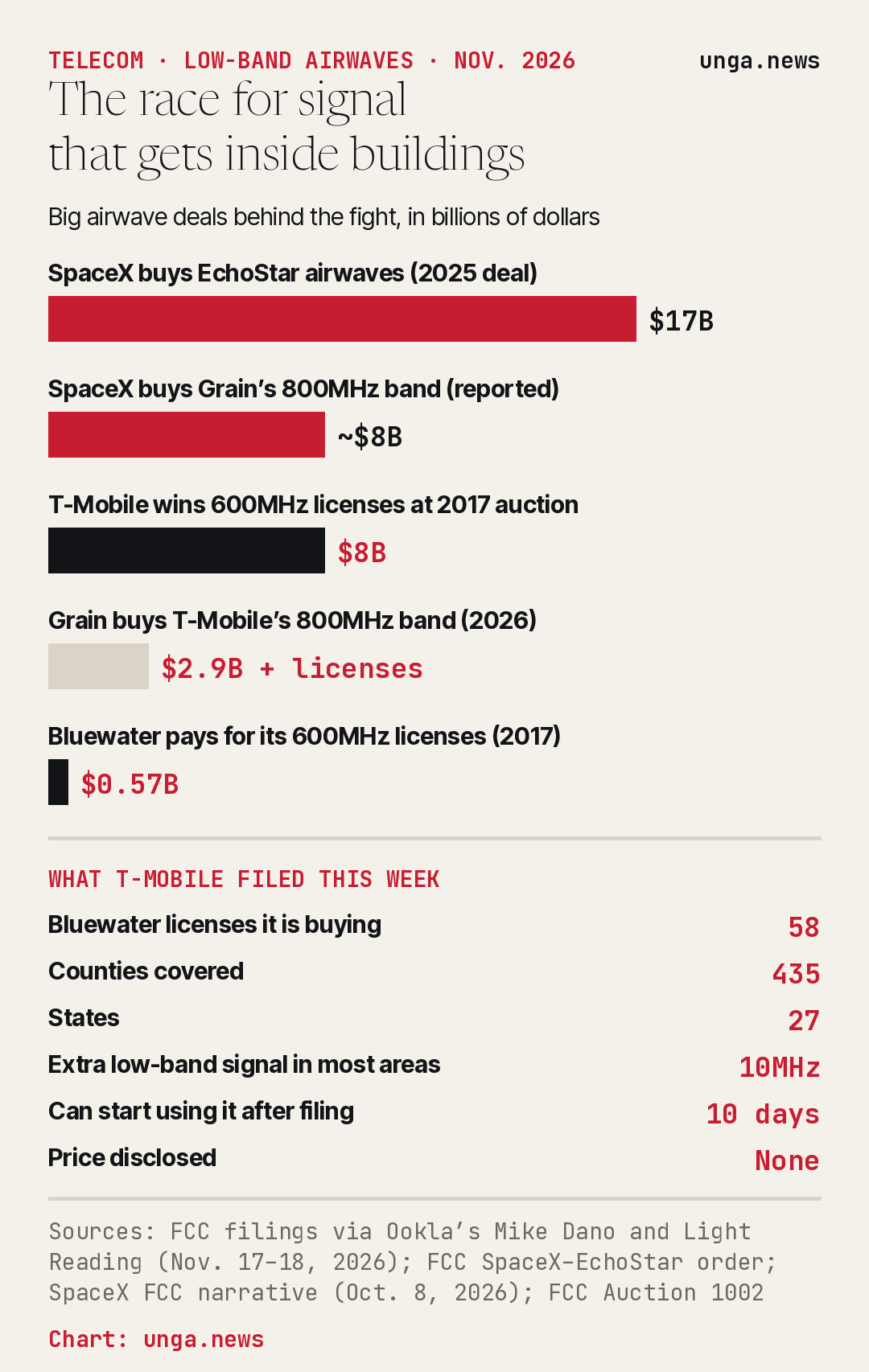
The filing at the Federal Communications Commission says T-Mobile will buy 58 licenses in the 600MHz band from a small company called Bluewater Wireless. Ookla analyst Mike Dano spotted it and flagged it on Nov. 17, and the trade outlet Light Reading laid out the details Wednesday. Neither company has said what T-Mobile is paying.
T-Mobile isn’t waiting for Washington to sign off, either. The two companies also signed a short-term lease, a rental, so T-Mobile can switch the signal on before the sale closes. “The lease commencement date will be ten days after the filing of this application and the term will be one year,” the companies told the FCC. That means some customers could see the extra capacity before the end of the month.
Why this slice of signal is so valuable
Not all wireless signal is the same. High-frequency bands carry a lot of data, but they fade fast and struggle with walls, trees and hills. Low-band signal like 600MHz is slower, but it travels for miles and gets inside buildings. Carriers use it as the floor of their networks, the layer that keeps you connected when nothing else reaches.
In most of the 435 counties, the deal adds about 10MHz of that low-band signal to T-Mobile’s network. In two Northern Colorado counties, it adds 20MHz, taking T-Mobile from 40MHz to 50MHz there. Dano checked Ookla’s Speedtest results from Android phones in those counties during the third quarter and found that about 14% of T-Mobile 5G tests showed 600MHz as the phone’s main 5G connection. “Adding more spectrum like this generally improves network speeds and performance,” he wrote.
The airwaves have been sitting partly idle. Bluewater paid $568 million for 66 licenses at the FCC’s 2017 auction, including the 58 in this deal. Analysts at New Street Research noted that the unbuilt licenses face a July 2028 FCC deadline, so any buyer “would need to build fast or win a waiver.” T-Mobile, which spent about $8 billion on 600MHz licenses at that same 2017 auction, already has the towers and gear to put them to work quickly.
The newcomer the carriers are watching
The bigger story is who doesn’t get these licenses. SpaceX is turning Starlink into a full phone carrier called Starlink Mobile, with satellites overhead and regular radios on towers and rooftops on the ground. To do that, it needs exactly this kind of low-band signal.
Musk’s company has been buying aggressively. Its roughly $17 billion deal for EchoStar’s airwaves, which the FCC approved this year, gives it the bands it needs for phone service from space, and the agency has since cleared up to 15,000 direct-to-phone satellites. In October, SpaceX agreed to buy Grain Management’s nationwide 800MHz licenses, a deal reported at about $8 billion. That is 546 licenses with up to 14MHz of paired low-band signal covering nearly every American. The FCC accepted the application on Nov. 10 and opened it for public comment, with comments due Dec. 1.
SpaceX told regulators in its own filing that Starlink Mobile “can ensure all Americans have access to high-speed mobile broadband no matter where they go,” and promised that “once approved, SpaceX will deploy rapidly.” That is a direct shot at the three carriers that have split the U.S. phone market among themselves for years.
So when Bluewater’s licenses came up, they were an obvious target. New Street Research had singled out the 600MHz band, and Bluewater’s and Comcast’s holdings in particular, as a “sensible bolt-on” for SpaceX that would “meaningfully improve its lowband coverage layer.” T-Mobile got there first.
A trade that came back around
There is some irony here. The 800MHz signal SpaceX is buying from Grain used to belong to T-Mobile. Earlier this year, T-Mobile sold that band to Grain for $2.9 billion in cash plus Grain’s own 600MHz licenses. Grain then turned around and sold the 800MHz band to SpaceX. In other words, the low-band signal that could make Starlink Mobile a serious competitor came out of T-Mobile’s own warehouse.
Since then, T-Mobile has been loading up on 600MHz wherever it can. Back in 2023 it struck a deal to lease and later buy some or all of Comcast’s 600MHz licenses. Comcast can still walk away from the optional part of that sale if somebody else, like SpaceX, offers more.
Dano read the Bluewater move in plain terms. T-Mobile wants better low-band 5G across the country, and Starlink, he noted, isn’t buying all the spectrum that is currently available.
What it means for your phone
In the short run, T-Mobile customers in those 435 counties should get a bit more breathing room on the network, especially indoors and out in the country, where low-band signal does the heavy lifting.
In the long run, the fight over these airwaves will decide whether Americans get a real fourth choice for phone service. For years, buying a phone plan meant picking from the same three companies at roughly the same prices. SpaceX already proved with Starlink home internet that it can reach farms, ranches and small towns the big providers wrote off, and it has added millions of customers doing it. Starlink Mobile would bring that same approach to the phone in your pocket.
The carriers know that, which is why every leftover scrap of low-band signal is suddenly worth fighting over. The FCC also plans to auction a big block of upper C-band signal starting April 27, 2027, the next major chance for SpaceX and the carriers to bid against each other.
T-Mobile won this round. But a company that spends $25 billion on airwaves isn’t building a hobby. It is building a phone company, and the carriers are acting like they know it.
Sources
- Light Reading — T-Mobile grabs for Bluewater's 600MHz licenses, keeping them out of SpaceX's reach
- Mobile World Live — T-Mobile US adds 600MHz spectrum in Bluewater deal
- SpaceX — Public Interest Statement and Description of the Transaction (Grain 800 MHz), FCC filing, Oct. 8, 2026
- Federal Communications Commission — Order Granting SpaceX-EchoStar Applications
- Light Reading — SpaceX's bid for Grain's lowband spectrum takes a step forward
- Advanced Television — FCC approves SpaceX’s move on Grain’s spectrum
- Via Satellite — FCC Grants SpaceX Approval for 15,000 Direct-to-Device Satellites in MSS Spectrum