

Tencent’s New SI Does Office Chores at One-Twentieth the Cost of Its Own Flagship
Hy4 flash costs about 7 cents per million tokens of input, and Tencent says it matches its bigger models on slide decks, documents and spreadsheets.
Tencent, the Chinese company behind WeChat and some of the world’s biggest video games, released a new SI model Tuesday that it says does everyday office work about as well as its bigger models for a small slice of the price.
The model is called Hy4 flash. Tencent says it costs about 7 cents per million tokens of input, the chunks of text a model reads, and about 28 cents per million tokens of output. Text the model has already seen, called cached input, drops to a third of a cent per million.
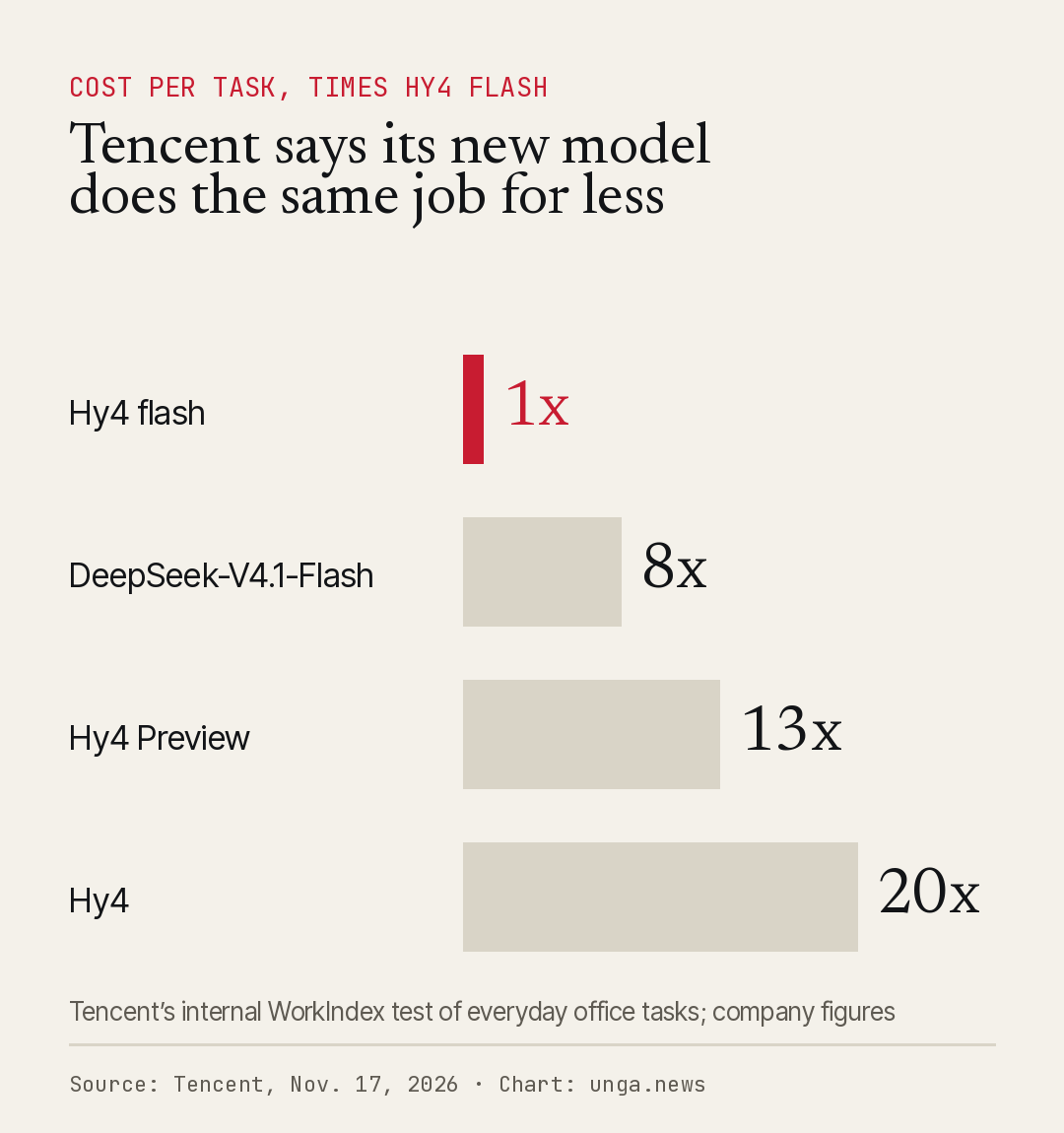
Those prices are a sharp cut from Hy4, the bigger model Tencent put out just two weeks ago on November 4. On Tencent’s own test of typical office jobs, Hy4 flash got each task done for one-twentieth of Hy4’s cost.
Small engine, big tank
Hy4 flash has 224 billion parameters in total, the internal settings a model learns during training. Only 12 billion of them switch on for any given word, a design trick that lets a big model run about as cheaply as a small one.
It can take in text and images and hold up to a million tokens at once, roughly the length of several long novels. Tencent says it generates more than 150 tokens a second, fast enough that answers stream out faster than most people can read.
The company credits a stack of engineering changes. The model’s short-term memory while it works, known as the KV cache, is one-sixth the size of Hy4’s and one twenty-fourth the size of the older Hy3. Training also taught it to be brief: Tencent says reinforcement learning cut the length of its average finished task in half, and shorter answers mean smaller bills.
On the serving side, Tencent squeezes the model’s numbers down to 4-bit precision and uses custom software to keep its chips busy, all aimed at running it cheaply for millions of users.
Graded on chores, not quizzes
Most SI companies brag about scores on public exams for math or coding. Tencent tried something different. It built its own test, WorkIndex, around the jobs people actually hand its WorkBuddy assistant: building and editing PowerPoint decks, editing documents, fixing broken spreadsheets, cutting audio and video, and understanding pictures.
The test looks at the quality of the finished work, how long the answers run and how long the job takes, rather than at public benchmark scores that, in Tencent’s words, are “detached from everyday work.”
On that test, Tencent says Hy4 flash slightly beat the much larger Hy4 Preview, which has 770 billion parameters and 49 billion active, while costing one-thirteenth as much per task. It says the new model also cost one-eighth as much per task as DeepSeek’s V4.1 Flash, a rival Chinese model, measured at DeepSeek’s top tier and peak-hour prices.
Tencent also ran a blind test. Eighty-five of its own WorkBuddy users tried the models on 259 tasks across 27 categories without knowing which was which. Tencent says users rated Hy4 flash close to Anthropic’s Claude Haiku 5.5, a popular American budget model, while Hy4 flash was the cheapest per task and finished fastest.
Those are Tencent’s numbers, from Tencent’s test, run on Tencent’s own staff. Nobody outside the company has checked them yet. Tencent does point to outside rankings for Hy4, which it says placed second among Chinese models on the Artificial Analysis Intelligence Index and first among open-source models on the Agent Arena leaderboard.
The price war
The release is the latest shot in a price fight that has pushed the cost of SI down fast. Meta last week priced its new budget model, Muse Ember, at 10 cents per million input tokens and 50 cents per million output tokens, according to Meta’s SI account on Threads. Tencent’s list prices come in below both.
Chinese companies have leaned hard on cheap, open models. Alibaba recently opened its next flagship model to the public for two weeks, as we reported. Tencent says it plans to release Hy4 flash as open source too, which would let anyone download and run it on their own machines.
Hy4 flash is live now across Tencent’s own apps, including its Yuanbao chatbot, the WeCom work app, QQ and the WorkBuddy assistant, and through Tencent Cloud, with access through the OpenRouter marketplace coming soon. Through November 30, WorkBuddy users get it free, and cloud customers get half off.
Tencent recommends the flash model for most daily work, such as research, documents, slide decks, simple web pages and operating a computer. For long, complicated software projects, it still points people to the bigger Hy4. The full announcement is on PR Newswire.
Sources
- Tencent via PR Newswire — Tencent Launches Hy4 flash to Power High-Speed, Cost-Efficient AI Deployment for Everyday Workflows
- AI at Meta on Threads — Muse Ember is available today on the Meta Model API
- unga.news — Alibaba Opened Its Next Flagship SI for Two Weeks Only. It Hasn’t Shown a Single Test Score.