

Tesla Wants to Make Solar Panels’ Most Basic Ingredient in Texas Instead of China
A new state filing lays out a $3.1 billion Tesla refinery near Corpus Christi for the ultra-pure silicon every solar cell starts as. China makes more than 90% of it today.
Tesla already makes the solar panels, the batteries that store the power and the cars that run on it. Now it wants to make the raw stuff the solar panels start as. A tax-break application posted by the Texas Comptroller on Wednesday lays out a $3.1 billion “Polysilicon Refinery Project” in Nueces County, near Corpus Christi, that would turn chemical feedstock into the ultra-pure silicon every solar cell is built on.
The filing calls the plant “the upstream component of Tesla’s vertically integrated domestic solar manufacturing platform.” In plain English, it’s the first step in a supply chain Tesla wants to own from top to bottom, on American soil.
Why one gray material matters so much
Polysilicon is the starting point for nearly every solar panel on the market. It gets melted and grown into ingots, sliced into wafers, turned into cells and wired into panels. Tesla’s application states plainly that China makes more than 90% of the world’s solar-grade polysilicon. The International Energy Agency’s solar program puts China’s 2025 share at 92%, according to EVX News, which went through the filing.
That means a solar panel made in America almost always starts life as Chinese silicon. Every tariff fight, export ban or shipping disruption runs straight through that bottleneck. A domestic refinery won’t change the global math overnight, but it would give Tesla a source it controls and a way around the single country that dominates the business.
Tesla isn’t inventing new chemistry to do it. The equipment list in the filing describes the Siemens process, the long-established industrial method for growing hyper-pure silicon rods: trichlorosilane production, distillation trains to purify it, hydrogen recovery, recycling loops for byproducts, and the reactors that deposit the silicon. The bet is on building it at scale and running it profitably in Texas, not on a lab breakthrough.
What the paperwork says
The numbers come from an economic analysis by the consulting firm EY that is attached to the application and built on data Tesla supplied. The total comes to $3.108 billion. About $1.5 billion goes to engineering and construction, $1.425 billion to equipment and $183 million to utility infrastructure. Spending runs from 2027 through 2030, and most of it lands in the middle: $1.02 billion in 2028 and $1.57 billion in 2029.
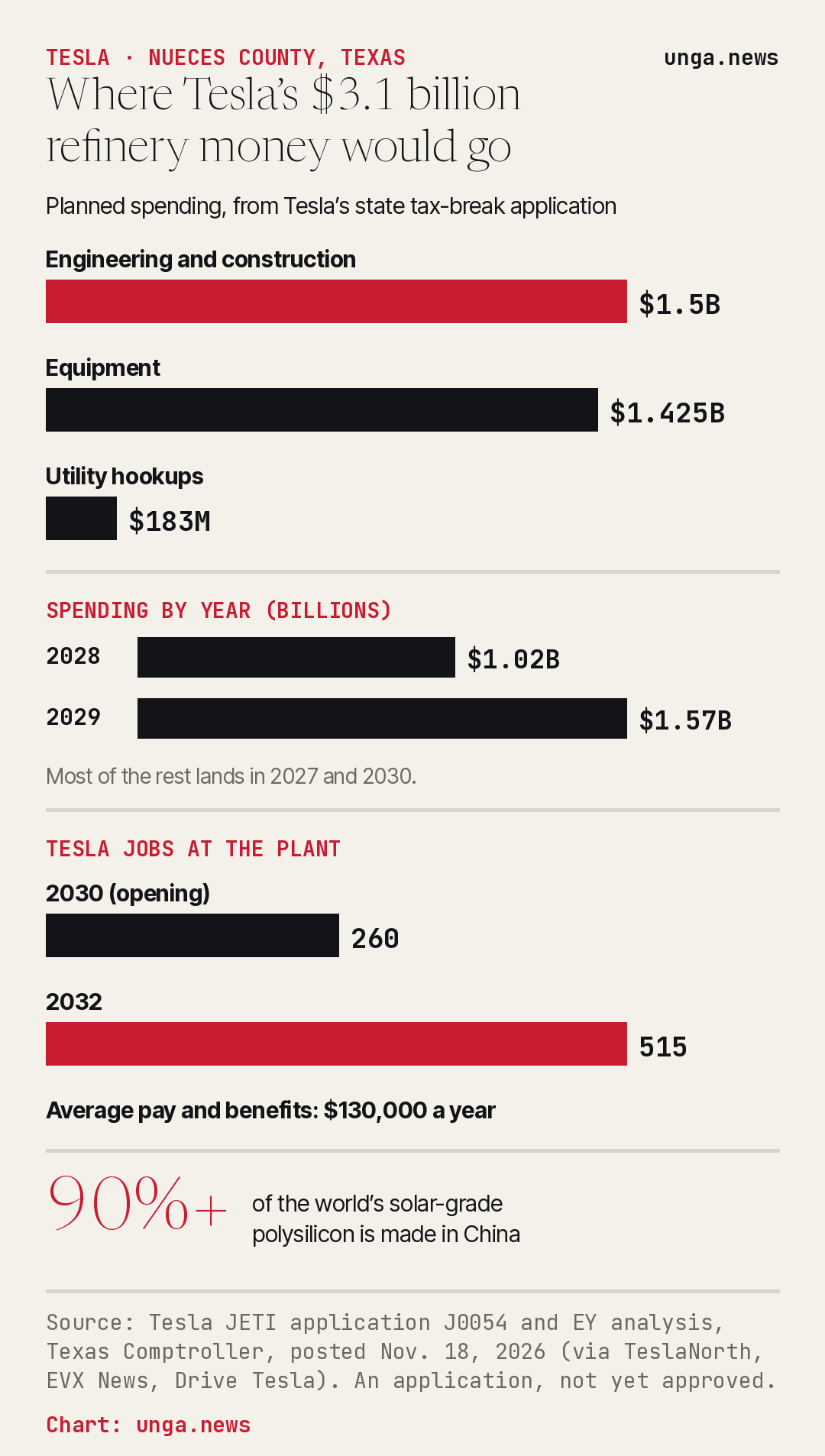
The jobs are real but not huge, which is typical for a chemical plant. Tesla would hire its first 260 refinery workers in 2030 and reach 515 by 2032, with average pay and benefits of $130,000 a year. EY estimates another 1,340 jobs at suppliers and local businesses, which are not Tesla positions. Construction would support an average of about 1,770 jobs a year across Texas from 2027 through 2030, according to Drive Tesla, with roughly 550 tied directly to the build. The analysis projects about $63.5 billion in economic activity in the state through 2065.
The deal Texas has to sign first
Nothing is approved yet. The application was filed under the Texas Jobs, Energy, Technology and Innovation Act, known as JETI, which caps the taxable value of a big new project for local school maintenance and operations taxes for 10 years. Tesla says it is still comparing the site near Robstown with other locations, and the filing states that without a JETI agreement it “would not make the proposed investment in this state.”
That kind of line is standard in these applications, and it is also leverage. States compete hard for plants like this, and Texas has been winning a lot of them. The application goes through the Tuloso-Midway school district and the Comptroller’s office before anything is final.
The pieces Tesla already has in Texas
The refinery would not be Tesla’s first heavy-industry bet in the county. The company already runs a lithium refinery in Nueces County that opened in January, turning raw ore into battery-grade material. Up the coast in Fort Bend County, site work is underway on Project Crystal Sun, the $10.1 billion factory planned to turn ingots and wafers into finished cells and panels. Polysilicon is what goes into those ingots.
Put the three together and the plan comes into focus. On Tesla’s fourth-quarter 2025 earnings call, Elon Musk said the company would work toward 100 gigawatts a year of solar cell production integrated from raw materials to finished panels. Until Wednesday, the raw-materials end of that goal had no address. Now it has a set of parcels along State Highway 44.
The hard part of making polysilicon has always been the power bill. The Siemens process eats electricity, which is one reason so much of the industry ended up in China, where power has been cheap and subsidized. Texas has some of the cheapest industrial power in the country and a grid Tesla already sells batteries into. If Musk’s team can make American silicon pay there, it gives the country something it hasn’t had in years: a solar supply chain that doesn’t start in Beijing.
Sources
- Texas Comptroller — JETI application J0054, Tuloso-Midway ISD, Tesla Inc. (posted Nov. 18, 2026)
- EVX News — Tesla Plans $3.1 Billion Polysilicon Refinery in Texas (Nov. 18, 2026)
- TeslaNorth — Tesla Eyes $3.1 Billion Texas Refinery for Its Solar Push (Nov. 18, 2026)
- Drive Tesla — Tesla wants to make its own solar-grade polysilicon at US$3.1 billion Texas plant
- San Antonio Business Journal — Tesla plans $3.1B solar material plant in Corpus Christi