

Tesla’s New Self-Driving Screen Looks Like Grand Theft Auto. Tap Anywhere and Your Car Goes There.
Tesla’s biggest self-driving update in years paints a live, game-like movie of the road from the car’s own cameras, shows you its next move, and runs on a sliver of the car’s computer.
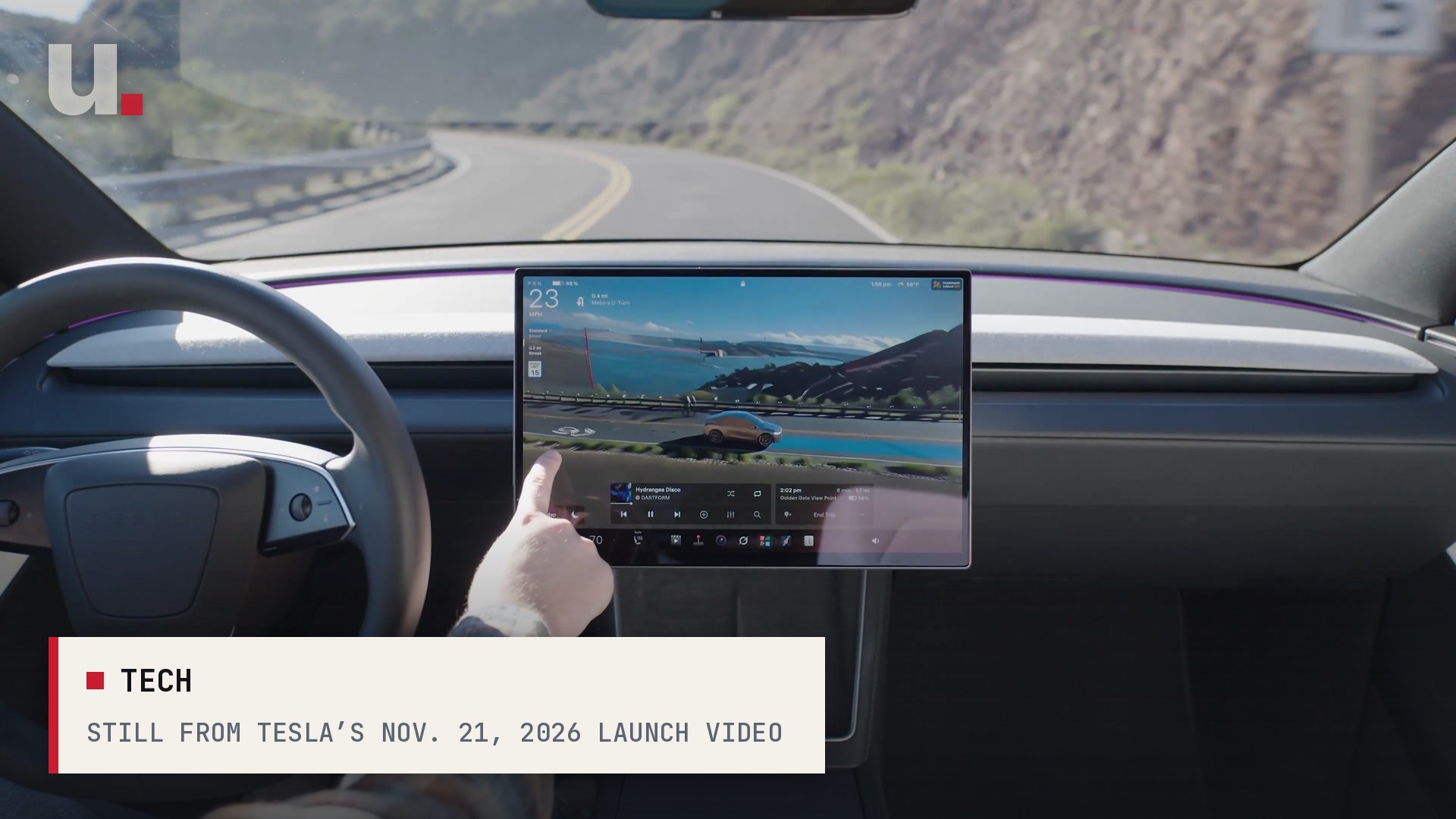
For years the screen in a self-driving Tesla showed a gray, cartoon version of the road: blocky cars, floating lane lines, a lot of empty space. As of Saturday, some owners are looking at something that resembles a video game, built live from what the car’s cameras see.
Tesla began pushing Full Self-Driving version 15 to early-access owners on Nov. 21. The company’s own announcement called it an upgrade to “every part of the end-to-end driving network,” and the release notes promise “25x better handling of safety critical cases.” The part everyone is talking about, though, is the new picture on the dash. Tesla calls it Reality View.
Elon Musk summed it up in three words on 𝕏: “It’s like GTA.” He was talking about Grand Theft Auto, the blockbuster video game series millions of Americans already know. In a second post Musk added the detail that makes this more than a pretty screen: “You can tap any point on the reality revisualizer to make your car go there.”
Tesla on 𝕏 — “FSD v15 now starting to roll out – upgrading every part of the end-to-end driving network.” The video shows Reality View on the center screen, with a driver tapping it on a coastal road. (Nov. 21, 2026)
— @Tesla View on 𝕏
The car is drawing what it sees, not dropping in game pieces
Here is why engineers are paying attention. Older Tesla screens worked like a set of toy figures. The driving system spit out a list of what it detected, a car here, a person there, a lane line, and the screen placed ready-made 3D models in those spots. If the system didn’t name something, it didn’t appear.
Reality View throws out the list. Ashok Elluswamy, who runs Tesla’s SI software, explained on 𝕏 that “the same end-to-end driving model also renders a realistic view of the world around the vehicle.” The view comes from a virtual camera hovering above and behind the car, an angle none of the real cameras can actually see, so the computer has to imagine it from the footage it does have.
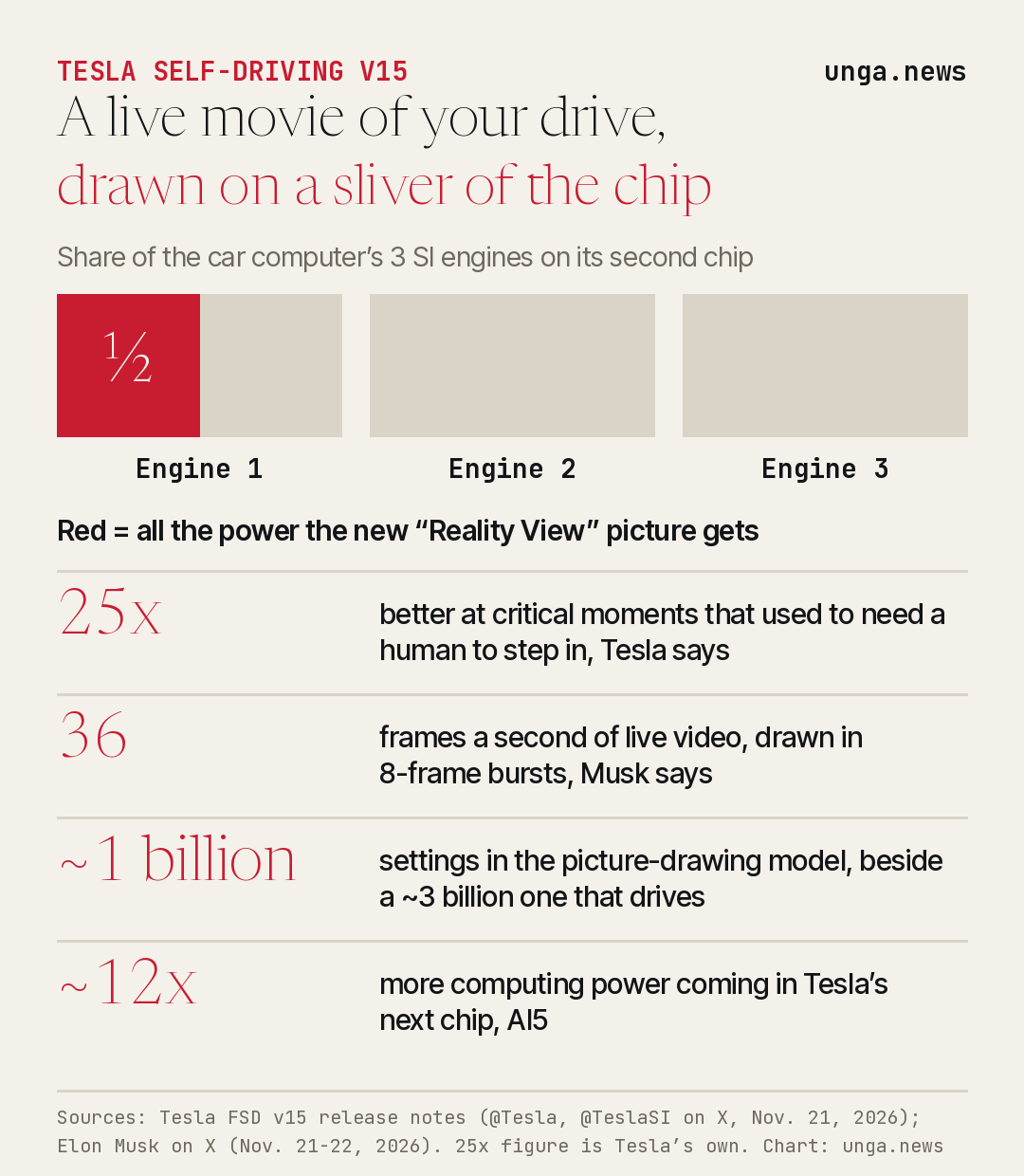
“This is real-time AI video generation (no gaming engine!) using just half of one AI4 TRIP accelerator,” Musk wrote Saturday afternoon. “Let that sink in.”
On Sunday morning he laid out how it works. Tesla’s driving brain is a roughly 3-billion-setting model that turns camera footage into steering and braking. A separate model of about 1 billion settings borrows the same camera understanding and paints the scene, producing “a small video chunk (8 images at 36 fps, at the resolution of the UI screen),” Musk wrote. Each new picture starts from the previous one and gets cleaned up, the same trick SI image generators use.
The striking part is the budget. Tesla’s current car computer, AI4, has three of these neural engines on the chip that does this job. Musk said Reality View gets only half of one of them, because Tesla had already spent the rest. “TRIP basically only handles 8-bit int and has to run softmax in emulation mode in 28 steps,” he wrote, which in plain English means it is old, narrow hardware being pushed far past what it was built for. Tesla’s release notes say the new view still uses less total computing power than the old system it replaces.
Why a prettier screen matters to the person in the driver’s seat
It would be easy to wave this off as eye candy. Tesla says it isn’t. “It’s not there just because it looks cool, but it also communicates the intent of the car,” Elluswamy wrote. The big floating arrows show which turn the car plans to make. Pins show which parking spot it intends to pull into. When you are the one supervising the car, seeing its plan before it acts is the whole game.
The old screen told you what the car noticed. The new one tells you what it is about to do, and lets you change it with a tap. Owners can still switch to a plain map, a split view, or a “quiet mode” for a calmer cabin, and turn signals now fade out after a few clicks instead of ticking the whole way through.
What else changed under the hood
Reality View grabs the attention, but most of v15 is about driving. Tesla’s full release notes, posted by the company’s SI account, list a new vision system shared across FSD, the Robotaxi service and the Optimus humanoid robot, trained on millions of internet videos. Tesla credits it with cutting the rate of critical moments that need a human to take over by 25 times. That number comes from Tesla, not an outside tester, and Tesla’s launch video goes further with a “9x safer than a human” claim. Independent crash data on v15 doesn’t exist yet because the software is days old.
The everyday fixes read like a list of owner complaints, now crossed off. The car is better at spotting road signs, small animals, debris, chains, potholes and deep standing water. It handles school zones and bad weather more smoothly and can slow for speed cameras. Navigation at the start and end of a trip now learns from what Tesla drivers actually choose, with the whole route coming in later releases. Parking picks use your own history and show several options at your destination.
Two changes will please drivers who found the old system naggy. The attention camera now works with hats and sunglasses, and it is less strict at the higher-speed driving profiles. A new Bike Rack Mode lets FSD run with a bike rack or similar hitch accessory attached. This is still FSD (Supervised), so the driver stays responsible and has to watch the road.
For now, v15 is reaching the early-access group on Tesla’s newer AI4 cars, so most owners will wait a bit. The update also follows Italy becoming the twelfth European country to clear Tesla’s supervised driving system, as unga.news reported.
Musk is already pointing to the next step. His AI5 chip, he wrote, brings “roughly 12X more compute.” If half of one old engine can turn a camera feed into a live, tappable movie of your drive, the bigger question is what Tesla builds once the car has twelve times the room. Musk’s own verdict on Saturday night: “Tesla FSD V15 is a banger release!”
Sources
- Tesla on 𝕏 — FSD v15 now starting to roll out (Nov. 21, 2026)
- Tesla Super Intelligence on 𝕏 — FSD v15 full release notes (Nov. 21, 2026)
- Ashok Elluswamy on 𝕏 — “V15 debuts the Tesla Reality View” (Nov. 21, 2026)
- Elon Musk on 𝕏 — “It’s like GTA” (Nov. 21, 2026)
- Elon Musk on 𝕏 — Tap any point to make your car go there (Nov. 21, 2026)
- Elon Musk on 𝕏 — “Real-time AI video generation (no gaming engine!)” (Nov. 21, 2026)
- Elon Musk on 𝕏 — How Reality View works (Nov. 22, 2026)
- Elon Musk on 𝕏 — Half a TRIP engine; AI5 “roughly 12X more compute” (Nov. 22, 2026)
- Elon Musk on 𝕏 — “Tesla FSD V15 is a banger release!” (Nov. 21, 2026)