

Teslas Steer Themselves in 12 European Countries. A December Vote Could Make It All 27
For the first time, the European Commission has put Tesla’s self-steering system up for a possible vote across the whole union. Germany is the swing vote, and the math is tight.
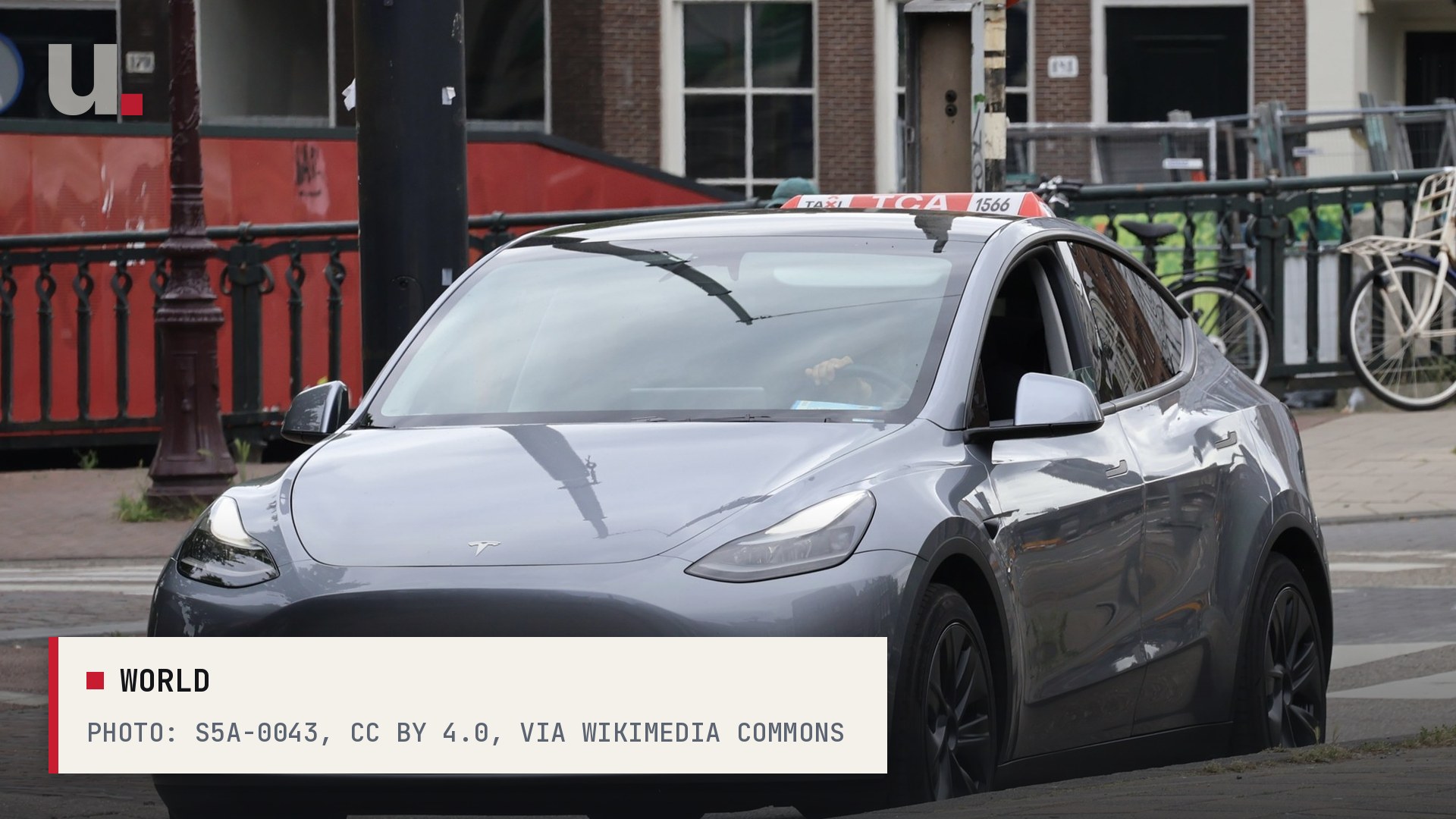
Europe’s car regulators have spent most of 2026 talking about Tesla’s self-steering software. On Dec. 15, they may finally have to vote on it.
A draft agenda from the European Commission, dated Nov. 24 and posted this week, lists “Tesla Assisted Driving” as item four at the next meeting of the EU’s motor vehicles committee, the panel of national experts that signs off on new car technology for all 27 member countries. The item comes with three words Tesla owners across the continent have been waiting months to see: “with possible vote.”
That is new. The committee took up the Dutch request in June and again in October and never put a vote on the table, according to Reuters. This is the first time the Commission has written the possibility into the agenda itself.
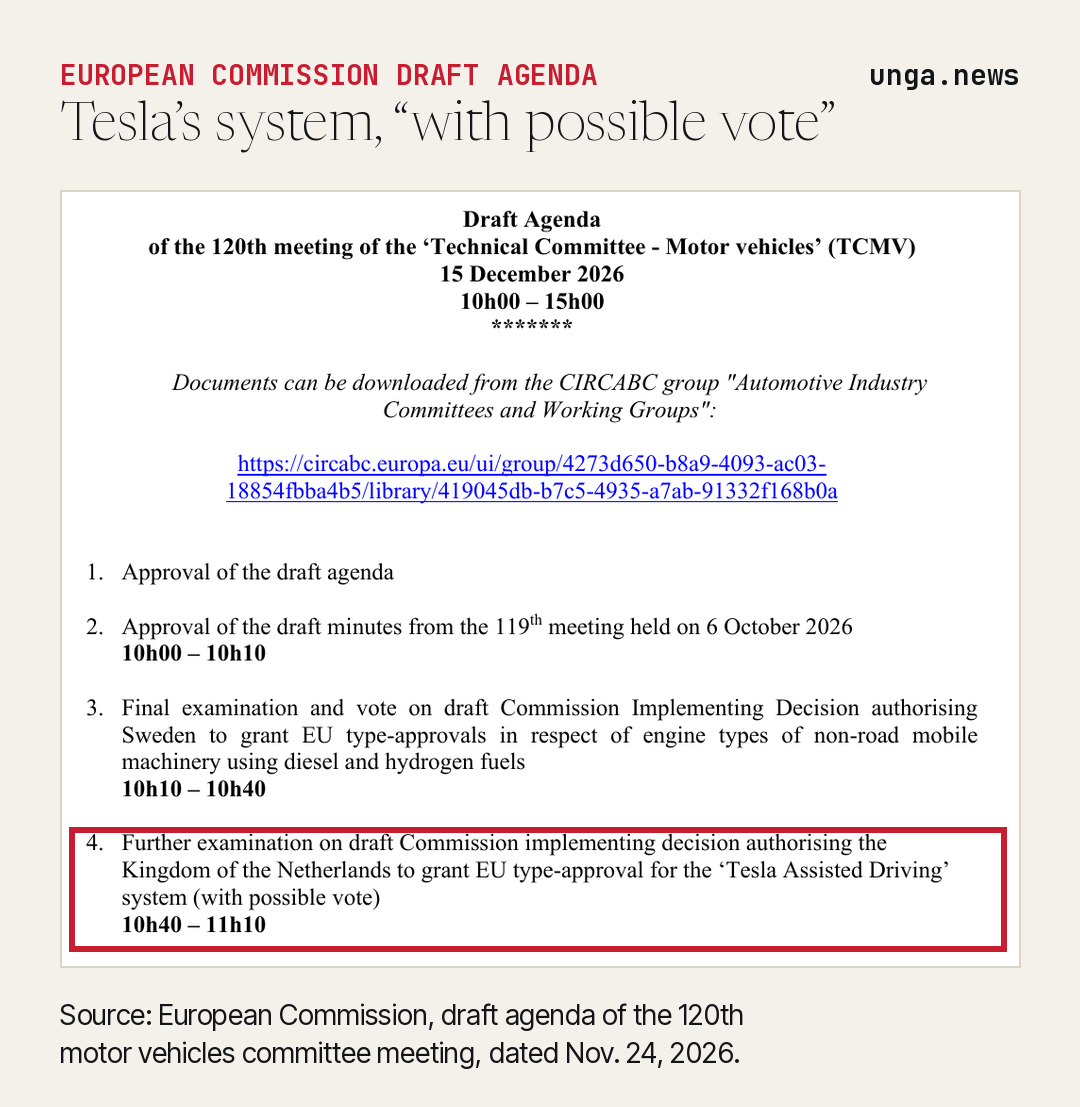
The wording changed, too. Earlier agendas called it a “continuation of discussions” on the Dutch request. This one refers to a “draft Commission implementing decision” that would let the Netherlands grant an EU-wide approval. In plain English, somebody in Brussels has written the yes down on paper. Now the countries decide whether to sign it.
A car that drives itself, with a human watching
Tesla Assisted Driving is the European name for the software Americans know as Full Self-Driving (Supervised). It is the company’s SI driving brain, a neural network trained on video from millions of Teslas, and it can steer, speed up, brake, take turns and handle roundabouts on the route the driver picks. The driver has to keep watching the road and stays legally responsible. Regulators call it “hands-off, eyes-on.”
The Dutch vehicle authority, the RDW, granted the first European approval on April 10 after more than 18 months of testing. It also requires Tesla to report safety-critical incidents. Under EU rules, other countries can honor that Dutch approval on their own roads while the bloc decides, and 11 have: Lithuania, Estonia, Denmark, Belgium, Slovenia, Czechia, Croatia, Slovakia, Latvia, Finland and, on Nov. 20, Italy. We covered Italy’s yes last week. It was the first of the union’s big four to sign on, and Tesla is charging Italian drivers €99 a month for it.
Add it up and about 130 million people, or 28.7% of the EU, now live in a country where a Tesla can steer itself. That sounds like a lot until you see the bar it has to clear.
Germany holds the keys
An EU-wide approval in this committee needs a qualified majority. That means at least 15 of the 27 countries, and those countries must together hold at least 65% of the bloc’s roughly 452 million residents, based on the population figures the Council of the EU uses for 2026.
Tesla’s 12 countries are three short on the count and far short on people. Most of them are small. Italy alone is 13.2% of the union. The other 11 together are about 15.5%.
So the math runs through the big holdouts. Germany is 18.5% of the EU, France 15.2%, Spain 10.9% and Poland 8.3%. Run the numbers and only four combinations of three more countries get Tesla over 65%, and Germany is in every one of them. The cleanest path is Germany, France and Poland, which would make exactly 15 countries and 70.7% of the population.
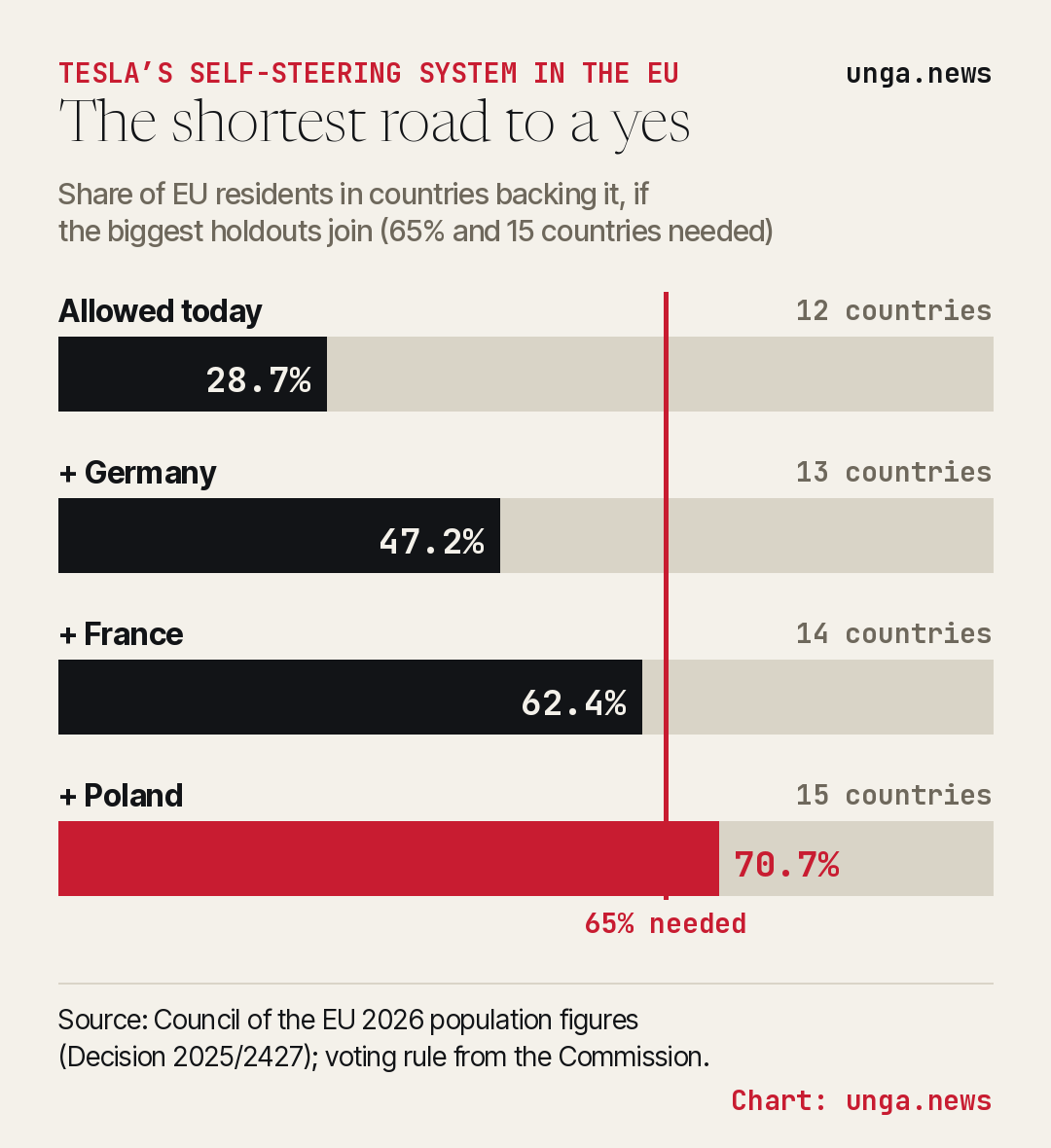
Without Germany, Tesla would need France, Spain, Poland and at least one more country, and it would need almost nobody to vote against. On the other side, blocking it takes at least four countries holding more than 35% of the population, and abstaining counts the same as a no.
Berlin has been sending friendly signals. Germany’s transport ministry said on Oct. 6 that the “FSD” name was “etwas irreführend,” or somewhat misleading, and that Tesla had offered to rename it. Tesla did, within days. The ministry also said Tesla agreed to cap how far the system can drive over the speed limit at 10%, and that Transport Minister Steffen Bilger would push for a timely EU-wide approval. The RDW signed off on those changes on Nov. 3.
That matters because the speed margin was the sticking point. Reuters reported in September that several countries, including Sweden, had raised concerns about the system exceeding speed limits. Tesla fixed it. France said no in July to the system as it stood then. It has not said how it will vote now.
Brussels can’t stall forever
Tesla had hoped for a vote by summer, then by October. Each time, the committee talked and went home. The Commission said the timeline would depend on member states being satisfied with Tesla’s answers. The December meeting itself slid from Dec. 1 to Dec. 15, a Commission spokesperson told Reuters, and no public reason was given.
This is how Europe so often treats new technology. Americans have used this software for years. A Dutch regulator spent a year and a half testing it, approved it and wrote safety conditions into the approval. A dozen governments looked at that work and agreed. And the whole continent still waits on a committee in Brussels.
The stakes cut both ways. A yes would open the system to every EU country at once, from Berlin to Lisbon, with no more one-by-one approvals. But Reuters notes that a rejection at the EU level would wipe out the national approvals already granted. The 12 countries that said yes are counting on the other 15 not to overrule them.
Tesla says its cars have driven more than 200 million kilometers on European roads with the system, and that the crash risk per kilometer is up to seven times lower than manual driving. That is the company’s own math and hasn’t been independently checked. It is also the kind of record a regulator can actually test, which is more than can be said for another year of “discussion.”
The agenda is still a draft, and “possible vote” is not a promise. The committee can talk again and push it to 2027. But for the first time, the paperwork for a yes exists, Germany has gotten most of what it asked for, and Italy has shown the big countries that saying yes doesn’t end the world. If Germany votes with Rome, the rest of the math starts to fall into place.
Sources
- European Commission — Draft agenda, 120th meeting of the Technical Committee – Motor Vehicles, Dec. 15, 2026 (dated Nov. 24, 2026)
- Reuters — EU may vote on authorising Tesla assisted-driving system at Dec 15 meeting (Nov. 26, 2026)
- Reuters via CNBC — EU postpones discussion to approve Tesla’s self-driving tech (Nov. 25, 2026)
- Council of the EU — Voting calculator and 2026 population figures
- The Next Web — EU delays Tesla self-driving meeting to 15 December (Nov. 25, 2026)
- Not an FSD Tracker — Tesla FSD (Supervised) faces a possible EU vote on 15 December (Nov. 26, 2026)
- unga.news — Elon Musk Wins Over Italy: Teslas There Will Soon Steer Themselves Through City Traffic