

Texas Democrats Want to Mail Every Household $1,500 From the State’s Emergency Savings
The bill behind Gina Hinojosa’s big campaign promise would take $17 billion of a roughly $27 billion rainy day fund, with no income limit, no tax return required and nothing about legal status.
Texas Democrats have put a price tag on their new governor’s biggest campaign promise, and it is a big one. State Sen. Roland Gutierrez of San Antonio filed a bill on Nov. 9 that would send a one-time $1,500 payment to every household in Texas, rich or poor, and pay for it by pulling up to $17 billion out of the state’s emergency savings account.
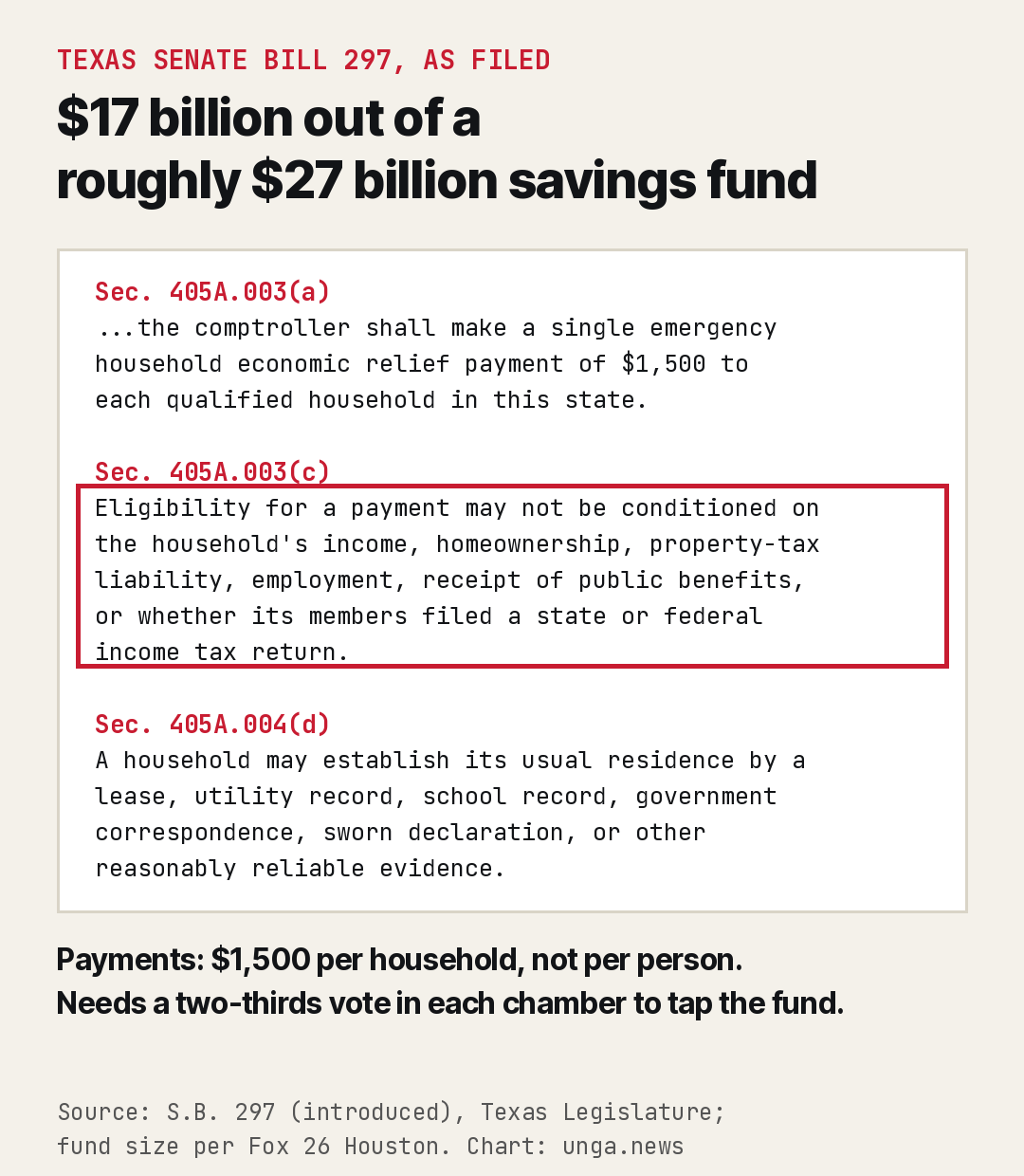
That account, the Economic Stabilization Fund, is what everybody in Austin calls the Rainy Day Fund. It holds roughly $27 billion right now, according to Fox 26 Houston. Gutierrez’s bill would take close to two-thirds of it in one shot.
The bill is Senate Bill 297, and it is meant to deliver on the checks Gov.-elect Gina Hinojosa talked up again and again on the campaign trail before she beat Greg Abbott last week. It landed on the first day of bill filing for the 2027 session, in a pile of more than 1,200 bills.
A check for everybody, no questions about income
Read the actual bill and the first thing that jumps out is how wide the net is. A “qualified household” is any home in Texas where somebody 18 or older lived on Jan. 1, 2027, and that passes whatever verification rules the state comptroller writes. One person living alone counts. Roommates who aren’t related count as one household.
Then comes the line that will start the biggest fights. The bill says eligibility “may not be conditioned on the household’s income, homeownership, property-tax liability, employment, receipt of public benefits, or whether its members filed a state or federal income tax return.”
In plain English: a millionaire in River Oaks gets the same $1,500 as a family stretching every paycheck in Laredo. You don’t need a job. You don’t need to own a house. You don’t even need to have filed a tax return. The comptroller is also barred from writing any rule that adds an income limit or trims the amount.
There is also nothing in the bill text about citizenship or legal status. The test is where you live, not whether you are here legally. In a state that borders Mexico for 1,254 miles, that is going to get asked about fast, and Gutierrez will need a better answer than silence. Texans who watched the border crisis up close are not going to love the idea of a state check landing in the mailbox of an illegal alien.
A sworn statement can prove you live here
How do you show the state your home counts? The bill lists a lease, a utility bill, a school record or government mail. It also accepts a “sworn declaration” or “other reasonably reliable evidence.”
The state is told it may use its own records to find households, but it “may not deny a household a payment solely because the household is not identified in an existing government database.” The comptroller has to offer applications by mail and in person, and write special rules for the homeless and people living in group housing.
The bill does tell the comptroller to take “reasonable steps” to stop duplicate and fraudulent payments, but only “without imposing an unreasonable burden on eligible households.” Anyone who remembers how pandemic unemployment money got looted in state after state knows how that tug-of-war tends to end. Easy to apply usually means easy to cheat.
Payments could go out by direct deposit, check or another method the recipient picks. The goal is to pay verified households by the end of 2027, with applications open through 2028. No more than 1% of the money, up to $170 million, could go to running the program.
The math is tight even on paper
Here is a number worth sitting with. After the 1% for administration, $17 billion pays for about 11.2 million checks. The bill itself admits the money may not stretch. If the comptroller figures there isn’t enough to pay every qualified household the full $1,500, the law would require a report of the shortfall to the governor, lieutenant governor, House speaker and the Legislative Budget Board. It would not allow spending a dime more.
So the state would be draining most of its emergency savings for a single round of payments, and the bill writes in a plan for what to do if that still isn’t enough.
The Rainy Day Fund exists for real emergencies: hurricanes, a crash in oil prices, a hole in the budget. To get around the Texas Constitution’s ban on handing public money to individuals, the bill declares that high prices for housing, electricity, food, transportation and insurance amount to a “public calamity.” That is the legal hook. Critics already argue the checks could push prices up even further, Fox 26 reported, the exact problem they are supposed to fix.
Hinojosa still has to get it past a Republican Senate
Winning the governor’s mansion did not hand Democrats the Legislature. Republicans still hold the state Senate, and pulling money from the Rainy Day Fund takes a two-thirds vote of the members present in each chamber. For the law to take effect right away it needs two-thirds of all elected members in both houses. Fall short of that and, even if it passes, it would not kick in until Sept. 1, 2027.
That is a steep climb for a $17 billion bill written by a Democrat who spent the fall blaming Trump and Texas Republicans for what he called “a world of economic pain.” Gutierrez is not exactly building bridges with the people whose votes he now needs.
Republicans who control the state Senate will have their own ideas about relief. Over the last few sessions, GOP lawmakers put billions into cutting property taxes without emptying the emergency fund. Expect that to be the counteroffer.
For now, nobody is getting a check. KHOU and Fox 26 both stressed that SB 297 is only a proposal, with no approved payment and no application to fill out. If someone texts you a link promising your $1,500 Texas refund, it is a scam.
Hinojosa made a promise that sounded simple on a yard sign. The bill shows what it really looks like: most of the state’s emergency cushion, gone in one payout, with no income limit, no tax return required and no question about who is in the country legally. The Senate gets to decide whether Texas wants to pay for that.
Sources
- Texas Legislature — S.B. 297, introduced version
- Fox 26 Houston — Texas $1,500 relief checks: Lawmaker files bill to send one-time payment to every household
- KHOU — Texas bill proposes $1,500 payments. Here’s who would qualify and how it would work
- USA Today — Texas $1,500 refund checks: What Senate Bill 297 means for Texans
- Senator Roland Gutierrez on 𝕏 — “A world of economic pain,” Nov. 1, 2026