

Texas Locked Its Border Razor Wire in Place for 30 Years. The Next Governor Can’t Pull It Alone.
Before leaving office, Ken Paxton and Greg Abbott got Trump’s Homeland Security team to promise in a federal settlement not to cut the state’s wire near Eagle Pass, and the deal binds the Democrat taking over in January.
For two years, the image that defined the Texas border fight was a Border Patrol agent with bolt cutters, slicing through razor wire the state had strung along the Rio Grande. That picture is now off the table for a generation, at least in the stretch of river where the fight got hottest.
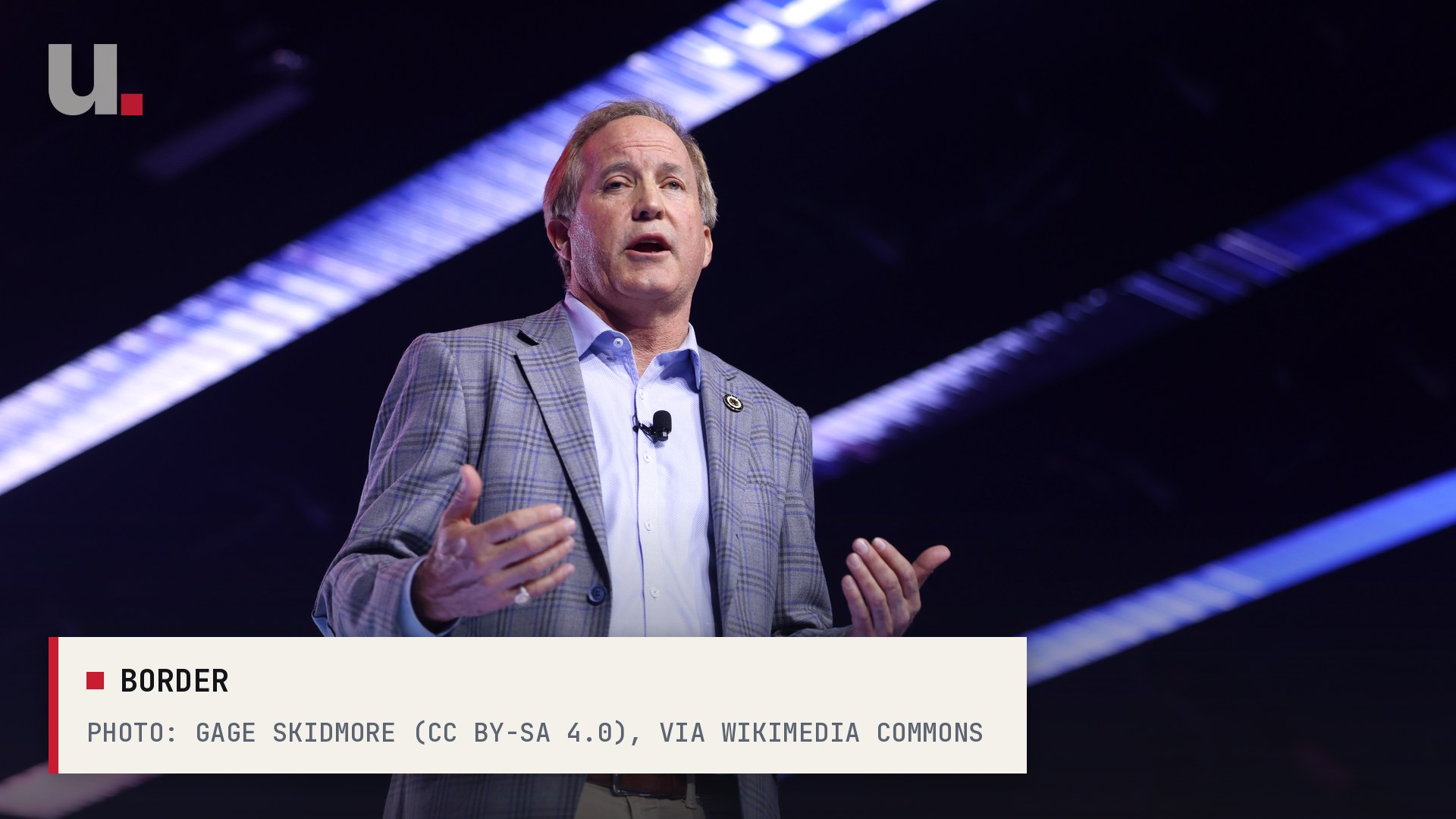
Attorney General Ken Paxton and Gov. Greg Abbott have signed a settlement with the Department of Homeland Security that keeps Texas’s concertina wire in the Border Patrol’s Del Rio Sector in place for 30 years. Federal agents and contractors “will not willfully cut, damage, destroy, remove, or otherwise interfere with” wire owned or placed by Texas on land the federal government doesn’t own, according to the settlement released by Paxton’s office. Lawyers for the state and the governor signed on Nov. 18, and Associate Attorney General Stanley Woodward Jr. signed for the Justice Department.
The timing is the whole story. Abbott lost his reelection bid to Democrat Gina Hinojosa this month, and Paxton lost his Senate race to James Talarico. Both men leave office in January. Before they go, they wrote a border policy into a federal court agreement that the next governor can’t simply sign away.
“Through coordination between federal and state authorities, this settlement ensures that concertina wire will remain in place to protect our southern border,” Paxton said in his Nov. 19 announcement. “We must never stop fighting to protect our nation from those who seek to destroy it.”
Attorney General Ken Paxton on 𝕏, Nov. 19, 2026 — “BREAKING: I secured a settlement to protect Texas’s border with concertina wire for up to 30 years.”
— @KenPaxtonTX View on 𝕏
A fight that started under Biden
Texas sued in October 2023, after agents under the Biden administration cut through wire the state had laid down during record illegal crossings. A federal judge in Del Rio quickly ordered the cutting stopped and later found the government’s actions likely unlawful, but she declined to keep that order in place while the case went on. The Fifth Circuit stepped in for Texas. Then, in January 2024, the Supreme Court split 5–4 and lifted that injunction, freeing agents to start cutting again. That came days after Texas took over Shelby Park in Eagle Pass and ringed it with wire and Guard troops.
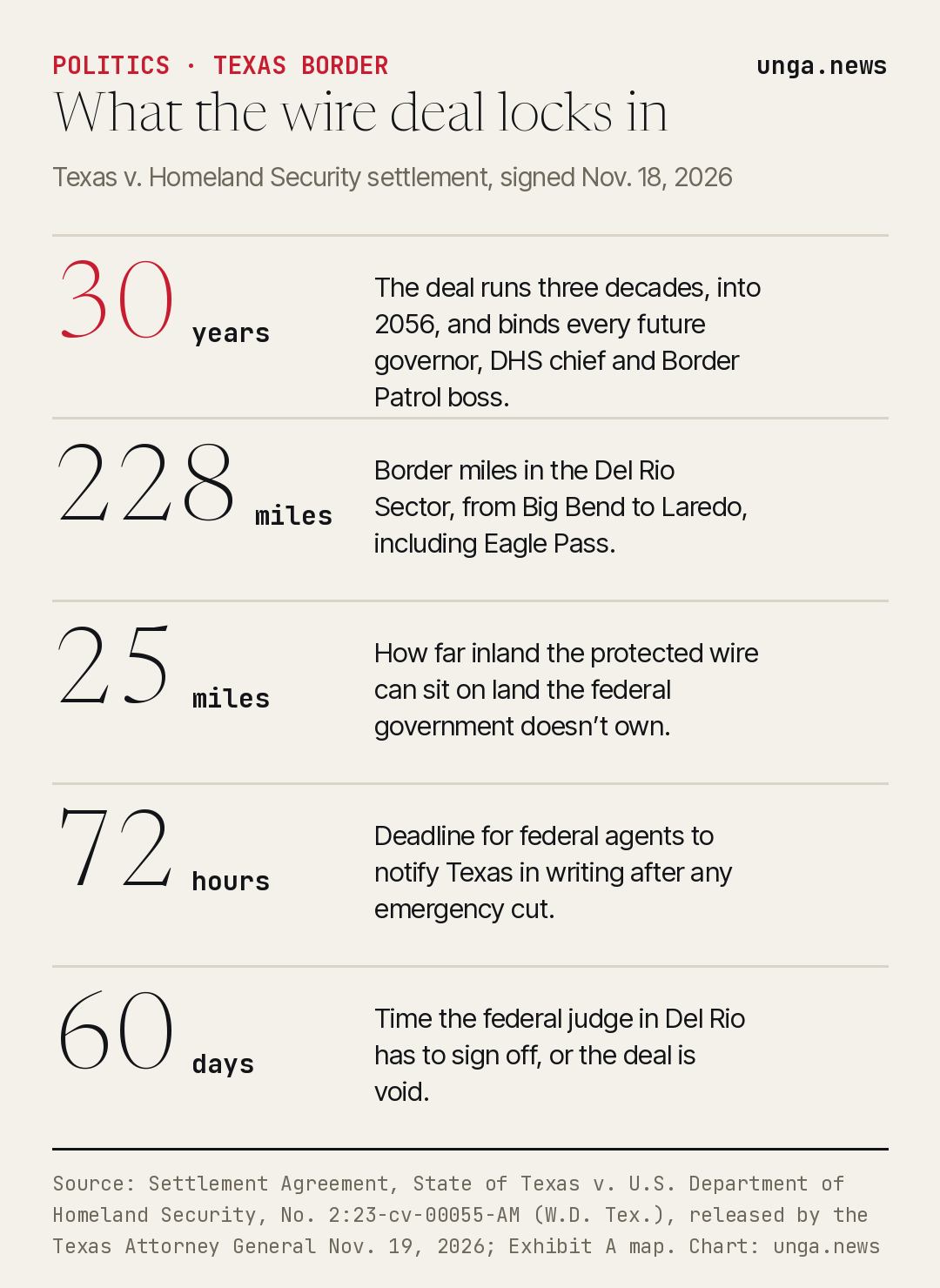
Eagle Pass sits inside the Del Rio Sector, and so does the international bridge where thousands of migrants camped in 2021. The federal map attached to the settlement shows 228 miles of border in the sector, running between the Big Bend and Laredo sectors. In other words, the deal covers the ground where the Biden years were hardest on Texas.
Under President Trump, the federal side is no longer fighting the wire. DHS Secretary Markwayne Mullin, Customs and Border Protection Commissioner Rodney Scott and Border Patrol leadership are all named in the deal, and Paxton’s office announced it as worked out “in cooperation with” Abbott, Mullin and Scott. After years of Washington treating Texas as the problem, the federal government is now promising in writing to leave the state’s barrier alone.
The clause that reaches the next governor
Most settlements end when the people who signed them leave. This one is written so it doesn’t. Citing Federal Rule of Civil Procedure 25(d), the agreement says “all successors to the named Defendants and Plaintiffs in their official capacity are legally bound as if they were named in the Agreement.” Abbott is a named plaintiff in his official capacity. Whoever holds his office next inherits his side of the deal.
That matters because the deal cuts both ways. Texas promises it “will not undertake or authorize any Restricted Acts without the prior written consent of DHS,” the same cutting and removing that federal agents swore off, outside of emergency aid or a real threat to officers or the public. A future governor who wants the wire gone in the Del Rio Sector needs Washington’s written permission. The agreement can be changed only in writing “signed by the Parties.”
Hinojosa hasn’t said how she’ll handle the wire. She told the Texas Tribune she called Trump to make sure “he had a direct line to me,” and said, “He understands my commitment to keeping a secure border.” She also said Texans near Big Bend would rather have electronic monitoring than a wall. But in the same interview she said, “What ICE is doing is making us less safe,” and signaled she could undo Abbott’s order telling state agencies to help federal immigration officers. Her office did not answer the Tribune’s request for comment on the wire deal.
Republicans in Texas aren’t waiting to find out. Rep. Keith Self posted on Nov. 20 that “Texas has a new governor who will open the border,” and called on Congress to write Trump’s border executive orders into law. The wire settlement is the state-level version of that same instinct: lock in what works before the people who built it are gone.
Where federal agents can still cut
The deal isn’t a blank check for the state, and it doesn’t tie Border Patrol’s hands. Agents can still cut or move wire when it is “objectively necessary” to give emergency aid, to “apprehend and process an alien under federal immigration law,” to answer serious and immediate threats to officers or the public, or to fix flood-damaged federal border infrastructure. When they do, they must notify Texas in writing within 72 hours and patch the barrier where they can. Routine work and new wall construction require coordinating with the state first.
Nothing in the deal limits Border Patrol’s power under federal law to enter private land, though not homes, within 25 miles of the border to patrol for illegal entry. Neither side admits fault, and any fight over enforcement has to go back to the federal court in Del Rio, where a judge can order the terms carried out.
There is one hurdle left. Within five business days, the two sides are to ask the federal court in Del Rio to dismiss Texas’s lawsuit for good while keeping the power to enforce the deal. If the court doesn’t enter that order within 60 days, the settlement “shall be terminated and of no further legal effect.” If the judge signs, the wire Abbott strung in the Del Rio Sector stays put into 2056, no matter who sits in the governor’s mansion.
Sources
- Office of the Texas Attorney General — Attorney General Ken Paxton Secures Settlement to Protect Texas’s Border with Concertina Wire for Up to 30 Years (Nov. 19, 2026)
- Office of the Texas Attorney General — Settlement Agreement, State of Texas v. U.S. Department of Homeland Security, No. 2:23-cv-00055-AM (W.D. Tex.) (PDF)
- The Texas Tribune — Paxton, feds OK 30-year pact to keep razor wire at Texas border (Nov. 19, 2026)
- The Texas Tribune — Q&A: Texas Gov.-elect Gina Hinojosa on Trump, border, vouchers (Nov. 18, 2026)
- Rep. Keith Self on 𝕏 — “Texas has a new governor who will open the border…” (Nov. 20, 2026)
- Attorney General Ken Paxton on 𝕏 — “BREAKING: I secured a settlement to protect Texas’s border with concertina wire for up to 30 years.” (Nov. 19, 2026)