

Texas Processed 2.9 Million New Registrations. Nobody Had to Prove They Were Citizens.
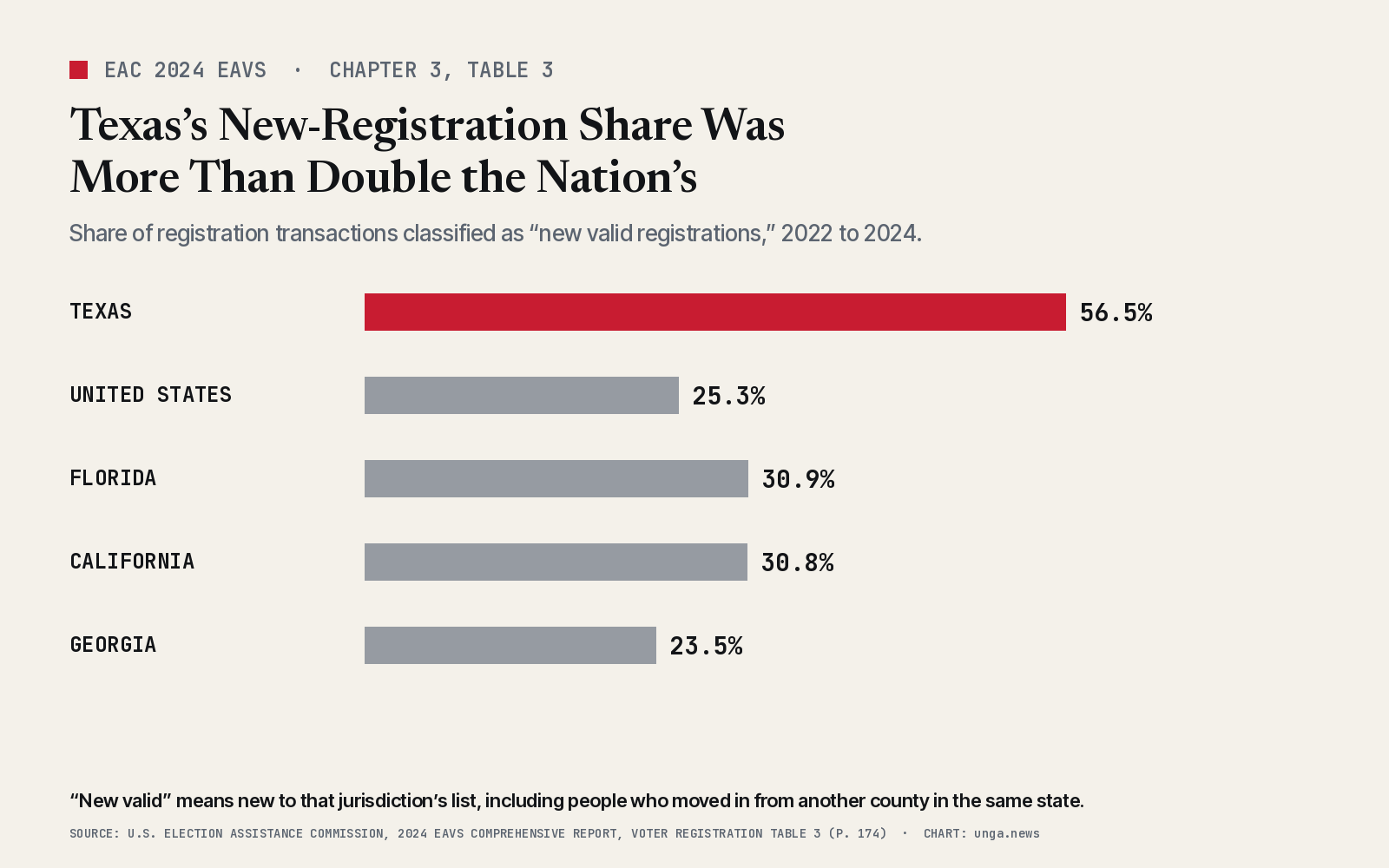
The Election Assistance Commission’s 2024 survey counted 2,900,357 new valid registrations in Texas between the 2022 and 2024 registration deadlines, 56.5% of the state’s transactions and more than double the national share. Texas law asks applicants to swear they are citizens. It does not ask them to show a birth certificate, a passport or naturalization papers.
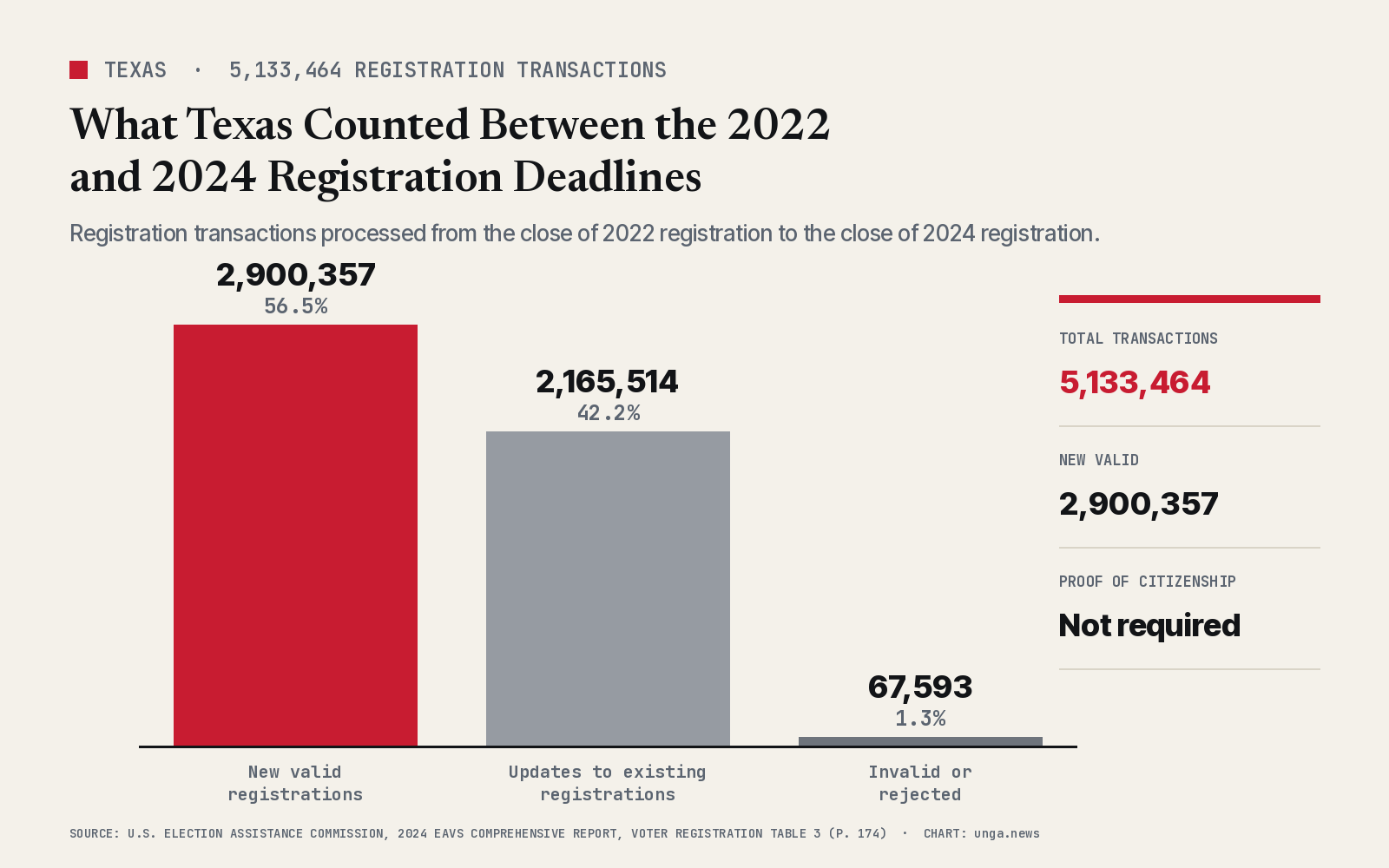
A federal report most people will never open counted 2,900,357 “new valid” voter registrations in Texas between the close of registration for the 2022 general election and the close of registration for the 2024 general election. Those new registrations were 56.5% of the 5,133,464 registration transactions Texas reported. Nationwide, the same category was 25.3% of 103,512,313 transactions.
The figures are in Table 3 of Chapter 3 of the U.S. Election Assistance Commission’s 2024 Election Administration and Voting Survey Comprehensive Report, on printed page 174. They spread on 𝕏 this week after Wall Street Apes posted the table. The source is the commission’s report, not the post.
Texas does not ask for a birth certificate, a passport or naturalization papers when someone registers to vote. Under Texas Election Code § 13.002(c)(3), the application must include “a statement that the applicant is a United States citizen.” The applicant signs it. Gov. Greg Abbott’s office says Senate Bill 1, which he signed in 2021, elevated lying while registering to vote to a state jail felony. Documentary proof is not part of the form.
That is the part that should worry anyone who wants a clean roll. The system can tell you how many new records went onto county lists. It cannot tell you how many of those people proved they were citizens, because nobody had to.
What “new valid” actually means
The EAC’s own report defines new valid registrations as “registration transactions received from eligible people in a jurisdiction where they were not previously registered and that resulted in a new registration record being added to the voter list.” Nationally, that category made up 25.3% of the transactions states reported.
The survey instructions go further. If a voter who was already registered in another jurisdiction in the same state moves in, the new county counts that person as a new valid registration. Texas reported data from 254 counties, each as its own jurisdiction. A move from Harris County to Fort Bend County is “new” in Fort Bend.
So the 2.9 million includes people who moved from one Texas county to another, people who turned 18 and people who moved in from other states. It is not a count of noncitizens, and it is not, by itself, 2.9 million extra names added to one statewide list. In the same two-year window, Texas also reported removing 1,798,955 people from the rolls.
Officials have not published a breakdown of those 2.9 million registrations into county-to-county movers, new 18-year-olds and arrivals from other states. They have not explained why Texas’s new-registration share is more than double the national rate, and well above other large states such as Florida (30.9%) and California (30.8%). The EAC’s Texas data brief shows 70.1% of the state’s transactions came through motor vehicle offices, and that Texas has no automatic voter registration.
A signed statement is not the same thing as a passport. The people who want to keep it that way have not explained who benefits from leaving proof off the form.
Texas checks some names after they are already on the list
Texas does run after-the-fact checks. They are not a substitute for asking for papers at the door.
On Aug. 26, 2024, Abbott announced that since Senate Bill 1 became law in 2021, Texas had removed more than a million people from the rolls, a list that included “over 6,500” described as noncitizens. The same release called them “potential noncitizens” in the next paragraph and said about 1,930 of them had a voting history and were being sent to the attorney general for investigation.
On Oct. 20, 2025, Secretary of State Jane Nelson said her office had run the entire Texas voter list — more than 18 million names — through the federal Systematic Alien Verification for Entitlements database, known as SAVE. The match flagged 2,724 “potential noncitizens.” Counties were told to investigate them under Chapter 16 of the Election Code. A voter who gets that notice has 30 days to show proof of citizenship or the registration is cancelled; it can be reinstated by showing proof. Nelson also said an earlier review, focused on people who may have voted in the November 2024 election, led to 33 referrals to the attorney general in June.
“Only eligible United States citizens may participate in our elections,” Nelson said. “The Trump Administration’s decision to give states free and direct access to this data set for the first time has been a game changer.”
On Sept. 15, 2026, Secretary of State Robert Howden said a later manual review with the Department of Public Safety narrowed that list. Five hundred seventy-eight of the 2,724 flagged voters “demonstrated citizenship.” Of those, 506 were cleared because passport information was added to SAVE after the state’s first run. Howden’s office told counties to reinstate those people if they had already been removed. The same day, the office referred 117 cases to the attorney general for investigation of potential noncitizen voting.
That sequence shows two things at once. After-the-fact matching can flag people, and the underlying data can be wrong — hundreds of the flagged names were later shown to be citizens. It also shows what the SAVE sweep does not do. It looks for people who already appear in federal immigration records as noncitizens. Not being flagged is not the same as having proved citizenship with a birth certificate or a passport. Officials have not said how many of the 2.9 million new registrations from 2022 to 2024 were individually verified as citizens, or how many of the 2,724 flagged names came from that group.
The federal bill that would change the form
Rep. Chip Roy, a Texas Republican, wrote the Safeguard American Voter Eligibility Act to require documentary proof of U.S. citizenship to register for federal elections. The House passed that bill, H.R. 22, on April 10, 2025, by a vote of 220 to 208.
On Feb. 11, 2026, the House passed S. 1383, 218 to 213, after attaching the SAVE America Act, a later version that would also require specified photo identification to vote. A Congressional Research Service brief dated Feb. 24, 2026, says the House-passed legislation would require documented proof of citizenship at registration — a REAL ID that indicates U.S. citizenship, a valid U.S. passport, or other listed documents — and would direct states to use the SAVE system to help keep noncitizens off the rolls for federal elections.
That federal change matters because current federal law is built around an attestation. The National Voter Registration Act requires a statement of eligibility and a signature under penalty of perjury. The Supreme Court held in Arizona v. Inter Tribal Council of Arizona that the NVRA’s federal mail registration form preempts a state from demanding extra documentary proof of citizenship for federal elections. A state bill can run into that wall. A change to the NVRA would not.
Neither House-passed bill has become law. The Senate has not sent the SAVE Act to the president. As of Nov. 5, 2026, two days after the midterm election, Congress had not taken a new vote on it.
Texas tried to require the papers. The bill never got a House vote.
In Austin, Sen. Bryan Hughes filed Senate Bill 16 in the 2025 regular session. The caption was blunt: it related to “requiring a person to submit proof of citizenship to register to vote.” The bill would have amended Election Code § 13.002 so that an applicant had to submit a copy of a U.S. passport or passport card, a certified U.S. birth certificate, U.S. citizenship papers, identification issued by the federal citizenship agency, or, for citizens born abroad, a State Department birth report. Its House companion was Rep. Carrie Isaac’s House Bill 5337.
The Senate passed SB 16 on April 1, 2025. The House Elections Committee reported it favorably. On May 25, 2025, the committee report was sent to the Calendars Committee. It never received a House floor vote, and it did not become law.
Lawmakers separately put Proposition 16, from Senate Joint Resolution 37, on the Nov. 4, 2025, ballot. The secretary of state’s official explanatory statement said the amendment would “provide that only United States citizens are allowed to vote in Texas elections,” with ballot language “clarifying that a voter must be a United States citizen.” It did not require anyone to show citizenship papers to register.
No new Texas proof-of-citizenship registration bill has become law since SB 16 died, and the Legislature’s next regular session begins in January 2027.
What to watch: whether the Congress that already passed the SAVE Act twice tries to send it to President Trump’s desk before January, and whether Texas lawmakers file another proof-of-citizenship bill when the 90th Legislature convenes.
Sources
- U.S. Election Assistance Commission — 2024 Election Administration and Voting Survey Comprehensive Report (Chapter 3, Table 3, p. 174; definition pp. 145–146)
- U.S. Election Assistance Commission — 2024 EAVS Data Brief: Texas
- U.S. Election Assistance Commission — 2024 EAVS questionnaire, items A3b and A3e (definition of new valid registrations)
- Texas Election Code — § 13.002, Application Required
- Texas Secretary of State — Request for Voter Registration Applications (citizenship eligibility)
- Office of the Texas Governor — Governor Abbott Announces Over 1 Million Ineligible Voters Removed From Voter Rolls (Aug. 26, 2024)
- Texas Secretary of State — Texas Completes Citizenship Verifications in the SAVE Database (Oct. 20, 2025)
- Texas Secretary of State — Texas Secretary of State Refers 117 Cases for Investigation of Noncitizen Voting (Sept. 15, 2026)
- Office of the Clerk, U.S. House — Roll Call 102, 119th Congress: H.R. 22, SAVE Act, April 10, 2025 (220–208)
- Office of the Clerk, U.S. House — Roll Call 69, 119th Congress: S. 1383, Feb. 11, 2026 (218–213)
- Congressional Research Service — Safeguard American Voter Eligibility Act (SAVE America Act) and Federal Voter Registration Policy and Law (updated Feb. 24, 2026)
- Texas Legislature Online — 89(R) SB 16 history (Hughes; companion HB 5337 by Isaac)
- Texas Legislature Online — 89(R) SB 16, engrossed text
- Texas Secretary of State — Explanatory Statements for the November 4, 2025 Constitutional Amendment Election (Proposition 16 / SJR 37)
- Wall Street Apes on 𝕏 — Post sharing the EAC table on Texas’s 2,900,357 new valid registrations (Nov. 5, 2026)