

Texas Sues Houston's Election Office for Aiming Vote Ads by Race. That Night, It Pulled the Targeting
The state's petition lists 46 Meta targeting tags on Harris County's taxpayer-funded vote ads, from 'Hispanic Kitchen' to Nepal, and not one said Houston. The clerk calls the ads lawful but switched the targeting off hours after the suit.
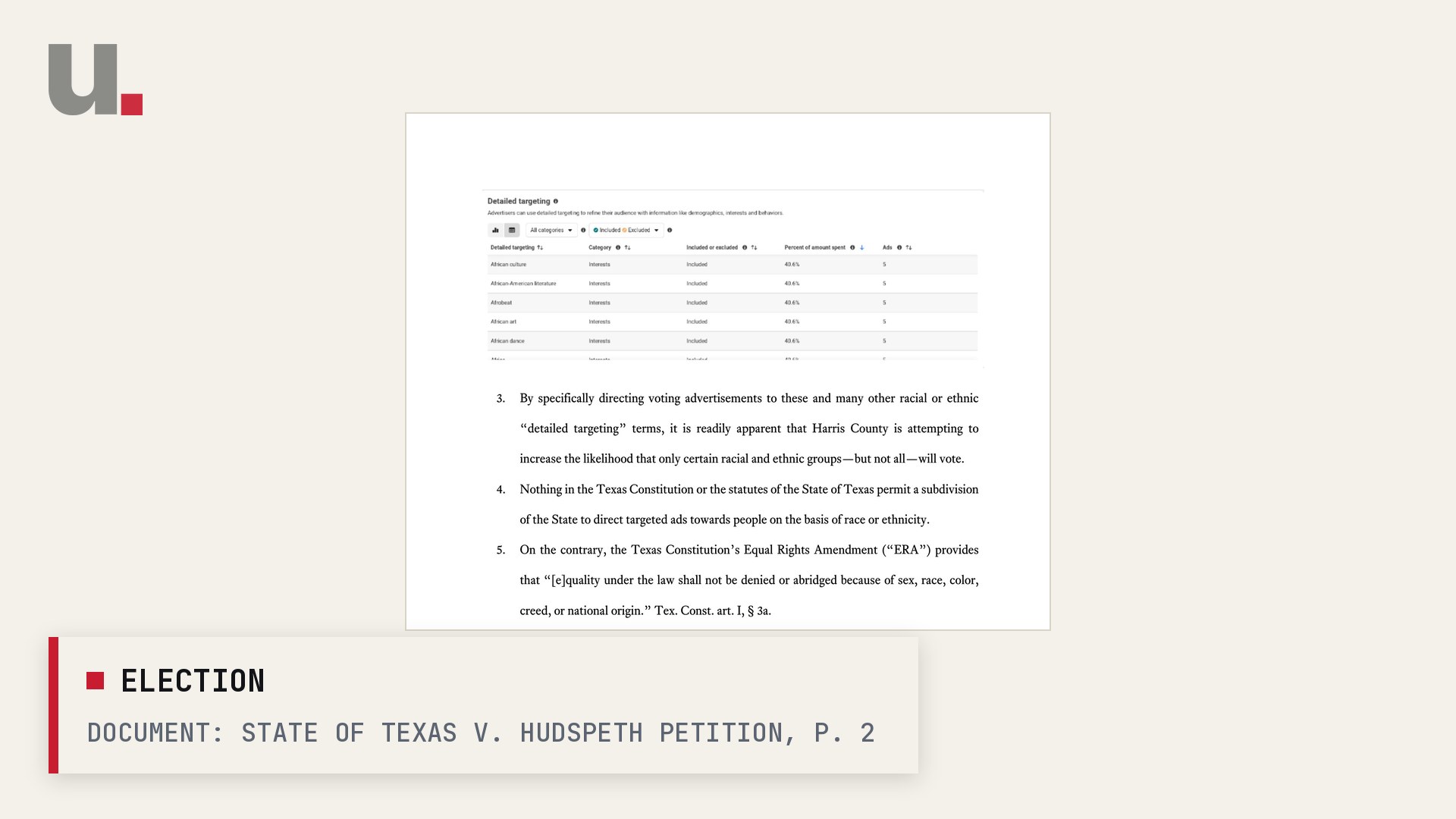
Houston's election office spent taxpayer money telling people when to vote. The question is which people. On Thursday, Oct. 29, the State of Texas sued Harris County Clerk Teneshia Hudspeth, saying her office narrowed its Facebook and Instagram vote ads with 46 racial and ethnic "detailed targeting" tags, from "Hispanic Kitchen" and "Afrobeat" to Nepal and Bangkok. Not one of those tags said Houston, Harris County or Texas.
By that night, the clerk's office said the targeting was gone. It insists the ads were lawful. It turned the settings off anyway.
What the state found
The state's verified petition, filed in Harris County district court by the attorney general's Special Litigation Division, is built almost entirely on Meta's own public Ad Library. Starting Sept. 23, the Harris County Elections Department ran a set of "Plan. Check. Vote!" ads with early voting dates, Election Day and a pitch for its "Harris Votes" app. More versions started Oct. 7.
The basic settings were fine, the state concedes: adults 18 and up, both sexes, located in Harris County. The problem is the layer on top. Meta lets advertisers pick "the demographics, interests and behaviors of people they want to see their ads," and the petition lists every tag the county picked:
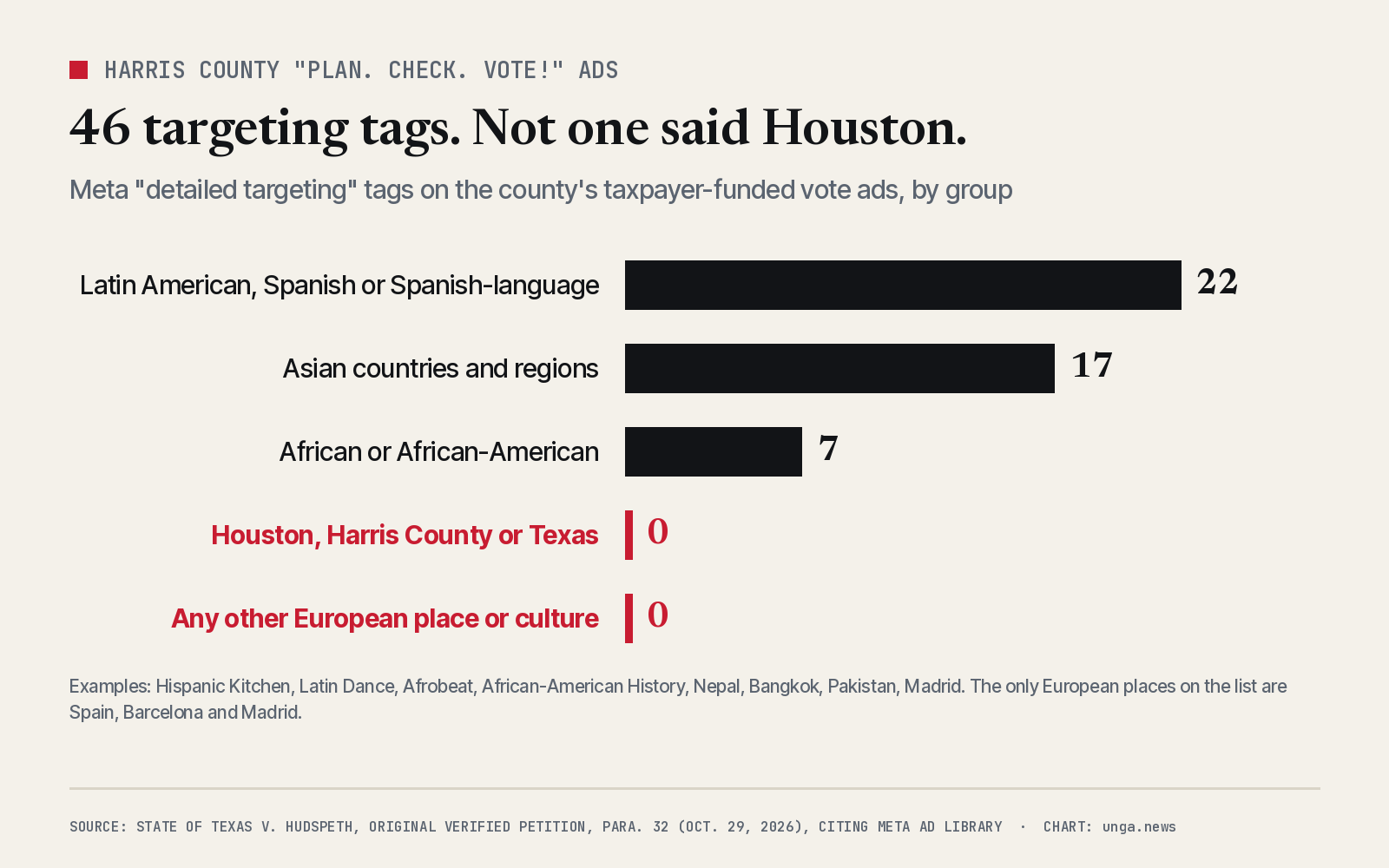
Twenty-two point to Latin America, Spain or the Spanish language. Seventeen are Asian countries and regions. Seven are African or African-American, including "African-American History" and "African-American Studies," which Meta files as demographics rather than interests. The only European places on the list are Spain, Barcelona and Madrid, which the petition dryly notes are "primarily Spanish-speaking."
The money is real. Meta's data shows an estimated $43,429 on these ads over 30 days and $10,804 in the last seven. One trio of ads that launched Sept. 23 cost an estimated $20,000 to $25,000 and racked up at least 2.7 million impressions.
The Texas Attorney General's office announces its lawsuit against the Harris County Clerk (Oct. 29, 2026)
— @TXAG View on 𝕏
Why that's a problem
Picture a school sending the field trip permission slip home only with kids whose parents like salsa music. Every family is technically allowed to go. Only some get the reminder.
That is the state's case. "By specifically directing voting advertisements to these and many other racial or ethnic 'detailed targeting' terms, it is readily apparent that Harris County is attempting to increase the likelihood that only certain racial and ethnic groups—but not all—will vote," the petition says. It calls the effort a "racially discriminatory voter suppression scheme" in the attorney general's announcement.
The legal hook is simple. A Texas county has only the powers the state gives it, and no statute lets an election office sort voters by race. The Texas Constitution's Equal Rights Amendment says "equality under the law shall not be denied or abridged because of sex, race, color, creed, or national origin." So the state calls the ad buy *ultra vires*, Latin for beyond its power, and asks the court to stop it.
The petition also asks the question no one in Harris County has answered: what public purpose does it serve to aim a Houston vote reminder at fans of "Latin Music" or people interested in Cambodia, "never mind towards interests tailored specifically to those in Houston or Texas—those who would actually be voting in Harris County Elections"?
Who's involved
Hudspeth is sued in her official capacity, along with Irene Nuñez, the clerk's communications director, who is listed as the ads' point of contact. Since a 2023 state law ended Harris County's appointed elections administrator, the elected clerk runs elections in Texas' biggest county.
Attorney General Ken Paxton is the Republican nominee for U.S. Senate against Democrat James Talarico, so he recused himself. The suit was brought in the state's name by the office's Special Litigation Division and signed by special counsel Zachary Berg.
What the clerk did
Late Thursday, the clerk's office answered on X. It said it is "confident that our voter outreach efforts are lawful." Then came the line that matters: "the Meta audience subsets have been deactivated to avoid unnecessary distractions."
Harris County Elections Department statement responding to the state's lawsuit (Oct. 29, 2026)
— @HarrisVotes View on 𝕏
That is most of what the state asked for. Its first request was a temporary restraining order telling the county to shut off the ads "or, in the alternative, to remove all racial and ethnic 'detailed targeting' items." If the ads were as harmless as the county says, it's worth asking why the settings came down within hours of the suit. The statement also doesn't say whether the ads still run without the tags, who chose the tags, or how much was spent before they were removed.
The Democrats' answer
Democrats came out swinging at Paxton, not at the tag list. Rep. Christian Menefee, a Houston Democrat, posted that Paxton "filed this lawsuit in the final days of voting because he wants to stop Houstonians from going to the polls" and is "upset that diverse voters across Harris County are making their voices heard." Paxton is recused, and none of the statements we reviewed explained why a county vote ad needed a Nepal or "Hispanic Kitchen" filter in the first place.
What happens next
Early voting ends Friday, Oct. 30, and Election Day is Tuesday, Nov. 3. The state says that's why it needed emergency relief: "once the 2026 Election is over, the harm will be done." Beyond the restraining order, it wants a temporary injunction and a permanent ban on Harris County aiming voter ads at specific racial or ethnic groups, which would cover every future election, not just this one.
The county turned off the tags before a judge had to make it. The court can still make it permanent.
Sources
- Office of the Attorney General of Texas — State of Texas v. Teneshia Hudspeth and Irene Nuñez, Original Verified Petition and Application for TRO, Temporary Injunction and Permanent Injunction, Harris County District Court (Oct. 29, 2026)
- Office of the Attorney General of Texas — The Office of the Attorney General Sues Harris County Clerk for Running Racially Discriminatory Voter Suppression Scheme (Oct. 29, 2026)
- Texas Attorney General (X) — @TXAG post announcing the lawsuit (Oct. 29, 2026)
- Harris County Elections Department (X) — @HarrisVotes: Office of Harris County Clerk Teneshia Hudspeth statement in response to the lawsuit (Oct. 29, 2026)
- Harris County Clerk Teneshia Hudspeth (X) — @TeneshiaforHC full text of the clerk's statement (Oct. 29, 2026)
- Rep. Christian Menefee (X) — @RepCDMenefee statement on the lawsuit (Oct. 29, 2026)
- Meta Ad Library — Harris County Elections Department ad library page (cited in the petition, Exhibit A)