

Texas Will Pull Paper Ballots to Double-Check Its Voting Machines Statewide for the First Time
A 2021 election integrity law finally kicks in. The state will draw a random number on camera Wednesday to pick which Senate ballots get checked by hand.
Texas is about to do something it has never done statewide: pull real paper ballots out of storage and check them against what the voting machines reported. Secretary of State Robert Howden announced Monday that the state’s first statewide risk-limiting audit will cover the Nov. 3 U.S. Senate race, the biggest contest on the ballot.
“Texans deserve to know their elections are secure and their votes are counted accurately,” Howden said. “We have multiple checks and balances throughout the process and now we have two ways to verify the results after the election.”
The process kicks off Wednesday at 2:30 p.m. Central, when Howden will generate a 10-digit random number on a public livestream. That number decides which paper ballots get pulled. Nobody, not the state, not the counties and not the campaigns, gets to pick the sample ahead of time.
Howden’s release didn’t say why he chose the Senate race, but it’s an obvious pick. It was the one contest on every ballot in all 254 counties, it drew the most votes and it carried the highest stakes. If the state is going to test its new audit, it might as well start where the most Texans have skin in the game.
A promise from 2021 finally comes due
This audit didn’t appear out of nowhere. It traces straight back to Senate Bill 1, the 2021 election integrity law carried by state Sen. Bryan Hughes, and Senate Bill 598 from state Sen. Lois Kolkhorst. SB 1 was the law Democratic lawmakers fled the state to try to block that summer. Republicans passed it anyway, and the audit requirement inside it came with a five-year runway so the state could get the process right before going big.
Howden’s office says it used that runway. It ran smaller trial versions of the audit in earlier elections to work out the kinks before the statewide requirement kicked in this year.
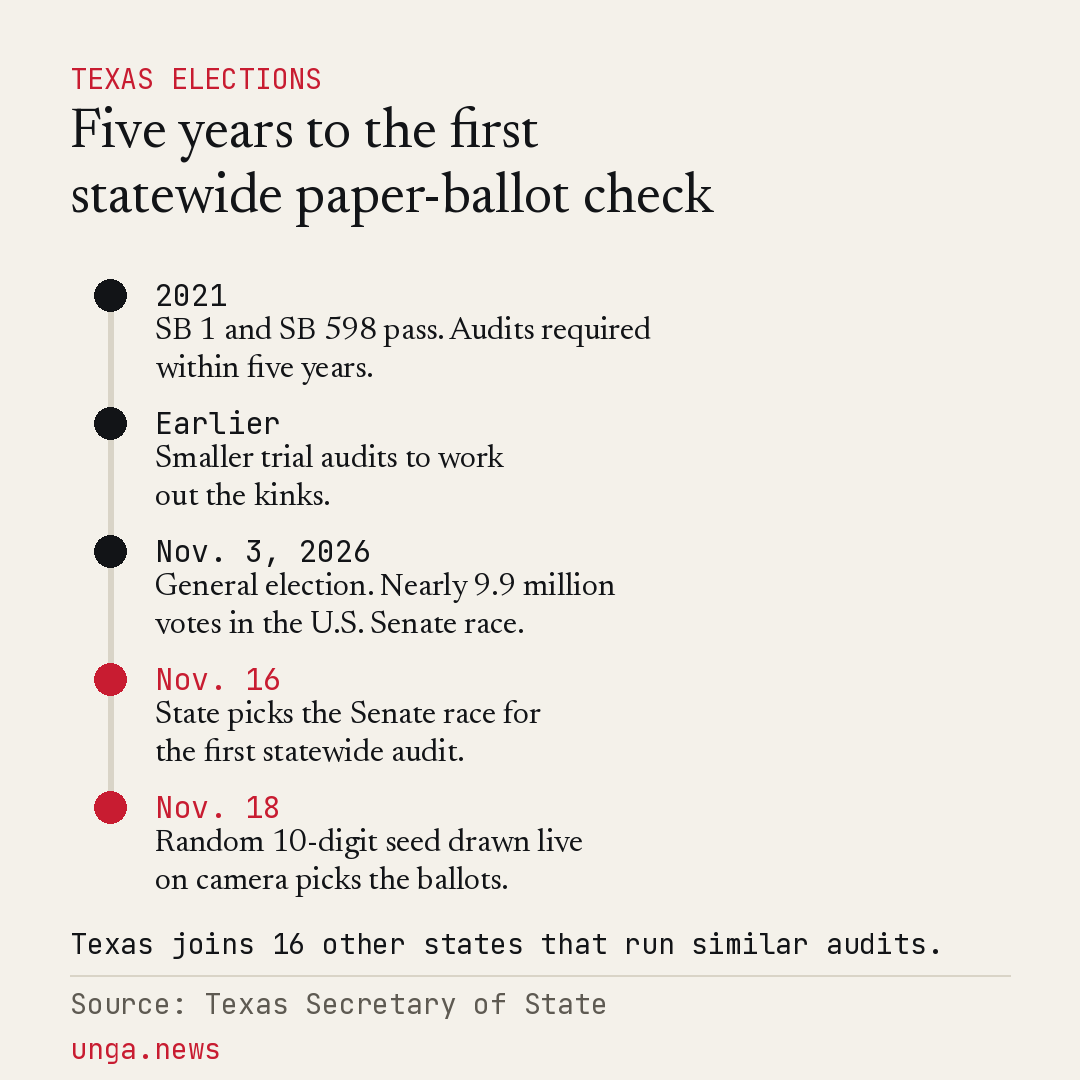
Texas isn’t inventing the idea. According to Howden’s office, 16 other states already run similar audits. What makes this one stand out is the scale. The Senate race drew close to 9.9 million votes in the state’s unofficial returns, which makes Texas one of the largest places in the country to put its count through this kind of test.
How a random sample checks millions of votes
A risk-limiting audit sounds like jargon, but the idea is simple. Instead of recounting every single ballot, election officials pull a random sample of paper ballots and compare what humans see on the paper with what the machines recorded. The method is built so that if the machines had gotten the outcome wrong, the sample would have a strong chance of exposing it, and the audit would keep widening until the question is settled.
The key ingredient is the paper. Machines can be checked only if there is a physical record the voter marked or approved. Texas’s 2021 law leaned hard on that idea, and this audit is the first statewide payoff.
The random seed matters too. Because the number is drawn in public, on camera, anyone who doubts the process can watch the moment the sample is chosen. That openness is the whole point. Howden called it “an additional layer of accountability and transparency into the process.”
Counties do their own hand counts on top
The statewide audit is only half of it. Texas law also requires every county that uses electronic voting equipment to run its own partial hand count after the election, comparing hand-counted samples with the electronic totals to make sure the equipment worked.
For this election, the state picked the races those counties must check: the U.S. Senate contest, the race for chief justice of the Texas Supreme Court, and one local race each county chooses for itself. That means the Senate results get looked at twice, once by the counties and once through the new statewide sample.
Democrat James Talarico was declared the winner of the Senate race over Republican Ken Paxton on election night, and the state’s unofficial returns show a margin of about 1.2 million votes. The audit isn’t a challenge to that result, and nobody in Austin has claimed anything went wrong. It’s a routine check now written into state law, and it applies no matter who wins.
That’s exactly why it’s worth doing. Voters on both sides have spent years arguing about whether machines can be trusted. Texas decided to stop arguing and start checking, with paper in hand and the cameras rolling. If the paper matches the machines, the doubters get an answer. If it doesn’t, the audit is built to keep digging until the right answer is clear.
Wednesday’s livestream will be short. The work that follows, county by county, will take longer. But for the first time, every Texan who wondered whether their vote was counted right has a statewide process built to show them.
Sources
- Texas Secretary of State — Texas Secretary of State Initiates Two Audits of the Nov. 3 Election as Prescribed by Law, Nov. 16, 2026
- Texas Secretary of State — Election Results, Nov. 3, 2026 (unofficial)
- FOX 26 Houston — Texas picks U.S. Senate race for first statewide ballot audit