

Texas Won the Fight to Put the Ten Commandments in Classrooms. Its Next Top Lawyer Won’t Defend It
A federal appeals court upheld the Texas law 9 to 8. Now Democrat Nathan Johnson says he’ll drop the state’s defense, and Ken Paxton is racing to keep the Supreme Court from reopening the case before he leaves.
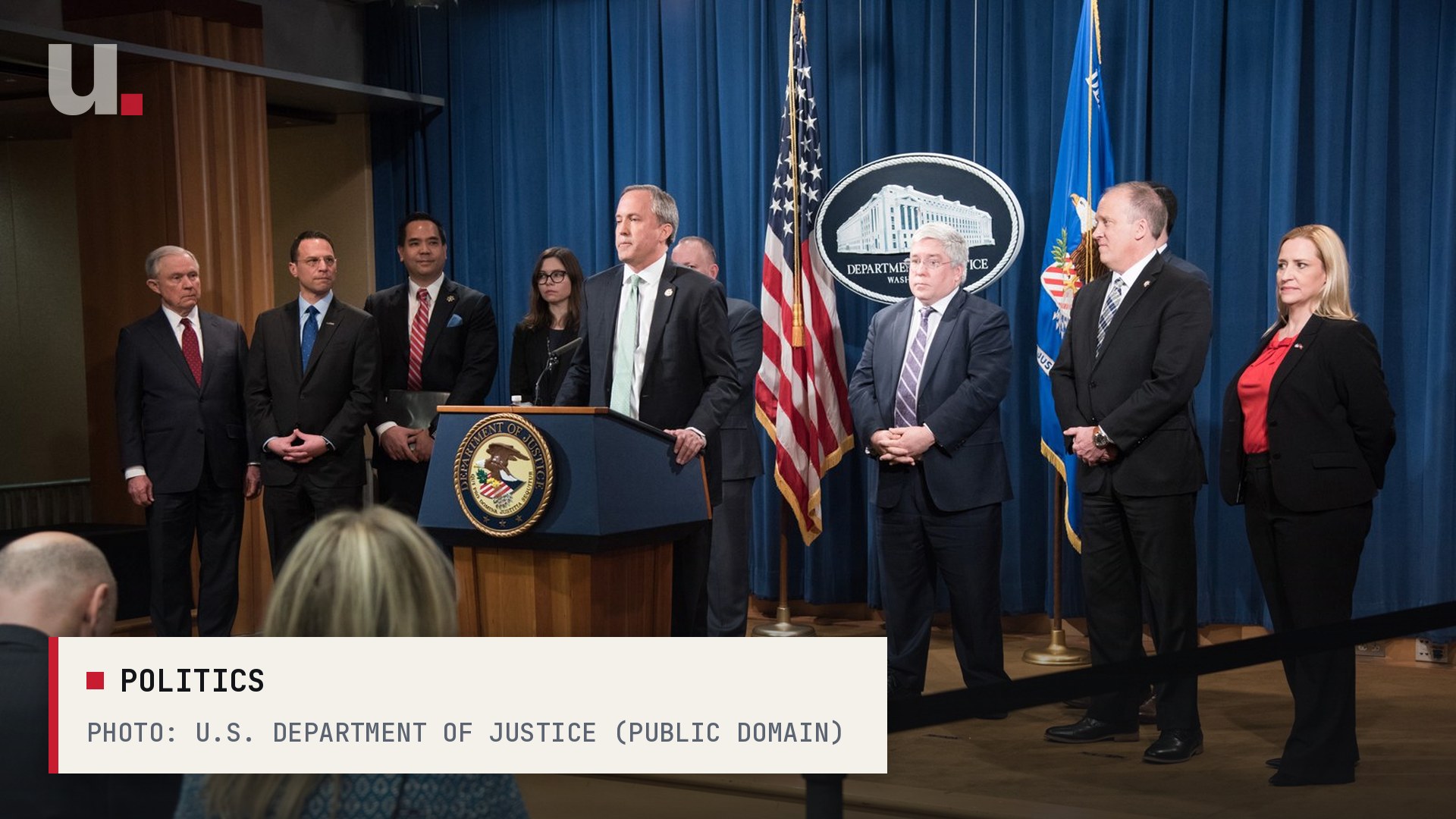
Texas fought for more than a year to put the Ten Commandments on the wall of every public school classroom in the state. It won. In April, the full federal appeals court that covers Texas upheld the law by a single vote.
Now the man about to take over the state’s legal defense says he won’t defend it.
“My jurisprudential opinion is that the law is unconstitutional,” Texas Attorney General-elect Nathan Johnson told The Dallas Morning News this week. “The court will have the ultimate say as to what’s constitutional and what is not, but I’m the one who says what the state’s position is, and it will not be the position the state has previously taken.”
Johnson is the first Democrat elected Texas attorney general in nearly three decades, and he takes office in January. The law he is walking away from, Senate Bill 10, was passed by the Texas Legislature in 2025 and signed into law. He isn’t repealing it, and he can’t. What he can do is leave it without a lawyer at the one court that can still knock it down.
A poster, not a sermon
Strip away the noise and the law is pretty modest. It requires a copy of the Ten Commandments, at least 16 inches wide and 20 inches tall, posted in a “conspicuous place” in every classroom of every public school and open-enrollment charter school. Schools can buy the posters, but they don’t have to. If a classroom doesn’t have one, the school has to accept a donated poster that meets the rules.
Teachers aren’t required to teach the Commandments, quiz kids on them or say a word about them. The text is the same version carved on the granite monument that has stood outside the Texas Capitol for decades, the one the U.S. Supreme Court allowed to stay put in Van Orden v. Perry back in 2005.
State Sen. Phil King, the bill’s author, put the purpose in plain words on the Senate floor: “every child needs to see on the wall that it’s wrong to kill, it’s wrong to steal, [and] that you’re supposed to respect and honor your parents.” Lt. Gov. Dan Patrick said the posters would “ensure our students receive the same foundational moral compass as our state and country’s forefathers.”
Most Texas parents wouldn’t argue with that. A group of them did, though. Parents in 11 school districts sued before a single poster went up, claiming their kids would be “unconstitutionally coerced into religious observance.” A federal district judge agreed and blocked the law.
Nine judges to eight
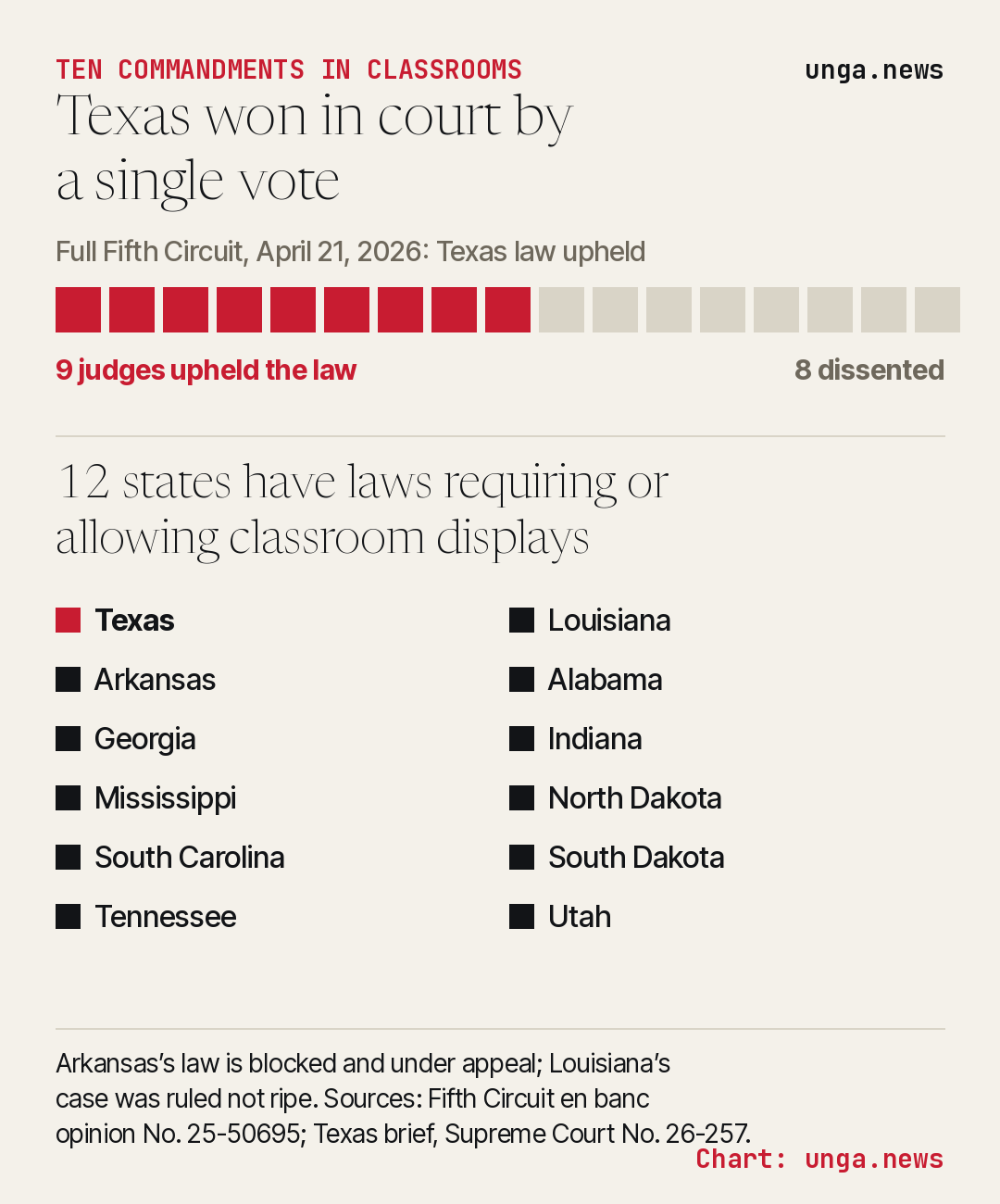
Attorney General Ken Paxton appealed, and the full Fifth Circuit took the case. On April 21, the court threw out the injunction and dismissed the parents’ claims, 9 to 8. Judge Stuart Kyle Duncan wrote the majority opinion.
The parents leaned on a 1980 Supreme Court case, Stone v. Graham, that struck down a Kentucky law posting the Commandments in schoolrooms. The majority said that case rested on an old legal test, the Lemon test, that the Supreme Court itself threw out in 2022 when it sided with a praying high school football coach in Kennedy v. Bremerton. “Unmistakably, Stone depended entirely on Lemon and nothing but Lemon,” the court wrote.
Under the newer test, judges look at history. The majority found the parents hadn’t produced “a shred of founding-era evidence” that the government displaying religious text amounts to setting up an official church. Real establishments of religion in the founding era fined, taxed and punished dissenters. A poster on a wall does none of that. Kids aren’t made to attend church or join a religious exercise, and the court said parents don’t have “the ‘right to micromanage’ what Texas schools hang on classroom walls.”
That ruling stands today, and it binds every federal court in Texas, Louisiana and Mississippi.
Why Paxton wants the justices to pass
The parents asked the Supreme Court to take the case in August. Paxton’s office answered on Nov. 10 with a brief urging the justices to say no.
His argument is simple. Texas already won, the law is in force, and no other appeals court has ruled differently. Then he pointed to the election. “Among other factors, the recent election in Texas renders this case a particularly poor vehicle,” the brief says. “The incoming Texas Attorney General has publicly stated that he ‘will not defend’ the challenged law, likely depriving this Court of an adversarial presentation.”
In plain English: if the Supreme Court takes this case, the State of Texas may show up with nobody arguing for its own law. Paxton is trying to lock in the win before he leaves.
That puts the next move on the justices. Douglas Laycock, a University of Texas law professor emeritus who thinks the law is unconstitutional, told Houston Public Media he expects the court to wait until Johnson is sworn in and see what he files. Johnson could even tell the justices Texas now thinks its own win was wrong.
The parents’ lawyers are thrilled. “The incoming Attorney General has correctly recognized what our clients have said from the start,” attorney Jonathan Youngwood said.
Eleven other states have skin in this
According to Texas’s brief, Alabama, Georgia, Indiana, Mississippi, North Dakota, South Carolina, South Dakota, Tennessee and Utah have all passed laws requiring or allowing the Ten Commandments in classrooms. Louisiana’s law was tied up in the same Fifth Circuit fight, and the court said that challenge came too early. Arkansas’s law was blocked by a district judge, and the Eighth Circuit heard arguments in September.
So when one state’s top lawyer decides a law passed by the people’s elected representatives isn’t worth defending, the effect can spill past his own state line. A Supreme Court ruling in a case where only one side shows up would land on all of them.
Constitutional lawyer David Coale told FOX 4 in Dallas that Johnson’s decision changes little on the ground. The law stays on the books, and the Fifth Circuit’s ruling still controls. “If you try to sue a school district and say, ‘Ha ha, I’ve got you because the attorney general’s not going to defend you,’ you’re going to lose,” Coale said.
That’s the part Johnson can’t undo. The Legislature passed the law. A federal appeals court upheld it. The posters are legal in Texas classrooms right now. The only open question is whether the man elected to be the state’s lawyer will let the case go to the Supreme Court without anyone in his office willing to stand up for it.
Paxton has a few weeks left to make sure that never happens.
Sources
- U.S. Court of Appeals for the Fifth Circuit — Nathan v. Alamo Heights ISD, No. 25-50695, en banc opinion (Apr. 21, 2026)
- Supreme Court of the United States — Texas brief in opposition, No. 26-257 (Nov. 10, 2026)
- Fox News — Texas attorney general-elect refuses to defend Ten Commandments classroom law (Nov. 28, 2026)
- Houston Public Media — Supreme Court likely to wait until next year to decide whether to hear challenge to Ten Commandments law (Nov. 24, 2026)
- FOX 4 Dallas-Fort Worth — Texas AG-elect Nathan Johnson won’t defend Ten Commandments classroom law
- Justia — Van Orden v. Perry, 545 U.S. 677 (2005)