

The Army Blew Up 5 Tons of Unstable Explosives in Iowa. Air Monitors Found Zero Lead.
Families near Middletown were warned about a toxic dust cloud. Instead, every federal air monitor read zero, the blast stayed in the ground, and FEMA gave the all clear the same day.
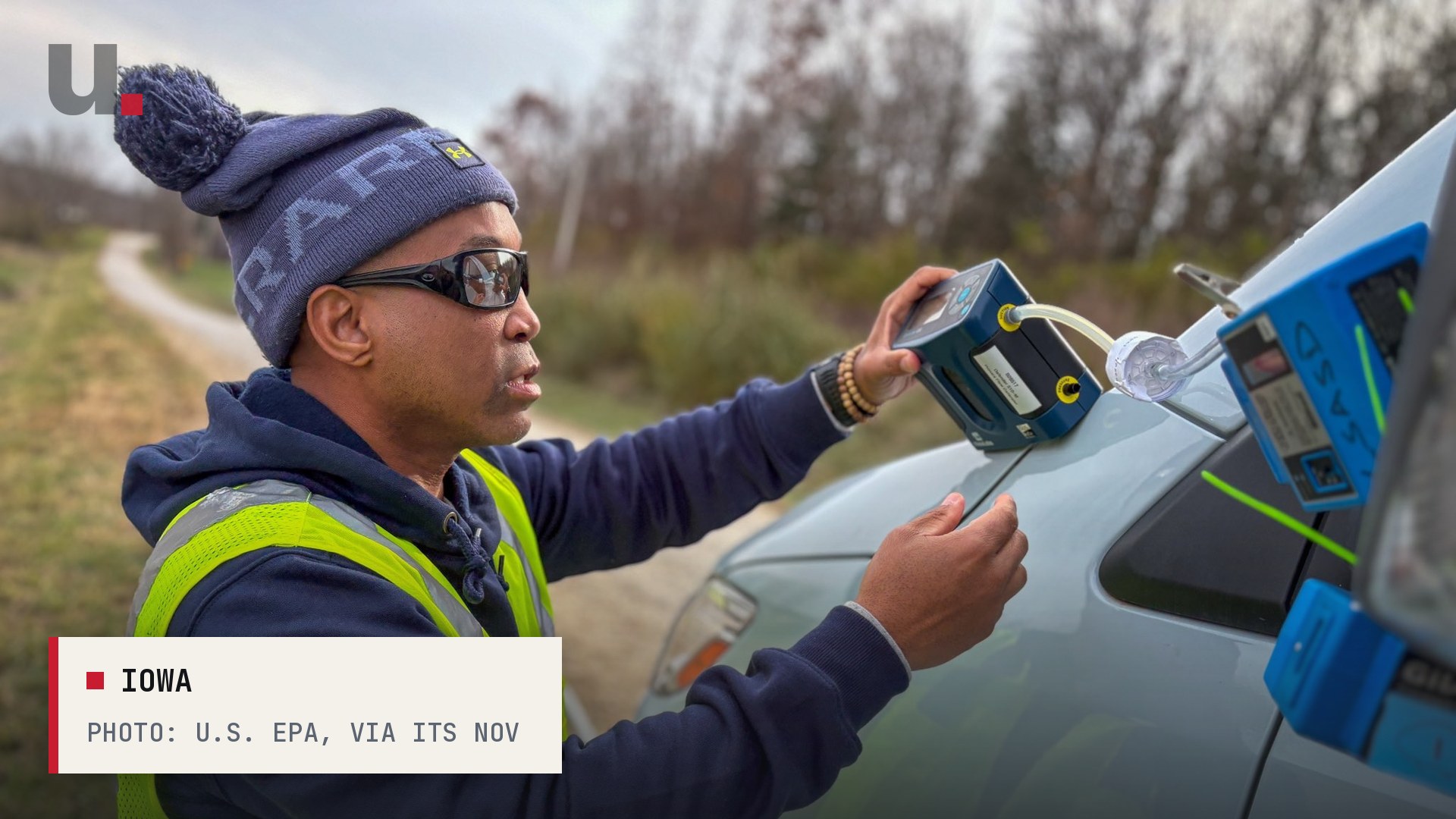
Since March, the people of Middletown, Iowa, have lived next to roughly 9,700 pounds of an explosive the Army itself said could go off on its own. On Wednesday morning the Army set it off on purpose, inside two buried bunkers smothered in foam, water and sand. By late afternoon FEMA had issued an all clear, and every air monitor the federal government had planted across the region was still reading zero for airborne lead.
That is the outcome nobody in southeast Iowa was promised a week ago. Environmental groups had warned in federal court of “a plume of lead dust that will blanket homes and communities, possibly as far away as 100 miles or more.” Families inside a five-mile cone southwest of the plant were told to leave town. Instead, Middletown’s mayor, Rodney Johnson, summed up the morning in two short sentences: “We did not feel anything. We did not see anything.”
We covered the fight over this blast on Monday, when the Army was waiting on a federal appeals court and Iowa’s incoming governor before it could move. The court cleared the way within hours. Wednesday was the day the job actually got done.
Five tons nobody could safely move
The explosive is lead azide, the tiny charge that sets off grenades and artillery shells. The Army found in March that the stockpile at the Iowa Army Ammunition Plant had “recrystallize[d],” which makes it far touchier to shock and friction. Its explosives experts concluded that even moving the drums risked an uncontrolled blast, and the Army warned that freezing weather would make a spontaneous chain reaction more likely. The stockpile had been shipped to Iowa in 2009. White House Chief of Staff Stephen Miller called it explosive material “improperly placed and stored by the Obama Administration in Iowa in 2009.”
So the plan was to blow it up where it sat and trap as much of the blast as possible. According to the Army and the federal agencies on the ground, crews built two-story sand barriers, poured foam and water over the bunkers, ran misting to catch particles, and engineered what the Army calls a “blast channel” to drive the force down into the earth instead of up into the sky. Sandia National Laboratories supplied the foam suppression technology, and Lawrence Livermore ran the wind modeling, Energy Secretary Chris Wright said. The National Weather Service launched weather balloons nearly every hour to pick the safest window.
The ATF director, Robert Cekada, said the blast “followed a blast channel that was designed to go down the right path to minimize any sort of dispersion of lead into the atmosphere 100% as planned.”
Zero, then zero again
The EPA came in heavy. Before the detonation, the agency collected 1,200 samples of air, soil, dust and water so it would have a clean baseline to compare against. It parked 300 employees and contractors around Middletown and reported real-time air readings every five minutes.
One hour after the blast, every one of those real-time monitors was reporting zero detection of airborne lead. Five hours later, EPA Administrator Lee Zeldin said the readings had not budged, and he offered a comparison that will stick with a lot of Midwesterners: he had been told that the particulate matter from Kansas City’s World Cup fan-fest fireworks was “roughly 10x greater than this morning’s detonation.”
The Army’s own account was just as clean. “There is a reading of 0.0 lead detected on the ground,” the service posted. Overhead imagery “confirmed that everything targeted for removal was cleared, with no secondary explosions, no kickout, and no infrastructure damage on or around the installation.” Maj. Gen. Eric Shirley, who runs Army Sustainment Command, said “all of the lead azide barrels were definitively removed.”
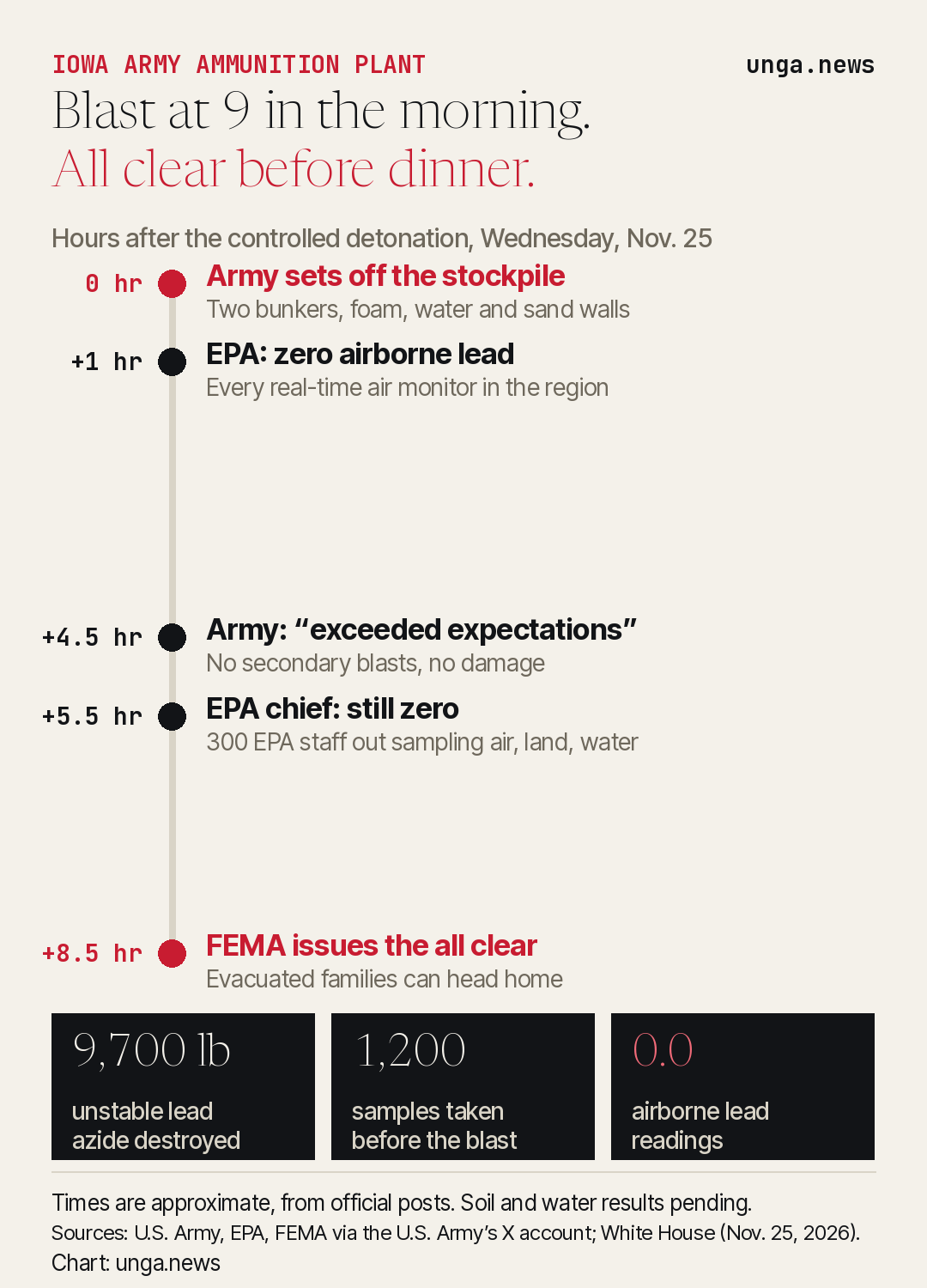
Then, late in the afternoon, the line evacuated families had been waiting for:
The U.S. Army on 𝕏: FEMA issues the all clear around the Iowa Army Ammunition Plant, Nov. 25, 2026.
— @USArmy View on 𝕏
Washington showed up before the blast, not after
This is the part of the story that deserves more credit than it will get. Usually the federal government arrives after something goes wrong in a small town. This time the Army, EPA, FEMA, the ATF, the CDC, the Agriculture and Energy departments and the Weather Service were all in place before the fuse was lit. FEMA covered rides, hotel rooms, food and water for evacuees through Friday. Agriculture Secretary Brooke Rollins said more than 140 USDA offices within 100 miles of Middletown would stay open to help farmers and ranchers file claims with the Army.
Acting Army Secretary Adam Telle called the operation “a HUGE success” and said, “The threat of an uncontrolled spontaneous detonation has been eliminated.” Iowa Gov. Kim Reynolds, a Republican, thanked the soldiers for “a flawless detonation” and called it “a best-case scenario for the residents of Middletown and its surrounding communities.” Sen. Chuck Grassley, never one to hand out easy praise to anybody in Washington, said the mitigation work “exceeded expectations” and that “it appears the lead was contained to the greatest extent possible.” Iowa Agriculture Secretary Mike Naig said that based on what is known now, he does not expect any harm to livestock or food safety.
House Democratic leader Hakeem Jeffries still put out a statement complaining that the Army had not treated the job with the “seriousness and gravity” it demands. The people of Middletown, who were told they could go home before dinner, may see it differently.
The work left to do
Nobody on the federal side is calling this finished, and they shouldn’t. The zero readings come from the real-time air monitors. Lab results from other air samples, plus the soil and water testing, are still coming. The Army said post-detonation surface sampling is underway and results will be released once complete, and the EPA said its 300 people are back in the field sampling air, land and water across the region. Health Secretary Robert F. Kennedy Jr. put it plainly: “Iowa families deserve clear answers about what the monitoring shows, what remains under investigation, and what they should do to protect their health.”
That is the right standard. If the soil and water numbers come back as clean as the air, the government will have done something rare: it took a dangerous mess that had been sitting in the ground since 2009, warned people honestly, threw everything it had at the risk, and left a small Iowa town the way it found it, minus five tons of explosives.
Sources
- U.S. Army on 𝕏 — FEMA issues All Clear around Iowa Army Ammunition Plant; zero airborne lead detection (Nov. 25, 2026)
- U.S. Army on 𝕏 — Controlled detonation exceeded expectations; 0.0 lead detected, no secondary explosions (Nov. 25, 2026)
- U.S. Environmental Protection Agency — Initial Air Monitoring Shows Zero Detection of Airborne Lead Following Controlled Detonation at Iowa Army Ammunition Plant (Nov. 25, 2026)
- Lee Zeldin on 𝕏 — Five hours after the detonation, all EPA air monitors still report zero airborne lead (Nov. 25, 2026)
- U.S. EPA on 𝕏 — Zero detect consistent before, during and after the detonation; 300 personnel sampling (Nov. 25, 2026)
- The White House — Trump Administration Leads Whole-of-Government Effort to Safely Neutralize Obama-Era Explosives Threat in Iowa (Nov. 25, 2026)
- U.S. Army — Public Safety Advisory: Controlled, Mitigated Detonation of Unstable Lead Azide at Iowa Army Ammunition Plant (Nov. 2026)
- U.S. Court of Appeals for the 8th Circuit — Iowa Environmental Council v. EPA, No. 26-3374, order denying emergency stay (Nov. 23, 2026)
- Associated Press — Army calls detonation of bomb chemicals in Iowa a success after earlier fears of a toxic plume (Nov. 25, 2026)
- Stars and Stripes — How the Army is planning to protect Iowans during lead azide detonation (Nov. 24, 2026)
- KCRG — EPA has live air quality monitoring from areas near lead detonation, collected more than 1,200 samples before blast (Nov. 25, 2026)
- NBC News — Live updates, including Jeffries statement on the Army’s handling of Iowa (Nov. 25, 2026)
- unga.news — Trump Gave Iowa’s Incoming Democratic Governor a Say on a Risky Army Blast. He Passed It Right Back. (Nov. 23, 2026)