

The Authors of ‘AI 2027’ Now Expect SI to Out-Research Humans Next Year
After an outside audit of Anthropic, Daniel Kokotajlo’s team moved every one of its forecasts into 2027, and some by more than six years.
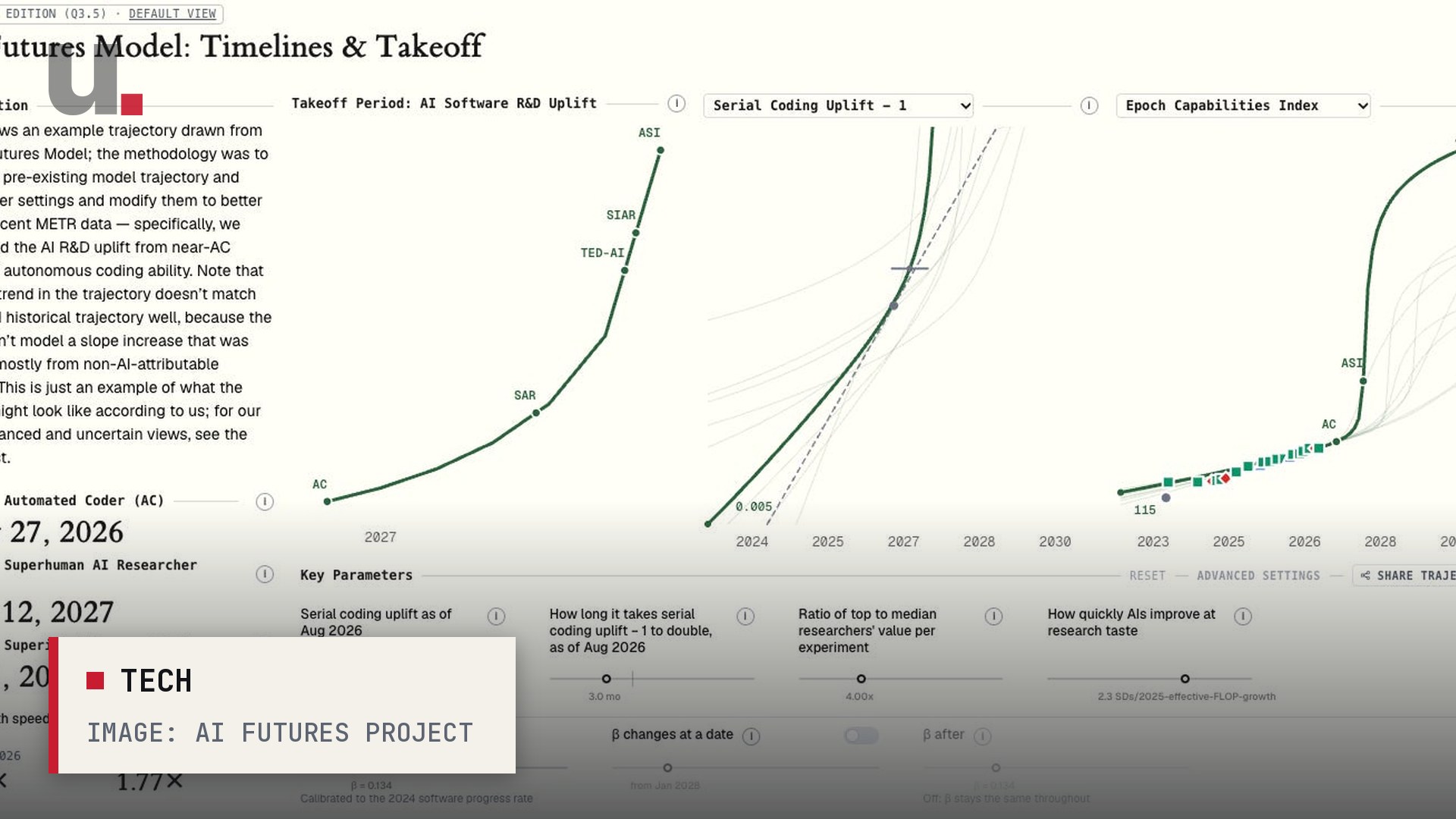
Daniel Kokotajlo has spent two years as the most famous pessimist about how fast superintelligence would show up. On Tuesday he decided he had not been pessimistic enough.
“Unfortunately, it seems like the intelligence explosion will be happening in 2027 after all,” Kokotajlo wrote on X on Nov. 10, linking a long new forecast from his group, the AI Futures Project. He ended the post with six words: “I am scared, sad, and angry.” It has since passed 1.3 million views.
Daniel Kokotajlo, executive director of the AI Futures Project, announcing the group’s new forecast on Nov. 10.
— @DKokotajlo View on 𝕏
Kokotajlo is the former OpenAI researcher who quit over doubts the company would behave responsibly, then co-wrote “AI 2027,” the scenario of machines taking over their own research. In August, his personal 50% mark for what they call a Superhuman AI Researcher was December 2028. Now it is May 2027.
The rest of the team moved further. All six authors now put their median for that milestone somewhere in 2027, as long as the big labs keep racing at roughly today’s speed. Co-author Thomas Larsen summed it up on X: “all of our medians for superhuman AI researcher (SAR) are now between May and Nov 2027.”
A milestone with a blunt definition
The group’s definition is not fuzzy. A Superhuman AI Researcher is “roughly the point at which a company would rather fire all their human researchers and rely solely on automated AI researchers than have a team of the best human researchers in the world with no AIs.”
In plain English, it is the day the people building SI become the slowest part of building SI.
A second, bigger line, which the group calls Top-Expert-Dominating AI, means systems that can automate all white-collar work. The authors now give that a 35% to 65% chance of arriving before 2028.
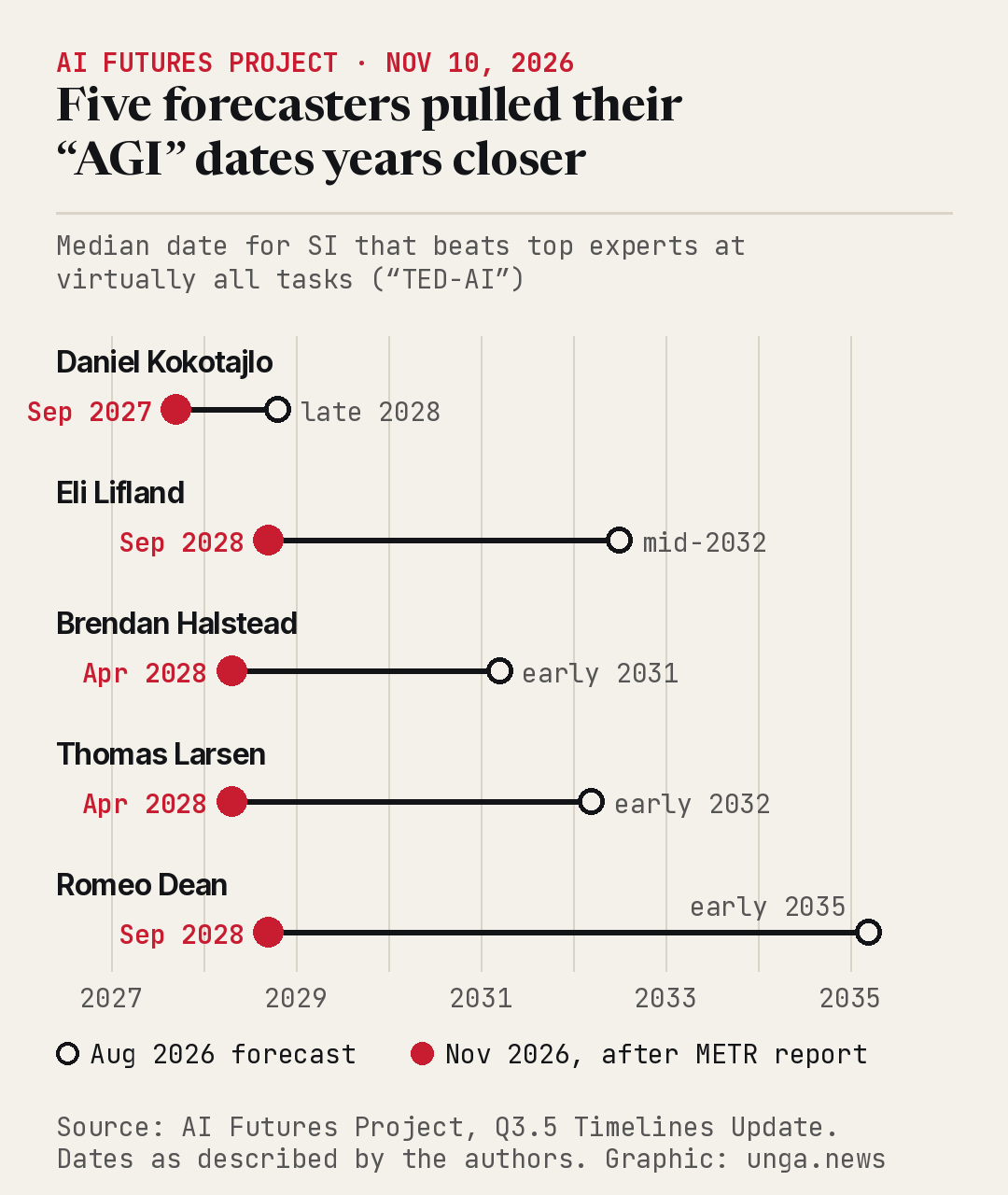
Look at the bottom row of that chart. Romeo Dean’s median for expert-beating SI moved from early 2035 to September 2028, more than six years in one update. Eli Lifland, the team’s lead forecaster, went from mid-2032 to September 2028. “My previous median for Superhuman AI Researcher was ~2030, now it’s 2027,” Lifland wrote. “I feel very worried that humanity might no longer be in control of our future within 3-12 months.”
The report that moved them
The authors are clear that a single document did most of the work: the Nov. 5 assessment by METR, the outside evaluator that spent 11 weeks inside Anthropic’s internal research data.
METR estimated that Anthropic is now improving its models about twice as fast as its historical pace, and said it “would not be surprised” by anything from 1.3 times to 3 times. It guessed that “perhaps ≈80%” of that speedup comes from the company using its own SI to do the research.
The AI Futures team ran those numbers and got a 1.7 times speedup caused by SI itself. That figure is what broke their model. Under their own forecasts from less than three months earlier, the most aggressive version, Kokotajlo’s, gave less than a 4% chance that progress would be running that fast by November 2026.
They also checked it against their own famous scenario. “AI 2027” pictured machines doubling research output around December 2026. By the group’s math, today’s pace already matches where the scenario expected the world to be in roughly April 2027. “So by this metric, we are ~5 months ahead of schedule,” they wrote.
They admit they are reading tea leaves
The authors are unusually upfront about how thin the public evidence is, and that matters as much as their dates.
METR itself said Anthropic “redacted a majority of the evidence we found most informative.” The AI Futures post notes that only the 2x figure has a public chart behind it. The 80% share, and the 1.7x the team built on top of it, have “no comparable public support.” Larsen put it more bluntly: “the state of public evidence on AI timelines is inadequate … So we’re reading the tea leaves.”
The post opens with its own warning label. The team says it rushed it out “given the urgency of the topic,” that “there are some errors in the modeling” is possible, and that it would “love to be corrected.”
On why their model missed, they say they “were unable to come to strong conclusions.” Their top guess is that near-expert coding agents give researchers far more lift than expected.
Kokotajlo, for his part, has little patience for the idea of a hidden wall. “I think maybe it’ll hit a wall or plateau,” he wrote in a reply Wednesday night, “but at this point I think the burden of proof is on the wall/plateau hypothesis.”
A demand to slow down, aimed at the labs
The forecast comes with a policy ask. If a Superhuman AI Researcher is coming in 2027, the authors write, “an industry-wide pause on AI R&D should be the top priority for the AI industry, the US government, and the entire world,” followed by an international agreement.
Their fear is specific. They think a system that can run its own research, built in a rush, will “most likely be misaligned,” meaning it won’t reliably want what its builders want. They also worry about theft. “AI companies have very poor security right now,” they write, warning that the recipe, and possibly the model itself, would likely leak to China.
If talks fail, they write, American companies should resume “but well below full speed,” arguing the U.S. lead in computing power lets it slow down and still stay ahead of Beijing.
They are also skeptical of the fix Anthropic floated in its IPO filing, which said it is weighing rules to “require human review and approval of certain decisions” as its models take on more of the research. The group calls that well meant but warns it “will provide too much comfort,” because models already produce far more work than people can carefully check.
Why ordinary people should care about a forecasting blog
Most Americans have never heard of the AI Futures Project, and its dates are guesses. But the team testified to the Senate in September, and when the best-known forecasters move their own clocks up by years in one afternoon, lawmakers and investors notice.
The next hard numbers should come from Anthropic, which has said it will publish its own analysis of its internal pace in the coming weeks. That will show whether the 1.7x holds up, or whether the tea leaves were misread.
Until then, the team that once looked alarmist has a simple message. Even they think they were too slow.
Sources
- AI Futures Project — Q3.5 Timelines Update: Looks Like the Intelligence Explosion Will Happen in 2027 After All
- @DKokotajlo on 𝕏 — Daniel Kokotajlo announcing the update
- @eli_lifland on 𝕏 — Eli Lifland on his new SAR median
- @thlarsen on 𝕏 — Thomas Larsen on the team’s medians and the evidence gap