

The Ban on Foreign-Made Drones and Wi-Fi Routers Has Created 9,100 American Jobs, Regulators Say
Brendan Carr’s FCC shut new foreign-made drones, routers, robots and power inverters out of the U.S. market. Now 71 makers have promised to build here, and the agency counts billions in new American factory money.

For years, Washington’s answer to risky foreign tech was a strongly worded warning and a shrug. Drones from overseas mapped American power lines and police scenes. Wi-Fi routers built abroad sat in tens of millions of living rooms. Everybody in national security knew the risk, and almost nobody did anything about it.
Brendan Carr’s FCC did something about it, and on Friday the agency put a price tag on the result. In a news release dated Nov. 20, the commission said its bans on new foreign-made drones, routers, robots and power inverters have “already created approximately 9,100 new jobs and prompted public announcements of billions of dollars in new investment.”
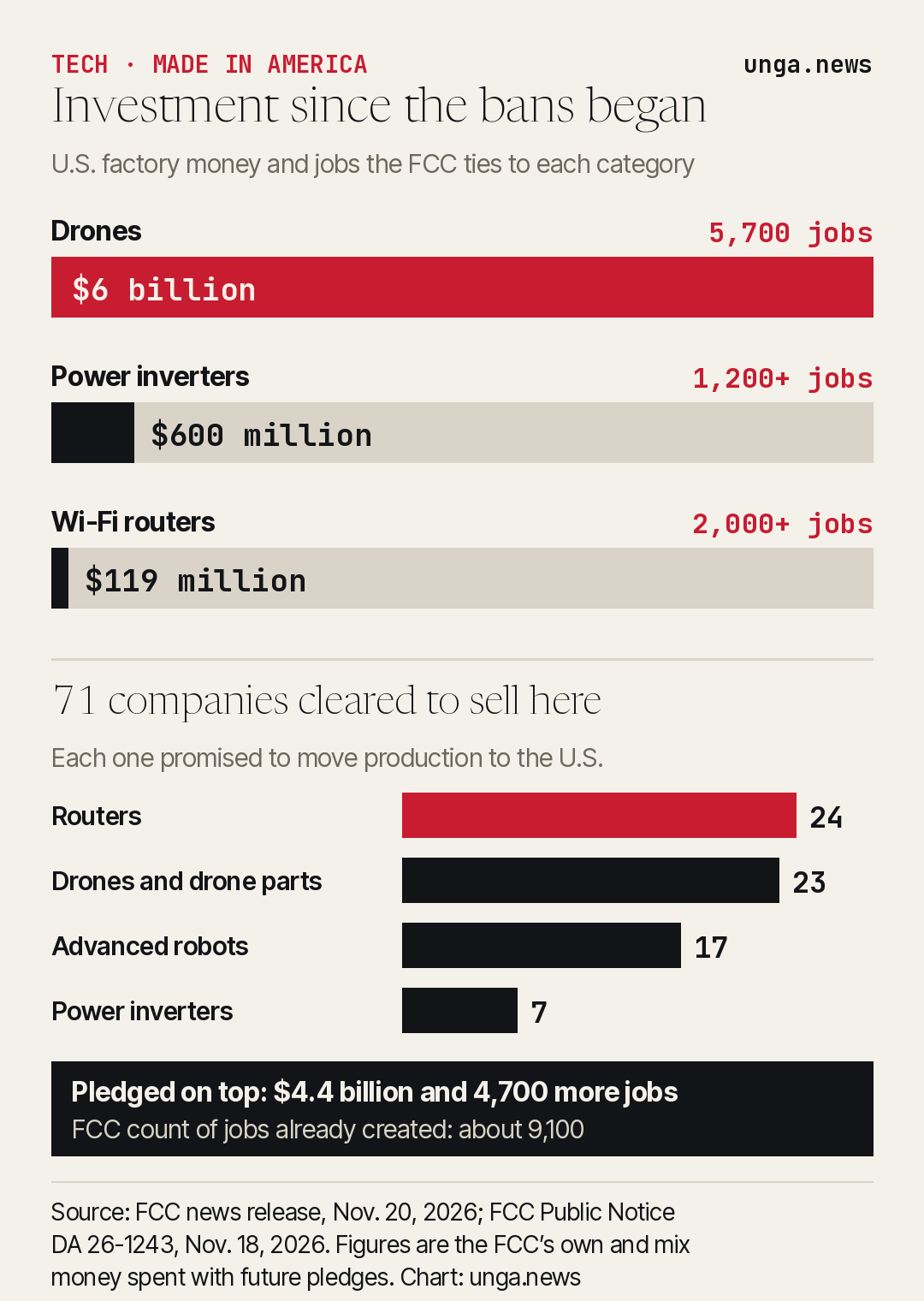
On top of that, 71 companies that build those products overseas have now been cleared to keep selling here, and every one of them had to promise to move production to American soil. Together, the FCC says, they have pledged another $4.4 billion and 4,700 jobs.
“The FCC’s Covered List has proven to be an essential tool in our national security toolkit, protecting America’s networks and communications infrastructure from dangerous products,” Carr said. “In addition to guarding against these threats, the Covered List has also generated a surge in investment in American manufacturing.”
A ban with a door built into it
The tool here is the Covered List, a roster the FCC keeps under a 2019 law, the Secure and Trusted Communications Networks Act, of gear that poses “an unacceptable risk to the national security of the United States.” Anything on it can’t get the FCC sign-off a new device needs before it goes on sale.
For years that list named specific companies. Starting last December, the commission went much bigger and added whole categories based on where things are made. According to the FCC’s Nov. 18 public notice, it added all foreign-produced drones and their key parts on Dec. 22, 2025. Foreign-made home routers followed on March 23, 2026. Foreign-made advanced robots and power inverters, the boxes that tie solar panels and batteries to the grid, were added on July 28. Each step was based on a national security finding from an executive branch panel that includes the country’s security agencies.
That’s a hard line, but it isn’t a blind one. Anything that already had FCC approval can still be used, imported and sold, so nobody’s drone or router got yanked out of their hands. And there’s a way in for trusted makers. A company hands over who owns it, how it handles cybersecurity and how it plans to build here. The Department of War and the Department of Homeland Security review it. If they’re satisfied, the product gets a “Conditional Approval” and comes off the banned list.
The FCC says that review now takes 24 days on average, down from 40 days three months ago.
Drones lead the way, and routers start from zero
The biggest money is in drones. The FCC says $6 billion has gone into U.S. drone manufacturing since December, tied to 5,700 jobs. That’s no small thing in a field Americans have mostly bought from overseas.
Power inverters drew about $600 million in new U.S. manufacturing in the second half of this year, along with more than 1,200 jobs.
Routers are the most striking line in the release. “There were no router companies building in the U.S. in 2025,” the FCC wrote, “and now there are more than 10 with plans to onshore manufacturing on the horizon.” The agency counts more than $119 million already invested and more than 2,000 jobs. The box blinking in your hallway may one day carry a “Made in USA” sticker.
In robots, the FCC pointed to Amazon’s new robotics manufacturing sites in Austin, Texas, and Greenwood, Ill., and a 130,000-square-foot robot assembly plant opened by Foundry Robotics.
Of the 71 approvals so far, 24 went to router makers, 23 to drone and drone-part makers, 17 to robot makers and seven to inverter makers. The list includes big household names. ASUS got its gaming and mesh Wi-Fi lines cleared in September. SpaceX’s Starlink routers were approved back in July. Husqvarna’s robot mowers and ABB’s factory robots are on it too.
This week’s batch added five more: an Italian heavy-lift drone from FlyingBasket, Wi-Fi 7 routers from EnGenius, a Zyxel router, four-legged robot platforms from SYNCROBOTIC and warehouse robots from BLUEPATH Robotics. Router approvals carry an end date, roughly 18 months out, so companies have to keep their onshoring promises to stay in the market.
What the numbers do and don’t say
These are the FCC’s figures, and they deserve a fair reading. The release doesn’t break the 9,100 jobs down company by company, and some of the money is spending already done while the $4.4 billion is a promise for the coming years.
Democratic Commissioner Anna Gomez has knocked what she called the “chaotic and haphazard way” the agency has rolled these bans out and walked parts back. After the Nov. 19 open meeting she also questioned using national security power to win factory pledges, according to DroneLife.
But look at what the policy actually asks. If you want to sell gear that sits inside American homes, rides on American power lines or flies over American neighborhoods, show the Pentagon and Homeland Security who owns you and start building here. Makers that pass get in, and makers that won’t stay out. It’s hard to call that overreach. It’s the deal most voters assumed Washington had been making all along.
The old approach left the country leaning on overseas factories for gear that touches its networks, its grid and its skies. Under Carr, the FCC turned a security rule into a reason to build in America, and it says 9,100 people already have jobs because of it. More than 400 meetings with industry, briefings for over 300 state, local and tribal officials, and more than 60 published guidance documents went into getting here, the agency says.
Seventy-one companies have already lined up for that bargain. Some of them ran their whole operation from overseas a year ago. Now they’re signing promises to hire in America, and that list keeps getting longer every few weeks.
Sources
- Federal Communications Commission — FCC Announces Latest Conditional Approvals for Covered List Equipment (Nov. 20, 2026)
- Federal Communications Commission — Public Notice DA 26-1243: Conditional Approval and Exemption of Certain UAS, Routers, and Advanced Robotic Devices From FCC Covered List (Nov. 18, 2026)
- Federal Communications Commission — List of Equipment and Services Covered By Section 2 of the Secure Networks Act
- DroneLife — FCC Reports $6 Billion in U.S. Drone Manufacturing Investment as Conditional Approvals Expand (Nov. 23, 2026)
- Communications Daily — FCC Says Bans on Foreign-Made Devices Are Having Desired Effect (Nov. 23, 2026)