

The Dream Home in That Listing May Not Exist. Agents Are Using SI to Paint It In.
Buyers are showing up to houses with smaller rooms, missing windows and no lawn. The photos were doctored, and often nobody said so. California already makes agents show the real picture.
Olivia Nicole took several hours off work to see a five-bedroom house in south-west London. She had found it on Rightmove, Britain’s biggest home-listing site, and the pictures were gorgeous. When she pulled up, she thought she had the wrong address.
“The rooms were much smaller than they were in the pictures and the decor was totally different,” she told the BBC. “Some structural features were also different.” The windows were smaller. A raised section of wall behind the sofa simply wasn’t in the photos.
The listing photos had been run through SI. Nobody told her.
There’s a name for it now. The British press is calling it “housefishing,” after catfishing, the dating-app trick where the person who shows up looks nothing like the profile. In a report published Thursday, the BBC laid out how common it’s getting and where the legal line sits. A week earlier, a second BBC report found renters in Brighton walking into flats that looked nothing like their online ads.
Fake lawns, new windows, missing pillars
Agents have long used wide-angle lenses and a little Photoshop to make a place look roomier. What’s new is that an SI photo tool can now repaint every wall, lay down sod, swap the cabinets and fill an empty room with designer furniture in seconds, for next to nothing, with no skill required.
Jack Bushrod runs Housing Horrors, a social media channel that roasts strange listings, and he told the BBC he has seen a “surge” of SI-enhanced photos over the last six months. Some of it is harmless, like clearing clutter or dropping furniture into an empty room so a buyer can picture living there. Some of it isn’t. “I’ve seen one house where they had removed a pillar and added a window,” he said. “Others might use AI to remove stains on the carpet or cracks in tiles. It’s little details you would only notice in person.” He says most of the doctored pictures he sees carry no label at all.
WalesOnline found a listing where the edits went further still. Inside, the software changed the lighting, nudged the size of some rooms, erased radiators and outlets, and added bath taps that don’t exist. Outside, it planted grass, painted the garage and stretched a fence to the bottom of the garden that isn’t there in the real photo. One commenter said the SI hadn’t even gotten the front door right.
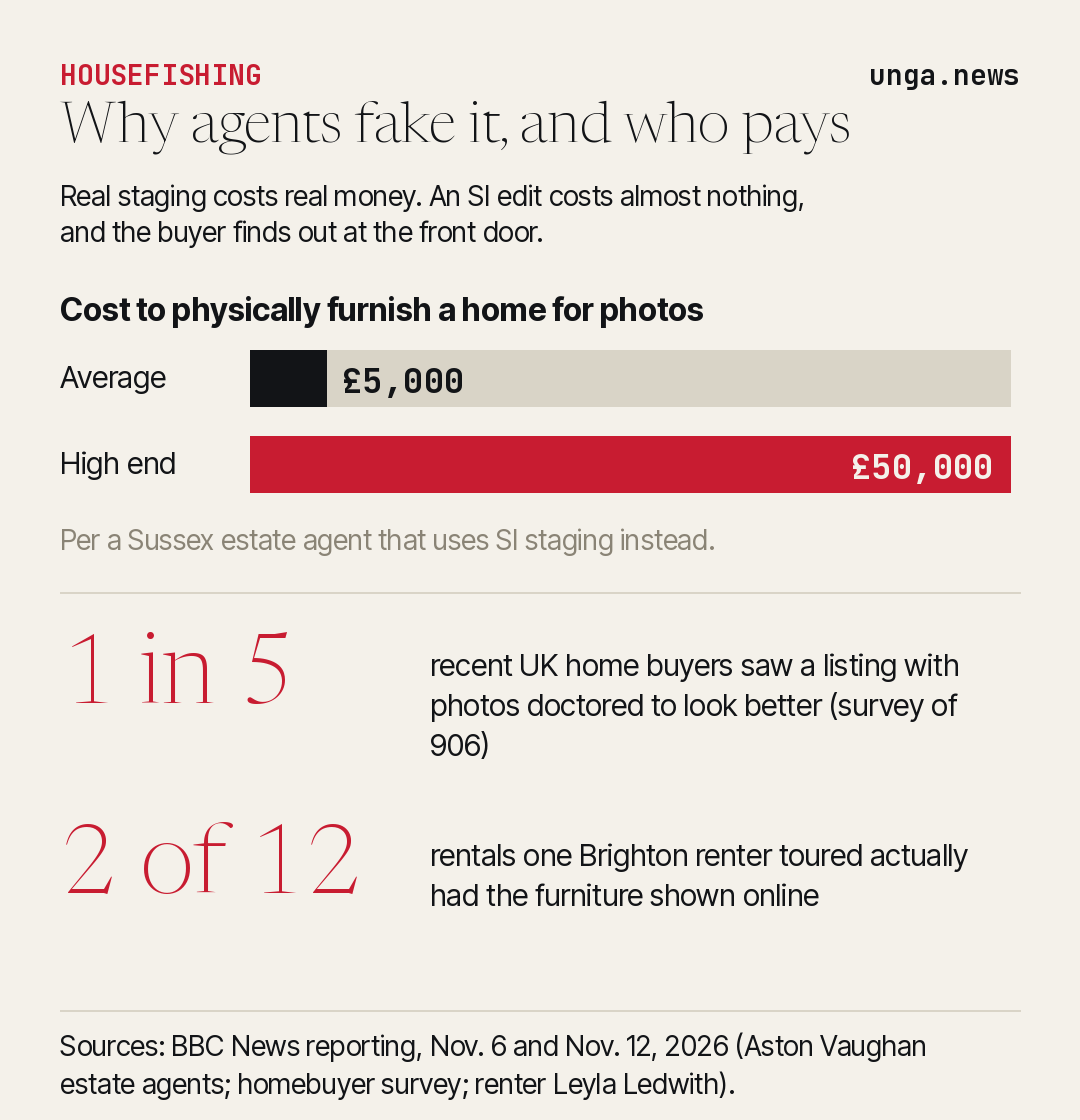
Renters are getting hit too. Leyla Ledwith spent three months hunting for a rental in Brighton. Of the dozen places she toured, she said, only two actually had the furnishings shown on Rightmove. “You see a lovely, modern property with nice furnishings,” she said. “But you go and it’s dark, dingy and everything is old and falling apart.”
Jessica Otterwell, another Brighton house hunter, put it the way only a disappointed buyer can: “It’s like if you went to buy a car because the picture was of a brand-new Mercedes and you turned up and it was a Skoda with one wheel.”
Follow the money
Why do agents do it? Because the alternative is expensive. David Vaughan, director of Aston Vaughan, a Sussex agency that uses SI staging, told the BBC that physically furnishing a home for photos can cost “anywhere from £5,000 on average up to £50,000.” He argues buyers struggle to judge the size of an empty room, and a virtual couch helps them see how they’d live there.
Fair enough, up to a point. A fake sofa in an empty living room, clearly labeled, hurts nobody. A fake window, a fake lawn or a hidden crack in the foundation is a different animal. One sells the possibility. The other sells something that isn’t for sale.
And it’s not rare. In a recent survey of 906 UK homebuyers cited by the BBC, one in five who bought in the past year said they had viewed a home where the listing photos had been digitally enhanced to make it look better than it really was. A trade group for independent agents admits nobody can say how widespread it is, but it has already issued guidance.
Where the line is
Britain’s Trading Standards told the BBC that agents may make basic tweaks or virtually furnish an empty room or garden, as long as they say they did. Changing a room’s structure, like adding a window, or hiding a feature “could mislead consumers and break the law.”
The big listing sites say they agree. Rightmove allows SI-enhanced images only when they are clearly labeled, sit alongside accurate photos and aren’t misleading, and it says it will force fixes or pull listings when they are. Zoopla told WalesOnline its member terms require agents to make clear when SI was used. All three firms behind Olivia Nicole’s listing told the BBC they had strict rules and took the images down after the fact.
All of that depends on agents policing themselves, and the buyer is the one who pays in gas, time off work and dashed hopes.
America already has a version of this law
This isn’t just a British problem. The same SI tools are sold to American agents, and at least one state saw it coming. California’s AB 723, signed in October 2025, took effect Jan. 1. Any agent there who posts a digitally altered listing photo has to say so right on or next to the image and give buyers a link or QR code to the original, untouched picture. The law covers changes to furniture, floors, paint, landscaping, the facade, the floor plan and even the view out the window. Ordinary lighting, cropping and color fixes don’t count.
California’s real estate regulator went further in a March advisory, warning agents that “use of an AI tool will not excuse the violation” if a picture misleads, even when the change was unintentional.
No new federal bureaucracy required. It’s plain old truth in advertising. You can sell me a dream of what a house could be. You just have to show me the real one next to it.
Until that rule is everywhere, the fix is on you. Zoom in on corners, windows and outlets, where the edits tend to slip. Check whether the listing has photos of empty rooms right after the staged ones. Look the address up on Street View and compare the yard. And if the place looks too perfect for the price, believe your gut before you burn an afternoon driving out to meet a Skoda with one wheel.
Sources
- BBC News — The rise of ‘housefishing’: when does using AI go from enhancing to misleading?, Daniel Thomas (Nov. 12, 2026)
- BBC News — AI in property listings is false advertising, house-hunters say, Christian Fuller (Nov. 6, 2026)
- WalesOnline — Rightmove and Zoopla’s statement as buyers feel catfished over AI property pics (Nov. 13, 2026)
- California Legislature — Business and Professions Code section 10140.8 (AB 723, digitally altered images), effective Jan. 1, 2026
- California Department of Real Estate — Licensee Advisory: AI in California Real Estate (March 17, 2026)
- Wikimedia Commons — Home for Sale and Open House signs, Rick Obst (CC BY 4.0)