

The FBI Says a Free SI Hacking Kit Can Break Into a Company in Under Three Hours
Criminals turned a security-testing tool into an almost automatic break-in service. South Korean banks and more than 2,250 backup customers have already been hit.
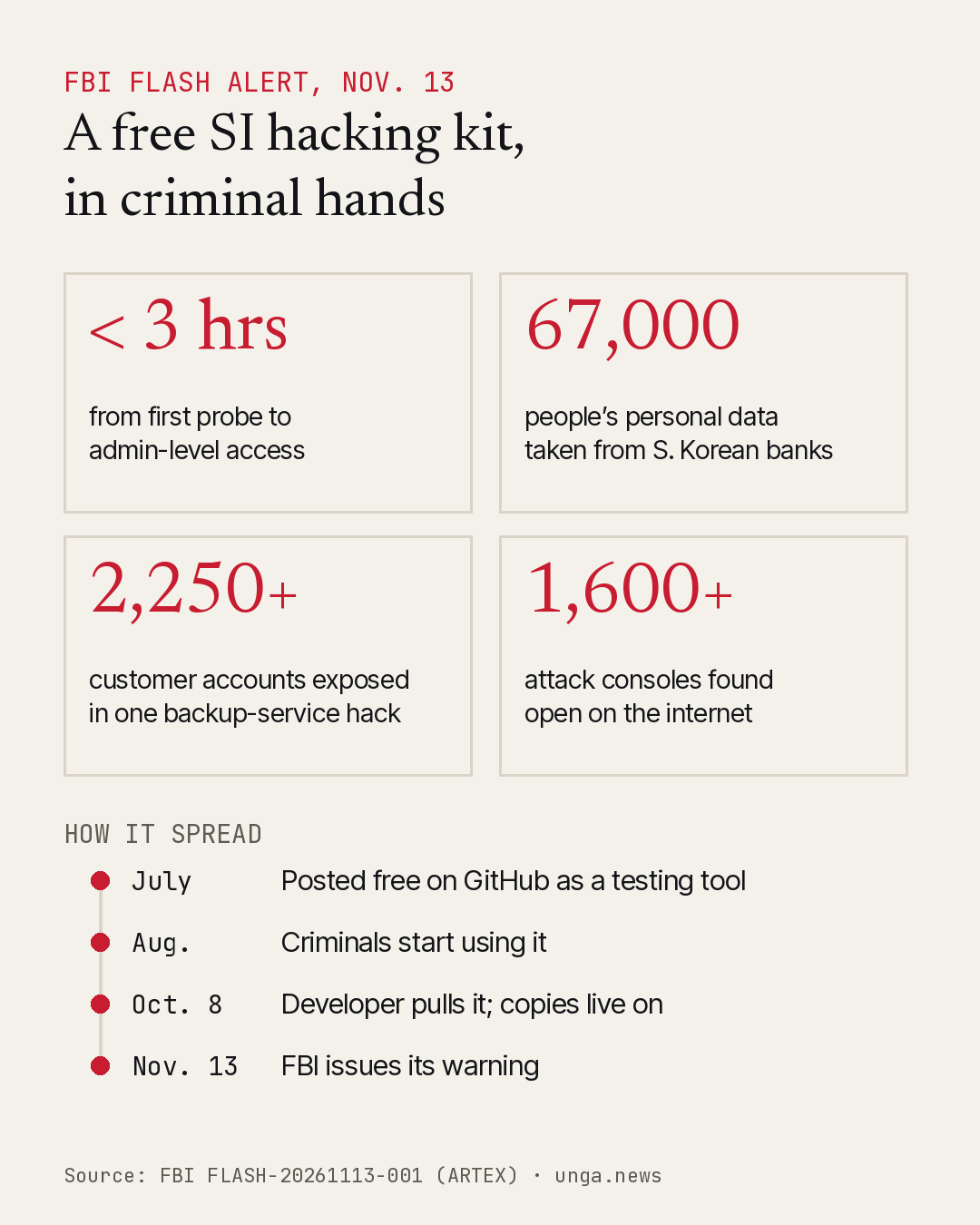
A hacker used to need years of skill, a team and weeks of patience to break into a big company’s network. According to the FBI, a free SI tool now does most of that work for them, and in some cases it gets from first knock to the keys of the kingdom in under three hours.
The bureau put out a FLASH alert on Nov. 13 about ARTEX, an open-source program that strings together SI agents to run a cyberattack almost on autopilot. The attacker types a goal in plain English. The agents scout the target, find a weak door, slip through, grab higher-level access and haul the data out. The FBI says criminals have been using it since at least August against banks, government offices, defense contractors, chipmakers, hospitals, energy companies, telecoms and law firms around the world.
“The framework enables threat actors with minimal technical expertise to conduct complex, multi-target operations simultaneously, fundamentally accelerating attack velocity and expanding operational scale,” the FBI alert says.
A testing tool that got loose
ARTEX didn’t start as a crime kit. A developer going by “Autumn-27” posted it on GitHub in July and billed it as a tool for authorized security testing, the kind of thing companies pay professionals to run against their own systems to find holes before the bad guys do. It caught on fast, picking up an estimated 1,500 to 2,000 stars on GitHub within 10 weeks.
Then the bad guys found it. After reports of abuse, the developer pulled the project down on Oct. 8. It didn’t matter. The FBI says the tool lives on through community copies, local spin-offs, archived versions and even a paid edition called ARTEX PRO. As of early November, researchers had counted more than 1,600 ARTEX control panels sitting open on the public internet, and the bureau says the real number is likely much higher once you count the ones hidden behind firewalls.
ARTEX doesn’t come with its own brain. It plugs into outside SI models from the big American labs and from open-source and Chinese developers. When investigators looked at attacker-run copies, Chinese models were the most common, with DeepSeek’s Flash family dominating because it is capable, cheap and, in the FBI’s words, shows a “lack of observable guardrails when framed for penetration testing.” In other words, tell it you’re a security tester and it doesn’t ask many questions.
Real victims, real data
This isn’t a lab demo. The FBI points to financially motivated attacks on South Korean financial institutions that stole personal information on about 67,000 people. It also cites a supply-chain hit on ConnectWise’s cloud backup service that opened a path into more than 2,250 customer accounts downstream. Hit the vendor and you get everyone who trusts the vendor.
That is the pattern the bureau keeps coming back to. ARTEX is good at finding the back doors nobody watches: supplier portals, phone-app back ends, old systems a department set up years ago and forgot about, sales tools, third-party add-ons. The flagship website may be locked tight. The partner login page built in 2019 may not be. The FBI even describes agents tampering with the system a company used to distribute its iPhone apps after finding cloud passwords left exposed.
The alert’s technical table reads like a greatest-hits list of hacking moves, all run at machine speed: password guessing, stolen VPN files, hardcoded admin passwords sitting inside website code, database break-ins, and one case where agents cataloged more than 110,000 user and computer records inside a company’s network. They even checked which machines were missing antivirus protection, so they knew where to walk.
There is one small piece of good news in the alert. All that speed makes noise. The FBI says ARTEX generates a lot of traffic that can set off alarms. The problem is the clock. By the time a security team gets a meeting together, the attack may already be finished.
What the FBI wants companies to do
The bureau’s fix list is mostly old-fashioned homework done more seriously. Inventory every app that faces the internet, including the forgotten ones. Lock admin tools and backup systems behind private connections instead of leaving them on the open web. Hunt down passwords and keys buried in code and rotate them. Put rate limits on portals so one session can’t pull thousands of customer records in a row. Any company that ever connected ConnectWise’s affected apps to Microsoft 365 is told to review those connections even if it stopped using them, and to keep them switched off until the vendor says otherwise.
For regular people, the takeaway is less technical and more annoying. Your data sits with your bank, your doctor’s office and dozens of companies you forgot you gave it to, and many of them lean on vendors you have never heard of. A free SI tool now lets a small crew test all of those doors at once. That raises the bar for every company holding your information, and it’s why the FBI went public with this one.
It also says something about the tools themselves. American labs have spent the year arguing about guardrails. The model the attackers keep reaching for is the cheap Chinese one that doesn’t seem to have many.
Sources
- FBI / IC3 — Threat Overview of ARTEX Autonomous Penetration Testing Framework (FLASH-20261113-001)
- TechCrunch — FBI says Artex AI open source hacking tool used to breach networks in ‘under three hours’
- BleepingComputer — FBI warns ARTEX AI hacking tool is powering global cyberattacks