

The FDA Stopped Calling It ‘Artificial’ Intelligence. On Trump’s Order, It’s Super Intelligence Now.
Starting Nov. 16, the agency that approves your medicines and medical devices uses “Super Intelligence” and “SI” in its new documents. More than 1,600 devices it has cleared already use the technology.
The agency that decides which drugs and medical devices reach your pharmacy and your doctor’s office has changed its vocabulary. Starting this week, the Food and Drug Administration calls the technology Super Intelligence, or SI.
The switch took effect Monday, Nov. 16. In a notice posted on its website, the FDA said it “will use ‘Super Intelligence’ and ‘SI’ in newly issued public-facing documents and communications, as applicable and permitted by law.” New guidance, new letters, new web pages: SI from here on.
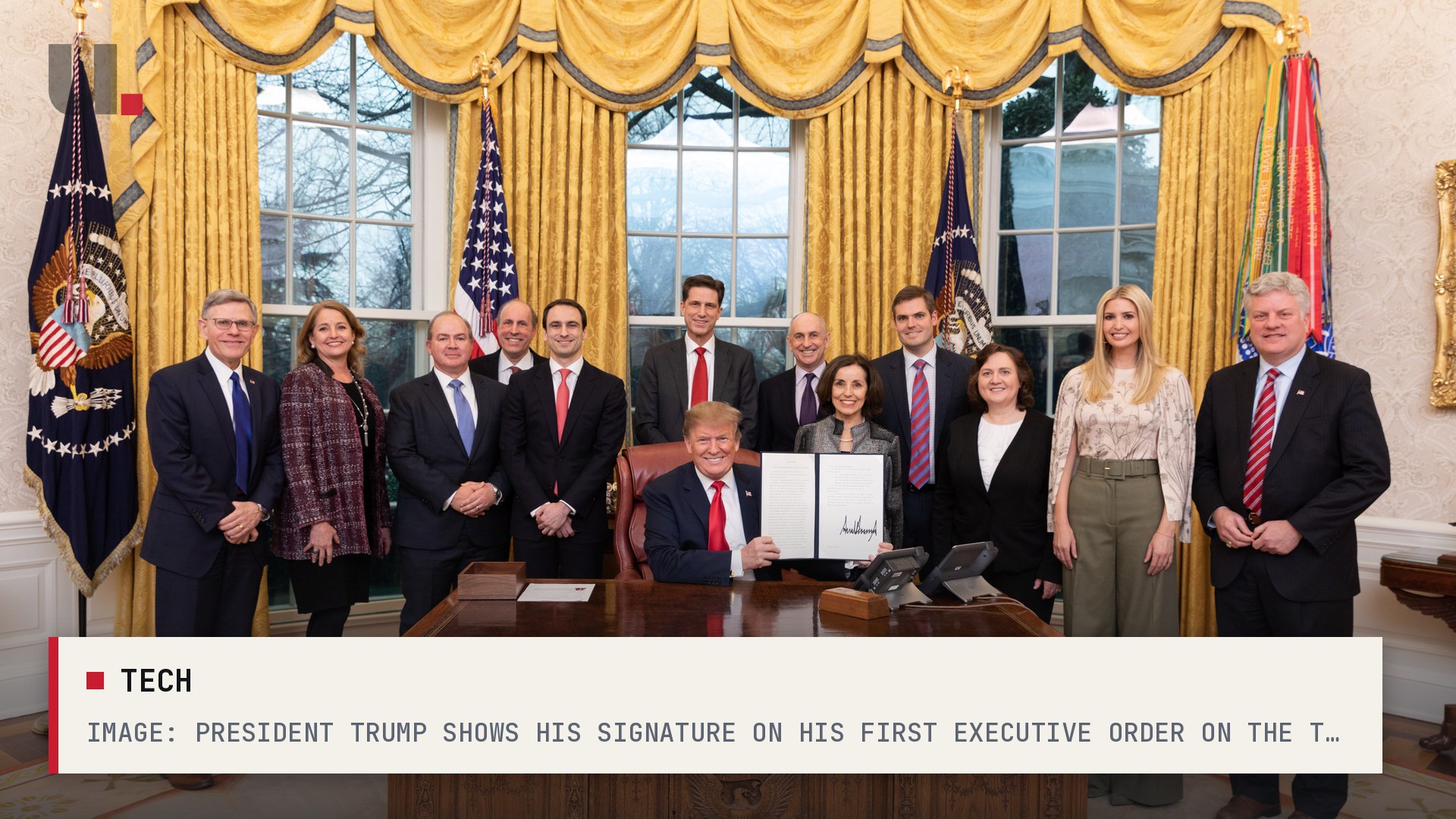
The order came from the top. On Sept. 29, President Trump signed Executive Order 14434, titled “Inaugurating the Era of Super Intelligence,” and the FDA is one of the biggest agencies to put it into practice so far.
Trump’s case for the new name
The executive order makes a straightforward argument. The field got its name in the 1950s, and the president says the old label no longer fits what American companies are building.
“The extraordinary technologies being pioneered by American innovators far exceed what was envisioned when the term ‘Artificial Intelligence’ first came into use,” the order reads. Today’s systems, it says, “increasingly amplify human ingenuity and unlock new forms of creativity, empowering Americans to achieve what was previously impossible across science, medicine, and nearly every other domain of human endeavor.”
The conclusion: “the term ‘Super Intelligence’ more appropriately captures the promise, potential, and rapidly advancing capabilities of these technologies.”
The order tells every executive agency to use the new terms “to the maximum extent permitted by law” in letters, public messages, websites, reports and policy papers. The White House fact sheet put it plainly: agencies are “to no longer acknowledge” the old terms.
It also reaches beyond word choice. Within 60 days, the president’s science and technology adviser has to send him draft legislation for a federal definition of Super Intelligence, including whether it should replace the old statutory definition. That clock runs out at the end of this month.
What changes on the FDA’s paperwork
Medicine was always going to be the place where this mattered most, because the FDA already oversees a mountain of these products. Its public list of authorized devices that use the technology runs to 1,614 entries, by our count of the list as last updated Sept. 4.
Most of them are not robots. They are software that reads a mammogram, flags a possible stroke on a brain scan, measures a heart on an ultrasound or sharpens a blurry MRI. About three in four, 1,230 of the 1,614, sit in radiology. Cardiology is a distant second with 154.
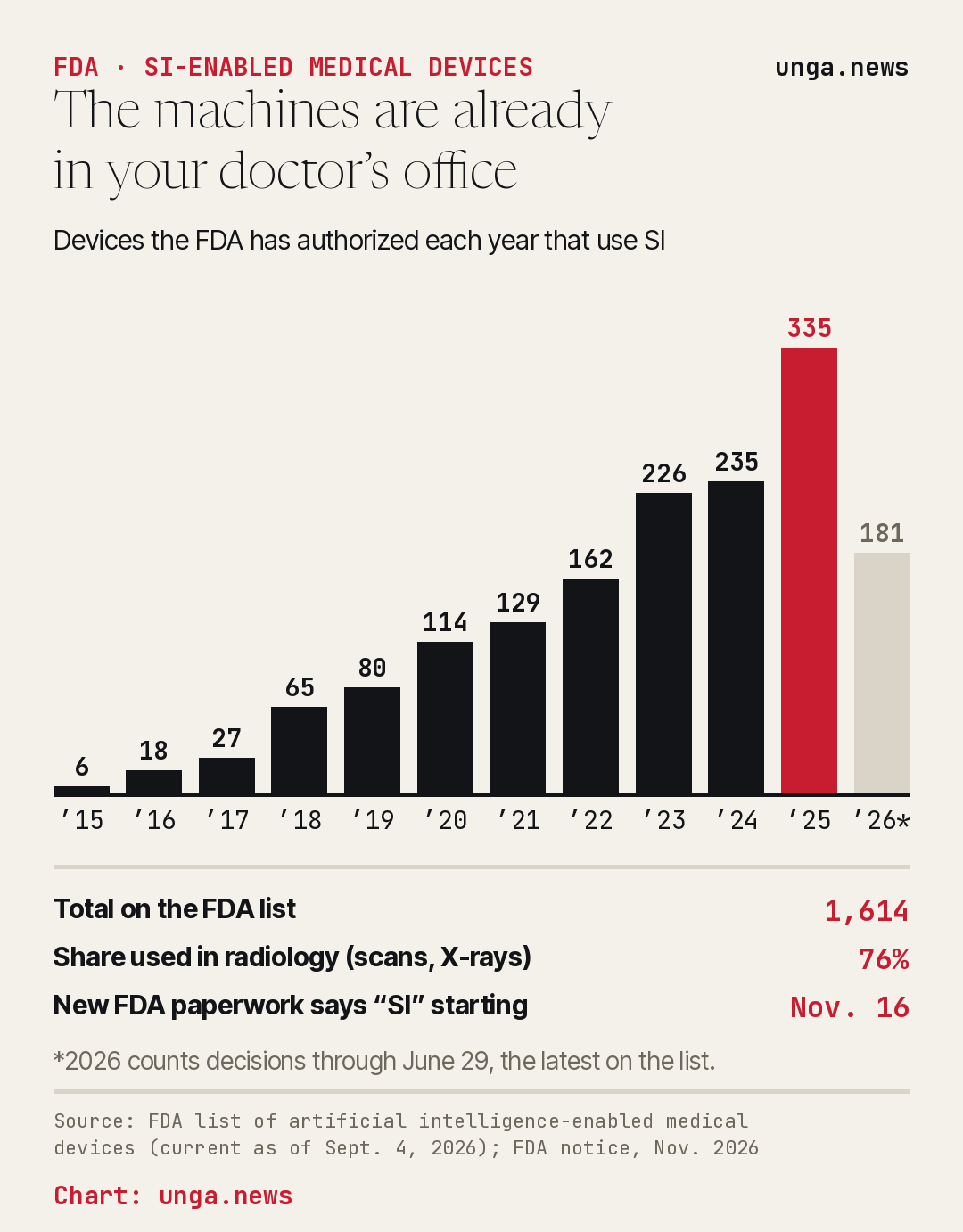
The pace keeps climbing. The FDA authorized six of these devices in 2015 and 335 in 2025, a record. Through June 29 of this year, the latest decision on the list, it had already cleared 181 more.
The agency was careful to say what the rename does not do. Every existing guidance, regulation and Federal Register notice “remain[s] in effect as written.” Older documents get the new wording only at “each document’s next substantive revision,” and forms, submission templates and databases will be updated “on their normal maintenance cycles.” Where a law itself says “artificial intelligence,” the FDA will keep quoting the law exactly.
Companies don’t have to change a thing. The order “does not create any new requirement for sponsors, applicants, manufacturers, or others who submit information to FDA,” the notice says, “including with respect to established names, proprietary names, trade names, or labeling.” A device maker can keep the old label on its box. The FDA’s letters back to that company will just use the new one.
Nothing about how a product gets reviewed moves either. The order defines SI by pointing straight to the existing definition in federal law, so the same tools fall under the same rules with the same evidence required.
Lawyers shrug, one researcher worries
Industry lawyers mostly see a paperwork change. Sydney White, an attorney at Wiley Rein, told the regulatory trade group RAPS that the order applies only to executive branch agencies, so drug and device makers aren’t on the hook. She added one caveat: “private-sector organizations could be affected if any of the EO’s directives are enacted into law.”
That is the piece worth keeping an eye on, since the adviser’s draft definition is headed to the president within days.
Christina Silcox, research director for digital health at Duke University’s Margolis Institute for Health Policy, called it “more of a semantic change than a meaningful change because neither artificial intelligence nor super intelligence have particularly strong definitions.” Her bigger worry is people. Calling every clinical tool super intelligence, she told RAPS, could lead to “over-reliance on the results by clinicians and patients.”
That concern cuts both ways. The FDA’s review standards didn’t get weaker on Monday, and a stroke-detection program has to prove itself with the same data it did last week. If anything, a bigger name puts more pressure on the companies selling these tools to live up to it.
The FDA has been moving on the tougher questions on its own schedule. In August it began taking public comments on how to regulate products built on the newest generative programs, including a possible “competency-based approach” to review, as MassDevice reported.
For a patient, the practical change is small. Your hospital’s scan-reading software works the same as it did Friday. What’s different is the language the government uses about it, and on that, the president has made his call. America invented this technology, he argues, and its own government should describe it by what it can do now, not by what it could do in 1956.
The FDA just got in line.
Sources
- FDA — FDA’s Use of “Super Intelligence” and “SI” Under Executive Order 14434
- The White House — Inaugurating the Era of Super Intelligence (Executive Order 14434)
- Federal Register — Inaugurating the Era of Super Intelligence
- The White House — Fact Sheet: President Donald J. Trump Inaugurates The Era of Super Intelligence
- FDA — Artificial Intelligence-Enabled Medical Devices (list)
- RAPS — FDA to refer to AI as ‘super intelligence’ going forward
- MassDevice — FDA moves from AI to SI, but sponsors don’t have to follow