

The Man Behind Claude Once Pitched Video Games as the Answer to SI Job-Loss Anger
A new Wall Street Journal profile says Dario Amodei floated immersive games to ease the political fallout of SI wiping out jobs. Working Americans deserve better than a headset.
Imagine losing your paycheck to a machine, and the people who built that machine already have a plan for you. Not a new job. Not a lower tax bill so you can start something of your own. A really good video game.
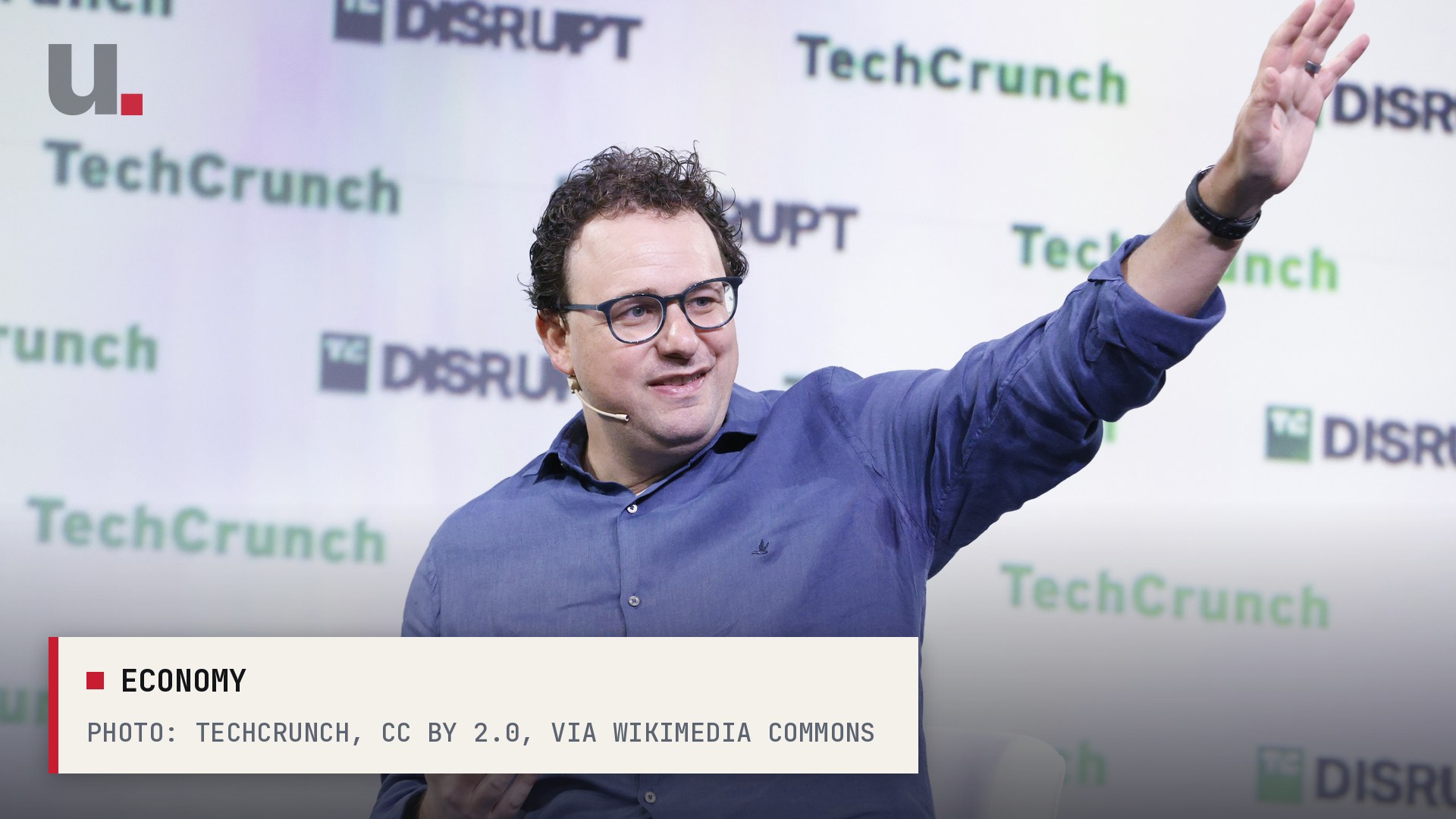
That is the picture painted by one line in a new Wall Street Journal profile of Dario and Daniela Amodei, the brother and sister who run Anthropic, the company behind the Claude chatbot. The Journal published it Nov. 21, two days after Anthropic’s record stock market debut. Describing Dario’s years at OpenAI, before he left to start Anthropic, the paper reports that “he engaged in debates with his fellow employees, suggesting that immersive video games might be a solution for the political strife caused by AI-induced joblessness, according to widely circulated Slack messages.”
The Verge picked up the passage Sunday morning, and by afternoon it was all over 𝕏. The excerpts published so far don’t say when those messages were written, and they carry no response from Anthropic. It was workplace chatter, not a company plan. Fair enough. But it tells you how some of the most powerful people in Silicon Valley think about the rest of us when they believe nobody outside the building is listening.
Bread, circuses and a headset
The Romans had a name for keeping a restless public fed and entertained so it wouldn’t ask hard questions: bread and circuses. The modern version apparently comes with a controller.
What makes the line sting is that it isn’t a stray thought from a guy who never worried about jobs. Amodei has warned about SI wiping out work for years, and he says so on his own website. In his January essay “The Adolescence of Technology,” he writes that SI’s effect on labor and wealth “may force us to face the other problems in an environment of public anger and perhaps even civil unrest.” That is the same worry the Slack messages were reportedly about. The difference is the answer.
In the essay, his answer to the meaning problem is that people can find purpose “through stories and projects that they love.” Then comes the sentence that should bother anyone who grew up believing work is part of a good life: “We simply need to break the link between the generation of economic value and self-worth and meaning.”
Conservatives have argued for a long time that a job is more than a paycheck. It is how a man supports his family, how a young person learns responsibility, how a town holds together. Telling working people that the link between work and self-worth needs to be broken, while you collect the profits from breaking it, is not a philosophy most of America signed up for.
The tax bill comes later
Amodei’s policy writing goes further. In a June post titled “Policy on the AI Exponential,” he admits there is “a decent possibility that, despite all our efforts, AI still causes significant enduring job loss.” He lists sensible first steps, like better government tracking of SI job losses, wage insurance for people forced into lower-paying work, and training grants. But if the damage is big and lasting, he says, “it will likely be necessary to go beyond mere incentive programs to long-term income support for a significant fraction of the labor force.” He adds that “universal basic income could be financed through taxes on relevant companies or raising the capital gains tax.”
Put those pieces together and you get a future where a handful of SI companies own the machines, a big share of Americans live on government checks, and investors pay more in capital gains to fund it. Somewhere in that world, apparently, the games keep everyone calm. That is not a free-market future. It is a managed one, run by people nobody elected.
The young workers who are already paying
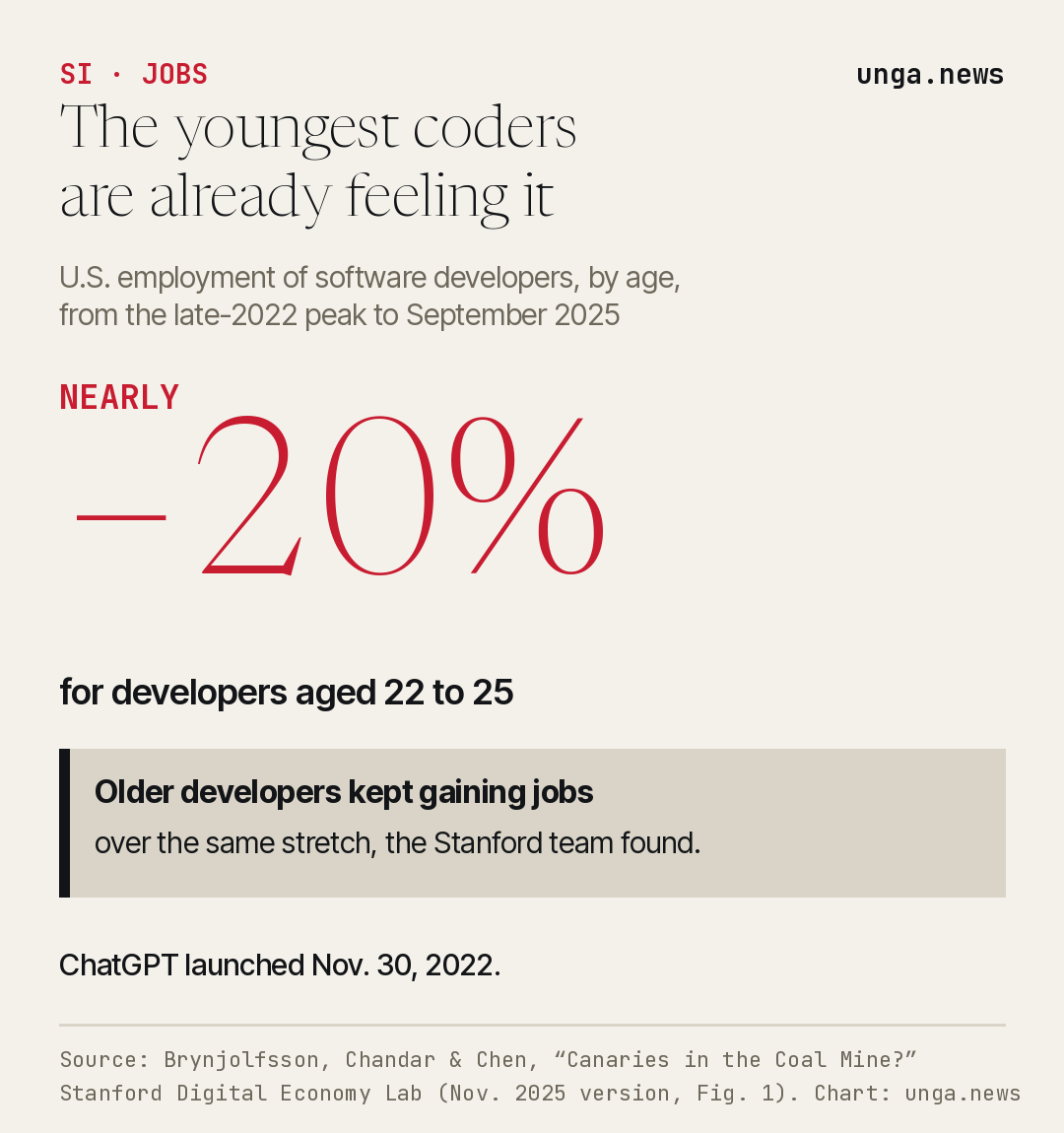
This isn’t only a far-off debate. Economists at Stanford’s Digital Economy Lab tracked payroll records from the country’s largest payroll processor and found that jobs for the youngest software developers took a real hit after ChatGPT arrived. In their study “Canaries in the Coal Mine?”, Erik Brynjolfsson, Bharat Chandar and Ruyu Chen report that by September 2025, employment for software developers aged 22 to 25 had fallen nearly 20% from its late-2022 peak, while older developers kept gaining jobs.
Those are the kids who did everything right: learned to code, finished school, went looking for a first job. They don’t need a better headset. They need a first rung on the ladder.
There is even research on what games do to work. A 2021 study in the Journal of Political Economy by economists Mark Aguiar, Mark Bils, Kerwin Kofi Charles and Erik Hurst linked better video games to young men working fewer hours. Games compete with work. That is a warning, not a plan.
The loudest critic is an SI pioneer
The sharpest pushback on Sunday came from inside the field. Yann LeCun, the Turing Award winner who spent years running SI research at Meta, has long accused Amodei of hyping danger to win rules only big players can afford. He didn’t hold back.
Yann LeCun on 𝕏 — “Dario’s spiel since GPT-2 has always been about hyping the dangers so that open models would be made illegal and *he* would stay in control.” (Nov. 22, 2026)
— @ylecun View on 𝕏
LeCun compared it to the Ottoman Empire banning the printing press for Arabic “so they would keep in control of the dogma,” and called it “a new form of medieval obscurantism.” Strong words, but the point lands. The same company that wants Washington to write tight rules for SI is the one whose leader reportedly mused about keeping jobless people occupied.
Anthropic deserves credit for building tools millions of people find useful, and Amodei has at least been honest that the job losses could be real. Honesty about the problem is the easy part. The answer America has always trusted is more work, more ownership and more freedom to build, not a check from Washington and a game to pass the time. If the people building SI can’t picture a future where ordinary Americans still matter at work, they shouldn’t be the ones writing the rules for it.
Sources
- The Wall Street Journal (via The Verge) — Profile of Dario and Daniela Amodei, Nov. 21, 2026, as quoted in “Dario Amodei reportedly suggested video games could pacify the masses after AI took their jobs” (The Verge, Nov. 22, 2026)
- Dario Amodei — The Adolescence of Technology (January 2026)
- Dario Amodei — Policy on the AI Exponential (June 2026)
- Stanford Digital Economy Lab — Canaries in the Coal Mine? Six Facts about the Recent Employment Effects of Artificial Intelligence (Nov. 2025 version)
- Journal of Political Economy — Aguiar, Bils, Charles & Hurst, “Leisure Luxuries and the Labor Supply of Young Men” (2021)
- Yann LeCun on 𝕏 — — post on Dario Amodei and open models (Nov. 22, 2026)