

USAID's Money Stopped in 2025. Since Then, the Left Has Lost From Santiago to Tokyo.
Since USAID was dismantled in 2025, the right has won from Santiago to Tokyo. Brazil could follow on Oct. 25, and America votes Nov. 3.
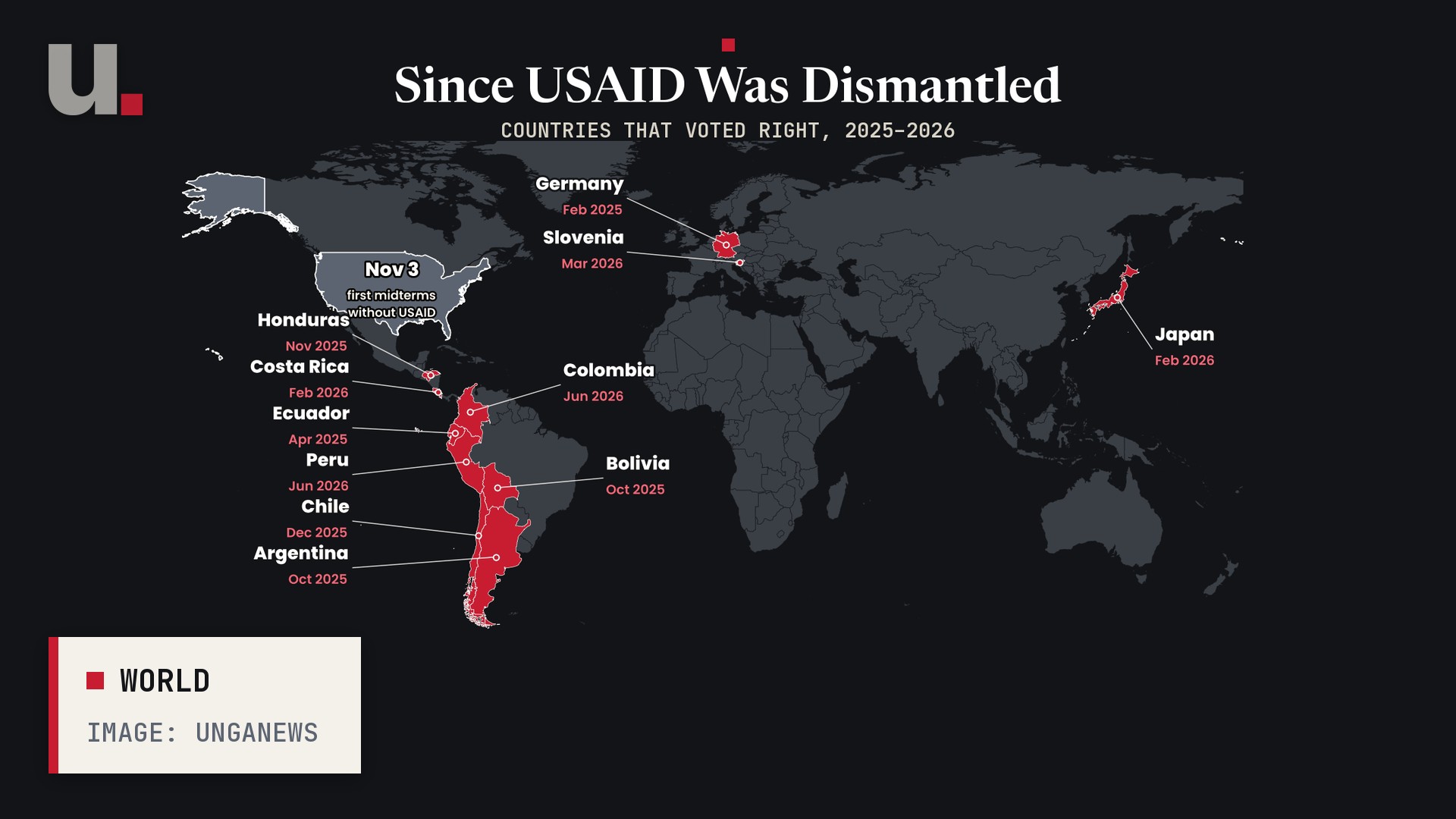
For decades, Washington ran a quiet political machine overseas and called it aid. In early 2025 the new administration switched it off. Then the elections started coming in, and the left started losing. Country after country, on three continents, in less than two years. There is a connection here, and at this point it is crazy obvious.
USAID started getting dismantled in early 2025. Since then: Germany went right. Argentina went right. Bolivia went right... (map)
— @UngaTheGreat View on 𝕏
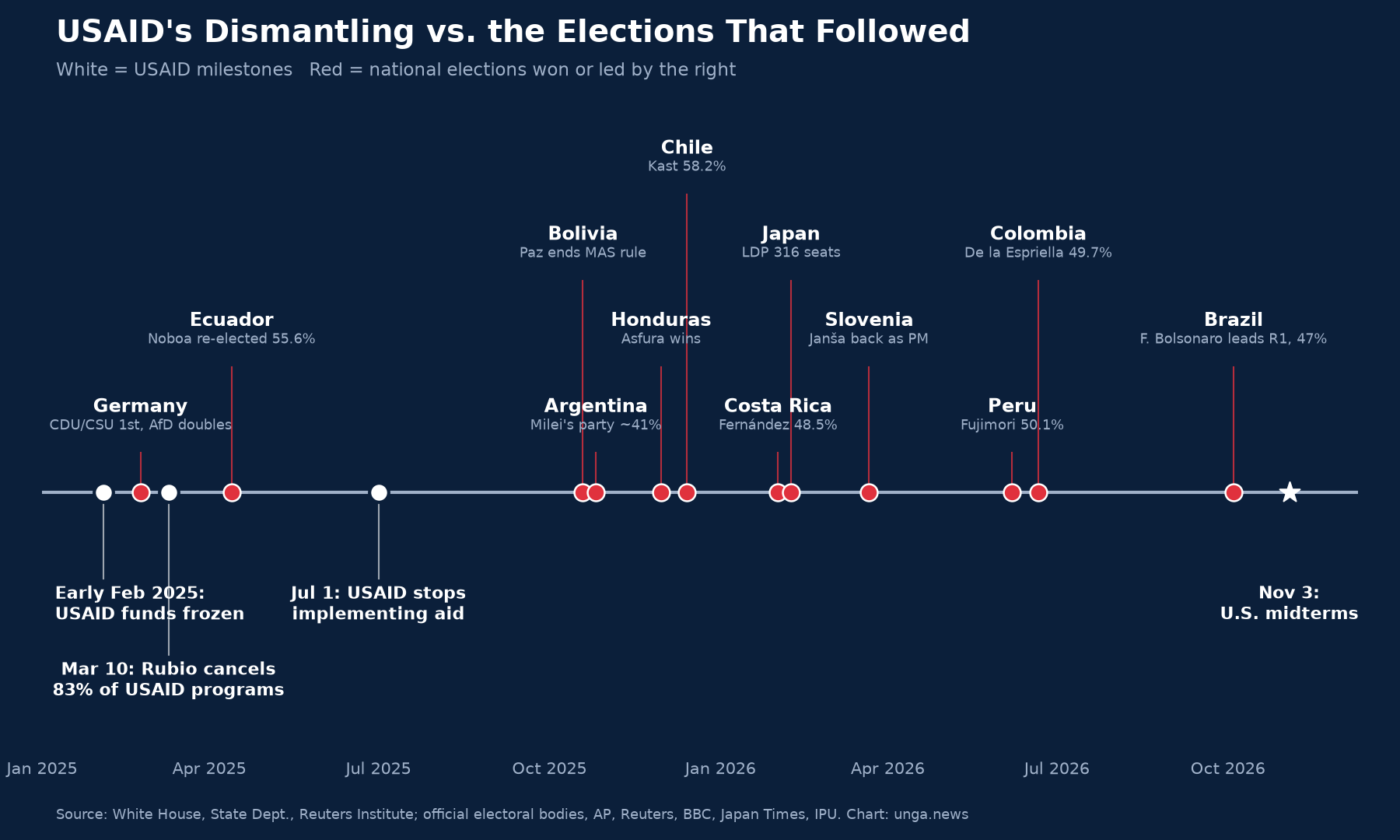
Start with what happened to the machine. Funding from the U.S. Agency for International Development was frozen in early February 2025, as the Reuters Institute at Oxford documented. On March 10, Secretary of State Marco Rubio announced the verdict on X: "After a 6 week review we are officially cancelling 83% of the programs at USAID." He added that the 5,200 cancelled contracts had "spent tens of billions of dollars in ways that did not serve, (and in some cases even harmed), the core national interests of the United States."
After a 6 week review we are officially cancelling 83% of the programs at USAID. (Marco Rubio)
— @marcorubio View on 𝕏
On July 1, 2025, USAID stopped implementing foreign aid altogether, and what survived was folded into the State Department. In his July 1 essay on the agency's end, Rubio did not describe a charity. He said USAID had built "a globe-spanning NGO industrial complex at taxpayer expense," and wrote that "too often, these programs promoted anti-American ideals and groups, from global “DEI,” censorship and regime change operations, to NGOs and international organizations in league with Communist China and other geopolitical adversaries." Those are the words of the man who audited it.
The White House's February 2025 list gave a taste of what the money bought, including "$47,000 for a “transgender opera” in Colombia" and "$32,000 for a “transgender comic book” in Peru." Critics at FactCheck.org pointed out that those two grants ran through U.S. embassies and the State Department rather than USAID itself. That is a distinction without a difference. It shows the same cultural project ran across the whole foreign-aid apparatus, and Colombia and Peru are both on the map of countries that have since turned right.
USAID Wasn't Aid — It Was Leftist Electioneering (Don Jr. clip)
— @UngaTheGreat View on 𝕏
Donald Trump Jr. put it bluntly in a clip that has circulated on X: "It's almost like USAID had nothing to do with aid and everything about perpetuating the leftist ideology." Look at the scoreboard and tell me he is wrong.
The scoreboard
Germany voted first, on Feb. 23, 2025. The CDU/CSU finished first with 28.5 percent, and the Alternative for Germany doubled its share to 20.8 percent, up from 10.4 percent in 2021, according to Germany's Federal Returning Officer. In April, Ecuador stayed right: President Daniel Noboa was re-elected in a runoff with 55.63 percent over Luisa González, the candidate of the movement founded by former leftist president Rafael Correa.
In October, Argentina's voters handed Javier Milei's La Libertad Avanza roughly 41 percent of the national vote in the midterms, a big win that boosted markets. That same month Bolivia elected Rodrigo Paz in a runoff, ending nearly 20 years of socialist MAS rule in what the BBC called a "shift to the right."
In Honduras, Trump-backed Nasry Asfura was declared the winner with 40.27 percent, while the ruling left-wing party's Rixi Moncada came a distant third at 19.19 percent. In Chile, José Antonio Kast won the Dec. 14 runoff 58.2 percent to 41.8 percent over the communist Jeannette Jara.
The streak carried into 2026. Costa Rica stayed right when conservative populist Laura Fernández won outright on Feb. 1 with 48.53 percent. A week later, Sanae Takaichi's Liberal Democratic Party won 316 of 465 seats in Japan, the most of any party in postwar history, according to The Japan Times. AP reported that the landslide "allows her to pursue a significant conservative shift in Japan's security, immigration and other policies."
In Slovenia, the March 22 vote was close: the ruling Freedom Movement edged Janez Janša's SDS by 29 seats to 28. But it was Janša who built the majority, and on May 22 parliament returned him as prime minister for a fourth term. In Peru, Keiko Fujimori beat leftist Roberto Sánchez in the June 7 runoff with 50.135 percent, as Peru's election board proclaimed. Two weeks later in Colombia, the Trump-endorsed conservative outsider Abelardo de la Espriella beat the progressive Iván Cepeda by about 1 point.
Brazil is next
Then came Brazil. On Oct. 4, Sen. Flávio Bolsonaro of the Liberal Party finished first with 47.03 percent of valid votes to President Luiz Inácio Lula da Silva's 45.16 percent, according to Brazil's electoral court. An incumbent president losing the first round is a political earthquake. The BBC reported that Bolsonaro's party also elected the most governors, senators and federal deputies, and that "the majority of Latin America has now elected right-wing presidents, aligned to the Trump administration, and the run-off will determine whether Brazil – Latin America's largest country and economy – will follow suit."
The runoff is Oct. 25, and the latest Datafolha and Quaest polls show Bolsonaro ahead, 47 to 45 and 46 to 44, within the margin of error. Brazil is heading in the right direction.
Update, Oct. 26: Officially, Brazil did not finish the job. With 100% of polling stations counted, the electoral court, the TSE, declared Lula the winner of the Oct. 25 runoff with 51.79% of valid votes (64,256,232) to Flávio Bolsonaro's 48.21% (59,826,041), a margin of about 4.4 million, AP and the BBC reported. But the night that produced that result raises questions the court has not answered. One minute after polls closed, Supreme Court Justice Cristiano Zanin, Lula's former personal lawyer, ordered two more hours of voting nationwide on a petition from Lula's own coalition. The TSE's own president, Kassio Nunes Marques, then said no rule allowed the extension and nothing like it had ever happened, and conceded it wasn't possible "in a few hours, to be certain that no side effect, especially on the technology side," would affect the count. The national count sat frozen for two hours while some stations kept voting. The TSE has not published an official figure for how many Brazilians voted in those extra two hours, or where. Independent reviews of its machine logs, by g1 and by a programmer cited by Metrópoles, put it between about 5,000 and 35,500 votes depending on the method, far below the margin, but the court has not confirmed either number. Why did Lula's former lawyer get the case? Why was an order the TSE's president says no rule allowed carried out at all? And why hasn't the court released its own station-by-station accounting? Flávio refused to concede, calling it "impossible to recognize the election result," and said he will ask for the election to be annulled.
And Brazil is where the old machine's fingerprints are clearest. A 2024 House bill, the No Funding or Enforcement of Censorship Abroad Act, laid out Congress's findings: that a USAID-funded elections consortium, CEPPS, "formed a key partnership with the Superior Electoral Court in Brazil (TSE) and worked together to discuss censorship strategies," and that Justice Alexandre de Moraes implemented censorship recommendations from groups including one "funded by the U.S. Agency for International Development (USAID) and the U.S. State Department." At a February 2025 House Judiciary hearing, journalist Michael Shellenberger testified that "USAID had funded the creation of a Censorship Industrial Complex in Brazil."
The objections, answered
The usual voices will wave all of this away. Here are their favorite arguments, and why they fail.
"Correlation isn't causation." Nobody is claiming USAID bought ballots. The claim is that it underwrote the referees. Before the cuts, the U.S. supported independent journalism in more than 30 countries, and USAID funded training and support for 6,200 journalists and assisted 707 outlets, per a USAID factsheet cited by Reporters Without Borders and the Reuters Institute. The National Endowment for Democracy was forced to suspend support for nearly 2,000 partners. When you pull that much scaffolding out of the information space at once, and a dozen elections break the same way in 20 months, the burden of proof shifts to the people calling it a coincidence.
"It was local issues: inflation, crime, anti-incumbent anger." Every country has local issues. Germany, Chile, Japan and Honduras do not share an economy, a crime rate or a language. What they shared was timing. Local grievances are the fuel. For years, a network of funded NGOs, fact-checkers and outlets decided which grievances counted as legitimate and which were "disinformation." Take the network away and voters finally get to say what they think.
"The money was too small to matter." The media budget RSF tallied was $268 million a year, a rounding error in Washington. But the same Reuters Institute report says it was "around half of government funding for public interest journalism around the world." USAID covered 70 percent of the budget at El Salvador's Voz Pública. In Ukraine, many local publishers got 50 to 75 percent of their budgets from USAID. In Colombia, the founder of La Silla Vacía said of hyperlocal newsrooms USAID helped fund: "This is going to be terrible for those outlets as USAID covered a huge part of their budgets." Tiny for America. Life support for the outlets that set the narrative.
"The shift started before 2025. Look at Milei in 2023." Sure, a few outsiders broke through against the current. But in 2024 the left was still winning the big ones: Claudia Sheinbaum took Mexico on June 2, 2024, and Yamandú Orsi won Uruguay on Nov. 24, 2024. Both came before the freeze. Since then, Milei's own party went on to win roughly 41 percent in his midterms, and the left has lost every presidential race on this map. A few breakthroughs became a wave.
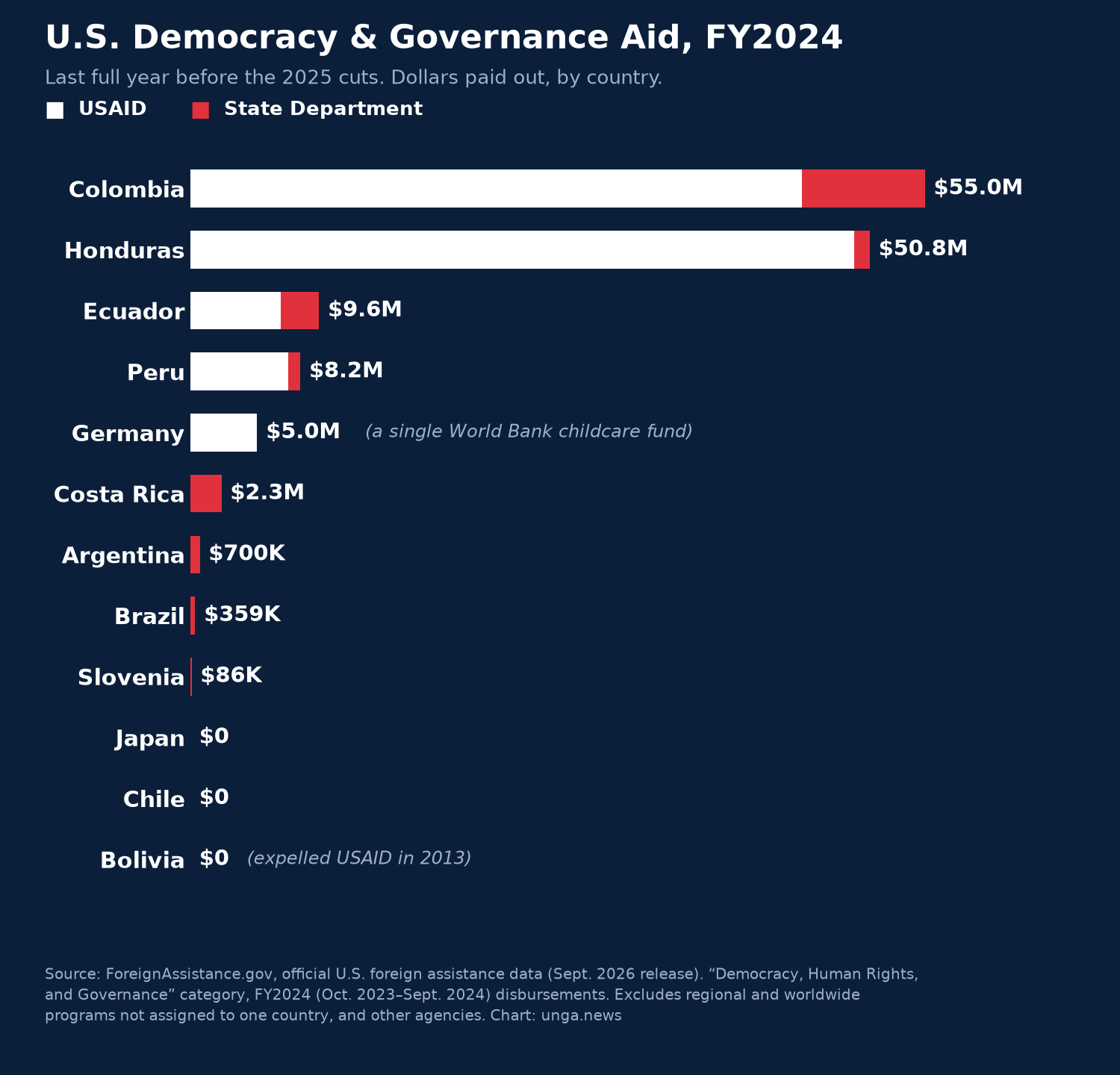
"Germany and Japan never got USAID money." Nearly right. Japan got none, and Germany's only USAID line was a single $5 million World Bank childcare fund, not democracy or political programming. They show the shift is global. The donor network was always bigger than one agency. The Reuters Institute reported that Meta ended its U.S. fact-checking program, the Open Society Foundations pulled back from funding news outlets, and European donors were trimming aid budgets. When the United States, the anchor of that ecosystem, walked away, the whole structure shrank. Germany and Japan voted in that new world.
"The left still wins some." Name one on this map. The left's big wins people point to, in Mexico and Uruguay, came in 2024 while the spigot was open. In Slovenia, the left's party edged out SDS, and the right still formed the government. In Honduras, the ruling left fell to third place.
Nov. 3
Look at the map again. From Berlin to Santiago to Tokyo, voters have had their first elections in years without American taxpayers funding one side of the conversation, and they keep choosing the right. Brazil votes on Oct. 25. America votes on Nov. 3, in its first midterms since the machine was shut down. The money stopped. The results speak for themselves.
Sources
- Reuters Institute (Oxford) — Shattered by a perfect storm: How Trump's cuts are crippling journalism beyond the United States
- U.S. Department of State — Making Foreign Aid Great Again (Marco Rubio)
- Reuters — As USAID stops foreign aid, Rubio says future US assistance will be limited
- The White House — At USAID, Waste and Abuse Runs Deep
- FactCheck.org — Sorting Out the Facts on 'Waste and Abuse' at USAID
- Congress.gov — H.R. 9850, No Funding or Enforcement of Censorship Abroad Act
- Congress.gov — Shellenberger testimony, House Judiciary, Feb. 12, 2025
- Federal Returning Officer (Germany) — 2025 Bundestag election: final result
- AP — Ecuador reelects President Daniel Noboa in runoff election
- AP — Milei triumphs in Argentine midterm elections
- BBC — Bolivia election: Centrist Rodrigo Paz elected in shift to the right
- AP — Trump-backed candidate Asfura declared winner of Honduras' presidential vote
- AP — Far-right José Antonio Kast wins Chile's presidential vote
- AP — Costa Rica elects conservative populist Laura Fernández as president
- The Japan Times — LDP secures two-thirds supermajority in Lower House election victory
- AP — Prime Minister Takaichi's party wins Japan's election
- IPU Parline — Slovenia National Assembly March 2026 election
- Jurado Nacional de Elecciones (Peru) — JNE proclama a Keiko Fujimori como presidenta electa
- AP — Trump-endorsed de la Espriella declared winner of Colombia's presidential runoff
- Tribunal Superior Eleitoral (Brazil) — Flávio Bolsonaro e Lula vão disputar o 2º turno
- BBC — Brazil election goes to run-off as right-wing Flávio Bolsonaro wins first round
- G1 — Datafolha e Quaest: Flávio Bolsonaro e Lula têm empate técnico
- AP — Mexico elects Claudia Sheinbaum as its first female president
- AP — Uruguay's leftist opposition candidate Yamandú Orsi becomes country's new president
- ForeignAssistance.gov — U.S. foreign assistance data, Democracy, Human Rights, and Governance, FY2024
- AP — Lula is declared winner of Brazil's election as Bolsonaro rejects results
- BBC — Lula wins fourth term in dramatic Brazil election comeback
- O Globo (TSE official count) — TSE resultados 2026: veja a apuração oficial do 2º turno