

The Senate Just Voted to Ban Betting on Wars, Assassinations and People’s Deaths
A Utah Republican helped turn a stalled bill into the first prediction-market crackdown to clear Congress, and it sailed through on a voice vote.
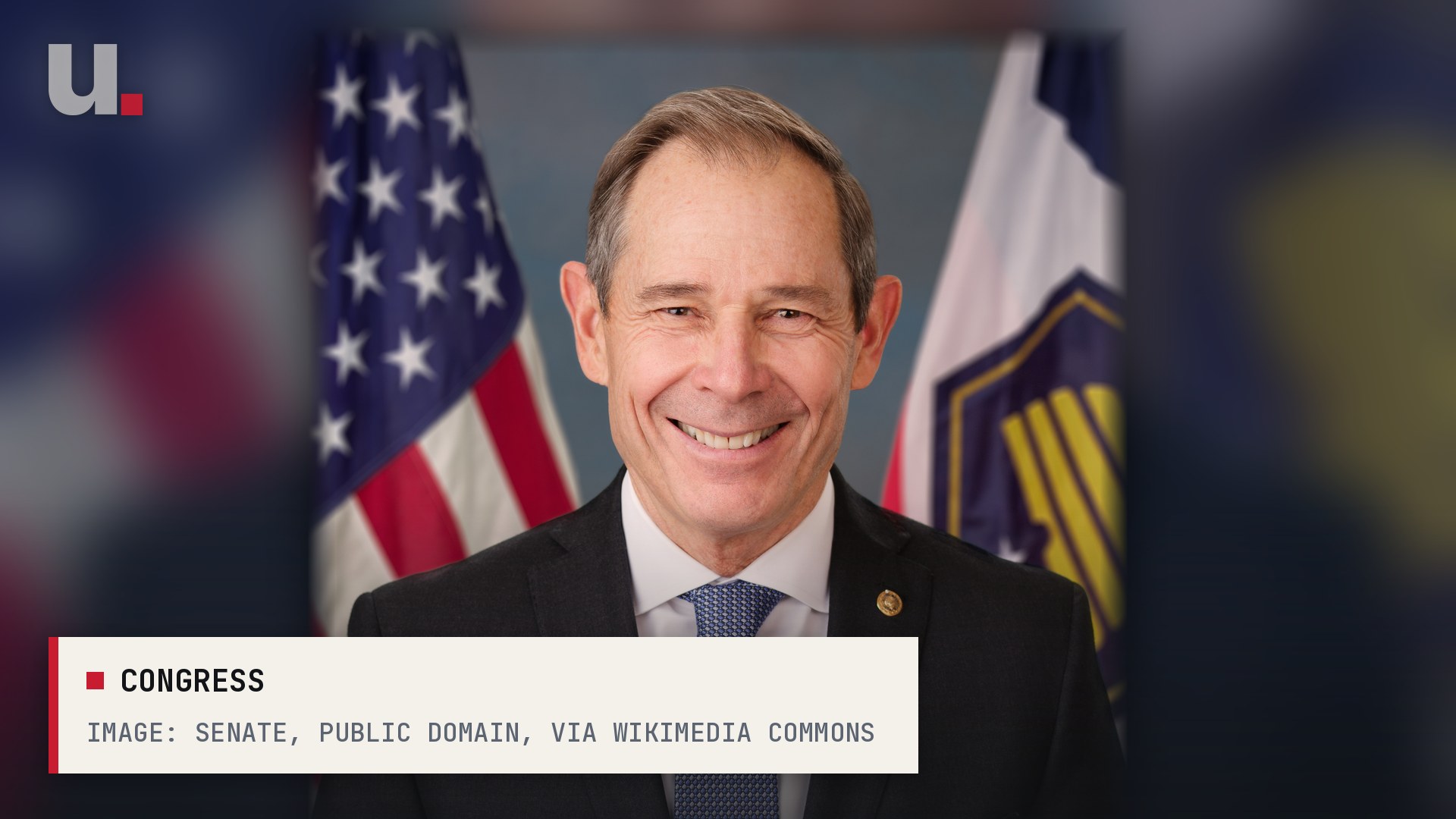
For two years, the hottest new corner of online gambling has let anyone with a phone put money on things most people would never say out loud at a dinner table. Will a missile hit a city by Friday? Will a world leader be gone by spring? Will a spacecraft full of astronauts blow up? On Thursday night the Senate decided some of those questions are off limits, and it did it on a simple voice vote, with no senator demanding a roll call.
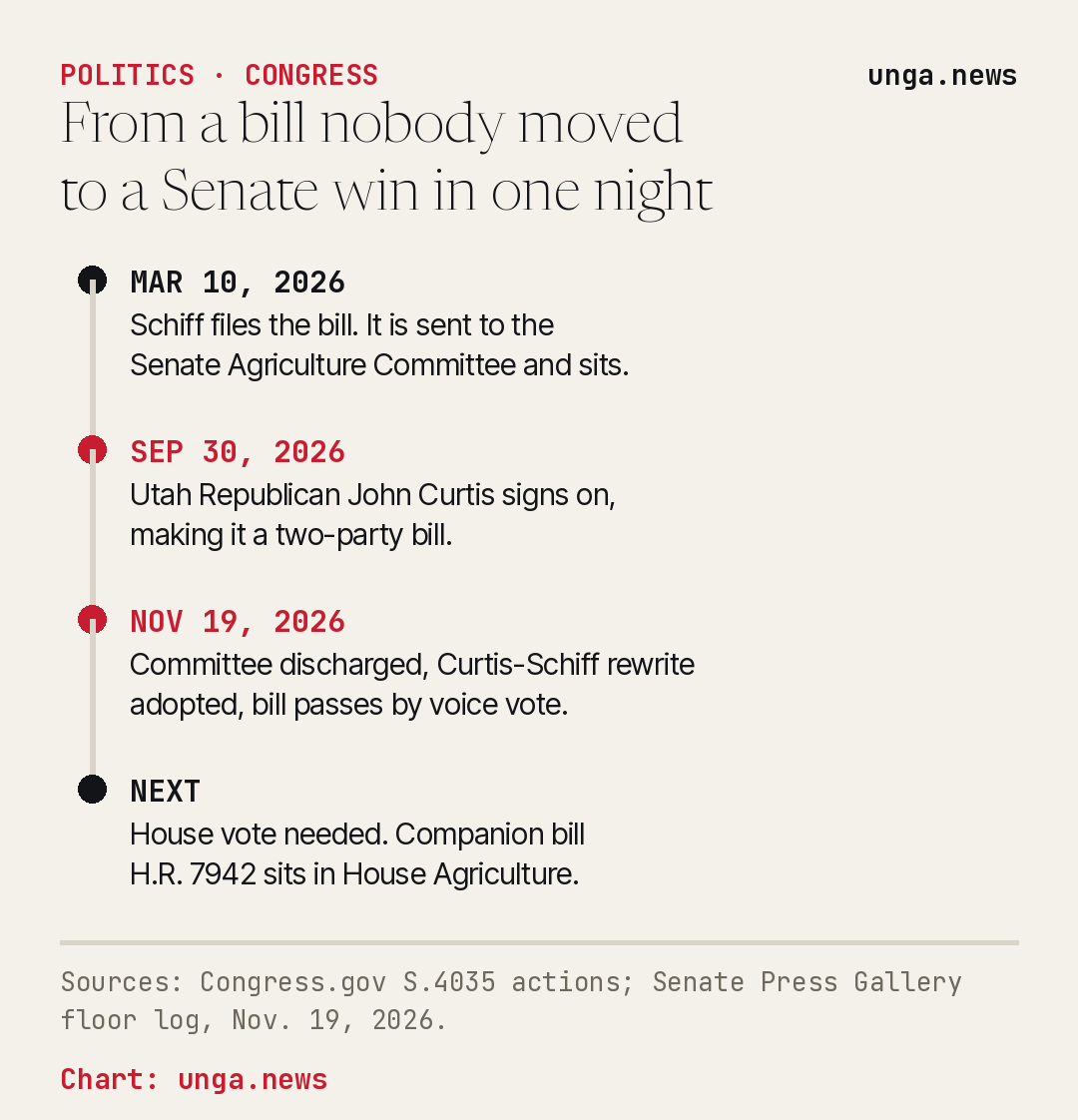
At 6:47 p.m., after Sens. Adam Schiff of California and John Curtis of Utah spoke on the floor, the chamber passed S. 4035, the DEATH BETS Act, by voice vote, according to the Senate Press Gallery’s floor log. The Agriculture Committee, which had sat on the bill since March, was discharged by unanimous consent. A rewrite from the two senators was adopted, and the bill went through. It’s the first bill aimed at prediction markets to clear either chamber of Congress.
What the bill actually bans
The name is a mouthful on purpose: the Discouraging Exploitative Assassination, Tragedy, and Harm Betting in Event Trading Systems Act. The text is short. It adds one new subsection to the Commodity Exchange Act, the law that governs the federally regulated exchanges where these bets are made.
Under the version that passed, an exchange or clearinghouse registered with the Commodity Futures Trading Commission “shall not list for trading or accept for clearing” any event contract that “expressly references” four things: terrorism, assassination, war, and “United States Armed Forces military operations.” The commission can add “any similar activity” by rule.
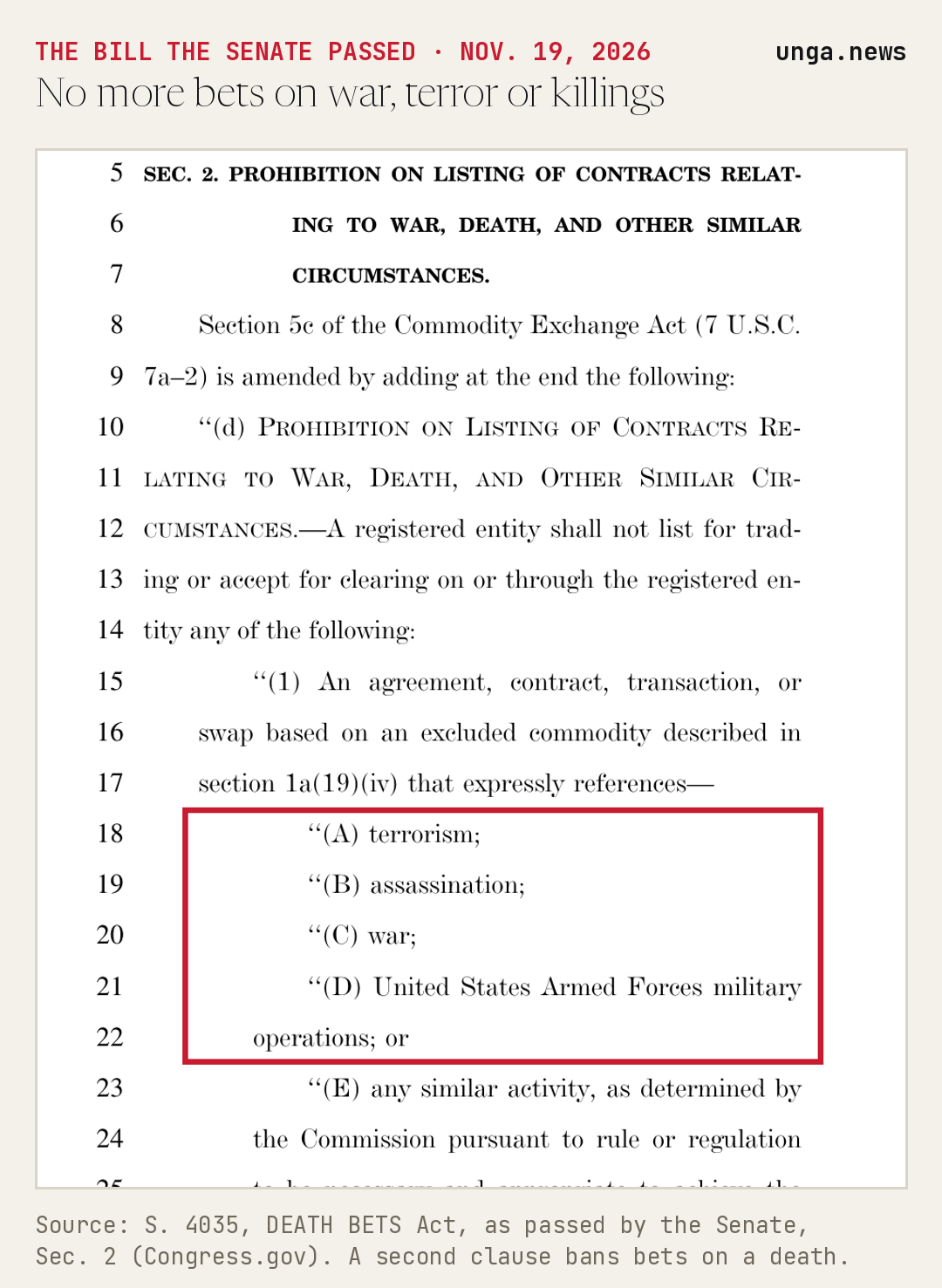
A second clause closes the obvious loophole. A market doesn’t have to say the word “death” to be banned. If, when it’s listed, the bet “is reasonably expected to resolve principally based on a death of an individual,” it’s out. That covers the wink-wink wording these platforms have used, where a contract asks whether someone will “leave office” or “no longer hold the position” when everyone trading it knows exactly what they’re betting on.
The bill also draws a line around what it doesn’t touch. A closing rule of construction says nothing in it changes the treatment of other categories already named in that section of the law, which includes gaming. Sports contracts, the business that has made these companies household names, aren’t affected by this bill.
Why this one got through
The original bill Schiff filed on March 10 was broader and vaguer. It reached any contract that would “involve, relate to, or reference” war or terrorism and any contract that could “be construed as correlating closely to an individual’s death.” It went nowhere for six months. The turning point came on Sept. 30, when Curtis signed on as the only cosponsor, according to Congress.gov.
That matters. Curtis is a Utah conservative, and his name turned a California Democrat’s messaging bill into something Republicans could pass without a roll call. The rewrite that passed Thursday is tighter: it targets contracts that expressly name the banned subjects, adds U.S. military operations to the list, and protects everything else in the statute. Those are the kinds of changes a careful conservative makes before he lets a new federal rule out of the barn.
Under current law, the commission already has the power to block war, terrorism and assassination contracts if it decides they’re against the public interest. Schiff’s office said in March that the problem is that this is left to the commission’s discretion. This bill takes the choice away and writes the ban into the statute.
The bets that got Washington’s attention
Schiff’s floor pitch was blunt. These contracts “are offered with no regard for national security and in far too many cases, even basic morality,” he said, as Fortune reported, calling the industry “a wild West, desperately in need of regulation and guardrails.” He pointed to a Polymarket market on whether NASA’s Artemis II mission would explode, which put money on whether four astronauts would live, and to a bet on whether Russian forces would capture the Ukrainian city of Myrnohrad.
The insider-trading worry is the part that should bother anyone who cares about national security. Users on some of these platforms trade without revealing who they are. Fortune reported that one Polymarket trader made more than $400,000 betting on Nicolás Maduro’s removal before U.S. forces captured the Venezuelan leader in January. Maybe that trader was just lucky. But when the outcome of a bet depends on a classified military operation, nobody outside the platform can tell the difference between a good guess and a leak.
When Schiff introduced the bill, he said betting on war and death “creates an environment in which insiders can profit off of classified information, our national security is jeopardized, and violence is encouraged.” Hard to argue with that when the bet is on an American military operation.
Kalshi also ran into a mess over a market on whether Iran’s Supreme Leader Ali Khamenei would leave office. After he was killed, the company declined to pay traders who had bet he’d leave, citing a rule that excluded death as a qualifying outcome. That is exactly the kind of fight the bill’s “resolve principally based on a death” language is written to end.
The companies say they already police themselves. “We don’t list markets directly tied to death,” Kalshi CEO Tarek Mansour wrote on 𝕏 in February, and a Kalshi spokesperson told Fortune that “Kalshi has never listed death markets.” Polymarket declined to comment. Its CEO, Shayne Coplan, has called conflict-related markets a “complicated question” and defended them as a source of useful information. If the big platforms already stay away from these bets, a law saying so shouldn’t cost them much.
The House is the next stop
The bill still has to pass the House and be signed by the president. A House companion, H.R. 7942 from Rep. Mike Levin of California, is in the House Agriculture Committee. Other lawmakers want to go much further. Sen. Ted Cruz has said he plans a bill requiring state or tribal approval for gambling-style event contracts, and Rep. Ro Khanna has called for banning sports prediction markets outright.
The sports fight will be loud and expensive. This bill was the easy part, and maybe that’s why it moved. A country can argue for years over whether a bet on Sunday’s game is a financial product. It shouldn’t need years to agree that nobody should get rich guessing which American service member, astronaut or foreign leader dies next. A Utah Republican and a California Democrat agreed on that, and so did a Senate that let it through on a voice vote. Now it’s the House’s turn.
Sources
- Congress.gov — S.4035 — DEATH BETS Act, all actions and cosponsors (119th Congress)
- U.S. Senate — S. 4035, as passed by the Senate (engrossed text, Nov. 19, 2026)
- Senate Press Gallery — Floor log, Thursday, November 19, 2026
- Office of Sen. Adam Schiff — Sen. Schiff Introduces Legislation to Explicitly Ban Death and War Prediction Contracts (Mar. 10, 2026)
- Fortune — Senate passes first-ever prediction market bill as Democrats turn up heat on upstart industry (Nov. 20, 2026)
- Bloomberg Law — Senate Passes Bill to Ban Bets on War, Death, Assassinations