

The Smart Ring That Tracks Your Sleep Is Buying an SI Doctor for $625 Million
Oura is buying Counsel Health, a startup whose SI answers medical questions and brings in a real physician in about two minutes, the company says. It can prescribe, refer and read your ring’s data.
If you’ve got one of those sleek little rings on your finger that grades your sleep every morning, it’s about to come with a doctor attached. Oura, the company that makes the best-known smart ring on the market, said Tuesday it is buying Counsel Health, a startup that answers medical questions with SI and hands you off to a real physician when you need one. The price is $625 million, and Oura is paying all of it in cash.
That’s a lot of money for a company most people have never heard of. Counsel was only founded in 2023, and it raised a $25 million first round of venture money about a year ago, led by Andreessen Horowitz and Google’s venture arm, GV, according to TechCrunch, which cited PitchBook’s estimate that Counsel had raised about $36 million in total. So Oura is paying roughly 17 times what investors had put in.
The pitch is simple enough for anybody to follow. Your ring already knows how you slept, what your resting heart rate is doing, and whether your body seems run down. Counsel is the part that is supposed to tell you what to do about it, and to get you a prescription or a referral if that’s what it takes.
Two minutes to a real doctor
Here’s how it works, according to the companies’ announcement. You open the Oura app and start chatting with Counsel’s medical SI, either about something your ring flagged or about anything else that’s bothering you. The SI pulls from your connected medical records, your earlier conversations, standard medical guidelines and the stream of data coming off your finger. At any point, you can pull a board-certified Counsel physician into the chat, and that doctor can diagnose you, write a prescription or refer you to a specialist.
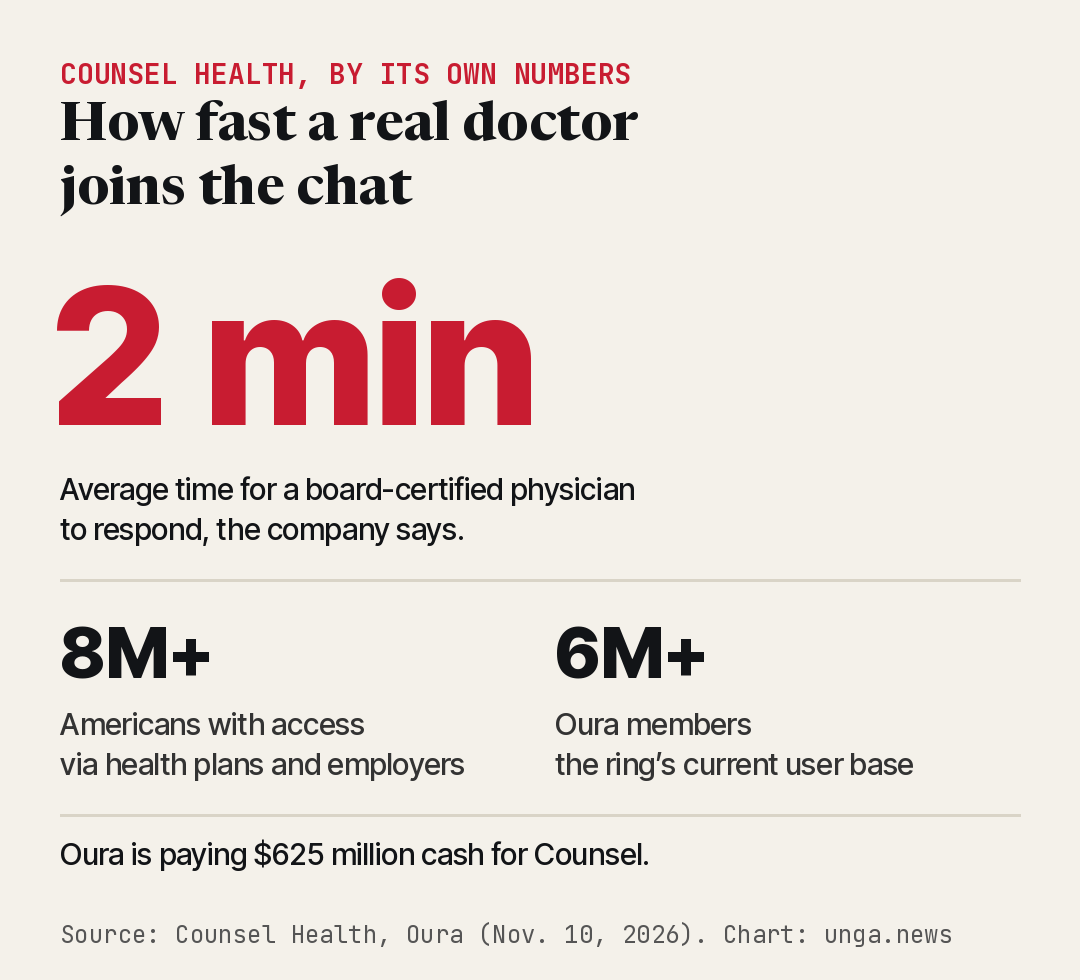
Counsel says its doctors respond in two minutes on average. In a blog post Tuesday, founder and CEO Dr. Muthu Alagappan also said 96% of medical concerns were “addressed without escalation,” and that Counsel is already available to more than 8 million Americans through health plans, health systems and employers. Oura says that among its members who use Counsel, more than 90% of those surveyed said their ring data helped them get better care, and patients who saw a Counsel doctor rated the visit 4.6 out of 5.
Keep in mind that every one of those numbers comes from the companies themselves. Nobody outside has checked them, and a company selling itself for $625 million has every reason to put its best foot forward. Still, if the two-minute figure holds up, that beats the hold music at most doctor’s offices I’ve called.
Under the hood, Counsel describes a set of specialized SI helpers, each with its own job. One takes your medical history. One looks up the right clinical guidelines. One reads your records. One watches for signs of an emergency. The company says each one is tested for safety and gets corrected by its own physicians. Doctors work from a screen Counsel calls the Clinician Cockpit, which sums up a patient’s chart and health trends and suggests next steps.
A ring that isn’t a medical device
There’s a catch printed right in Oura’s own fine print. “Oura Ring is not a medical device and is not intended to diagnose, treat, cure, monitor, or prevent medical conditions or illnesses,” the company says. That’s the legal line it has to walk. The ring can tell you your sleep was lousy and your heart rate crept up. It can’t tell you why.
That’s exactly the gap this deal is meant to fill. “Oura tells members what’s happening in their bodies, and Counsel helps them act on it,” said David Shuman, Oura’s executive chairman. CEO Tom Hale put it in even plainer terms, calling the goal “the promise of a 24-7 doctor in your pocket.”
Alagappan, a Stanford-trained physician who worked as an attending doctor at Massachusetts General Hospital and UCSF before starting Counsel, says the SI doesn’t get the last word. “At Counsel, we’ve built medical AI around trust, safety and responsibility, keeping physicians in the loop for clinical decisions,” he said. Bloomberg reported that he will join Oura as its chief clinical AI officer, bringing about 70 Counsel employees with him, according to TechCrunch.
I like the idea of a doctor on call, I really do. But I’d want to know exactly who sees my heart rate, my sleep and my medical records once they’re all sitting in one company’s app, and how that data gets used. The companies said Oura was built with “privacy and security at the forefront,” but they didn’t lay out in the announcement how the combined data will be handled.
Selling rings at a record pace
Oura isn’t making this bet from a weak spot. The Finnish-born company, now based in San Francisco, said revenue jumped 153% to $533 million in the quarter that ended Sept. 30, and it earned $87 million on an adjusted basis. For the full fiscal year it brought in about $1.75 billion, up 92%. Those figures are preliminary and unaudited, the company said.
It also has more than six million members. TechCrunch reported that Oura was valued at $11 billion after a $900 million round in October 2025, and that it shelved a planned stock offering of up to $2.2 billion a few weeks ago, citing “uncertainty in the IPO market.” Cheaper rivals such as RingConn and Ultrahuman are also chasing its customers.
Buying a doctor service gives Oura something a cheaper ring can’t copy overnight. Counsel will keep selling to health plans and employers too, and Alagappan said those customers won’t have to buy a single Oura ring to use it. If you already use Counsel’s own app, nothing changes for now, he said, with more details promised “in the coming weeks.”
The deal is expected to close before the end of this year, subject to the usual conditions, according to Oura. After that, the ring that’s been telling millions of people they slept badly will finally be able to send them to someone who can do something about it.
Sources
- Oura and Counsel Health — Oura to acquire Counsel Health, advancing vision for more connected, personalized healthcare
- Counsel Health — Reimagining the future of primary care alongside ŌURA (Dr. Muthu Alagappan)
- TechCrunch — Oura to acquire AI-native primary care startup Counsel Health for $625M
- Reuters (via Investing.com) — Smart ring maker Oura to acquire Counsel Health for $625 million
- Latham & Watkins — Latham Advises ŌURA in US$625 Million Acquisition of Counsel Health