

The Supreme Court Will Decide Next Week Whether States Can Ban America’s Most Popular Rifle
The justices hear a challenge to AR-15 bans in Cook County and Connecticut on Dec. 2, and Trump’s Justice Department is standing with the gun owners.

Eight days from now, the Supreme Court will decide whether a county or a state can make it a crime to own the most popular rifle in America.
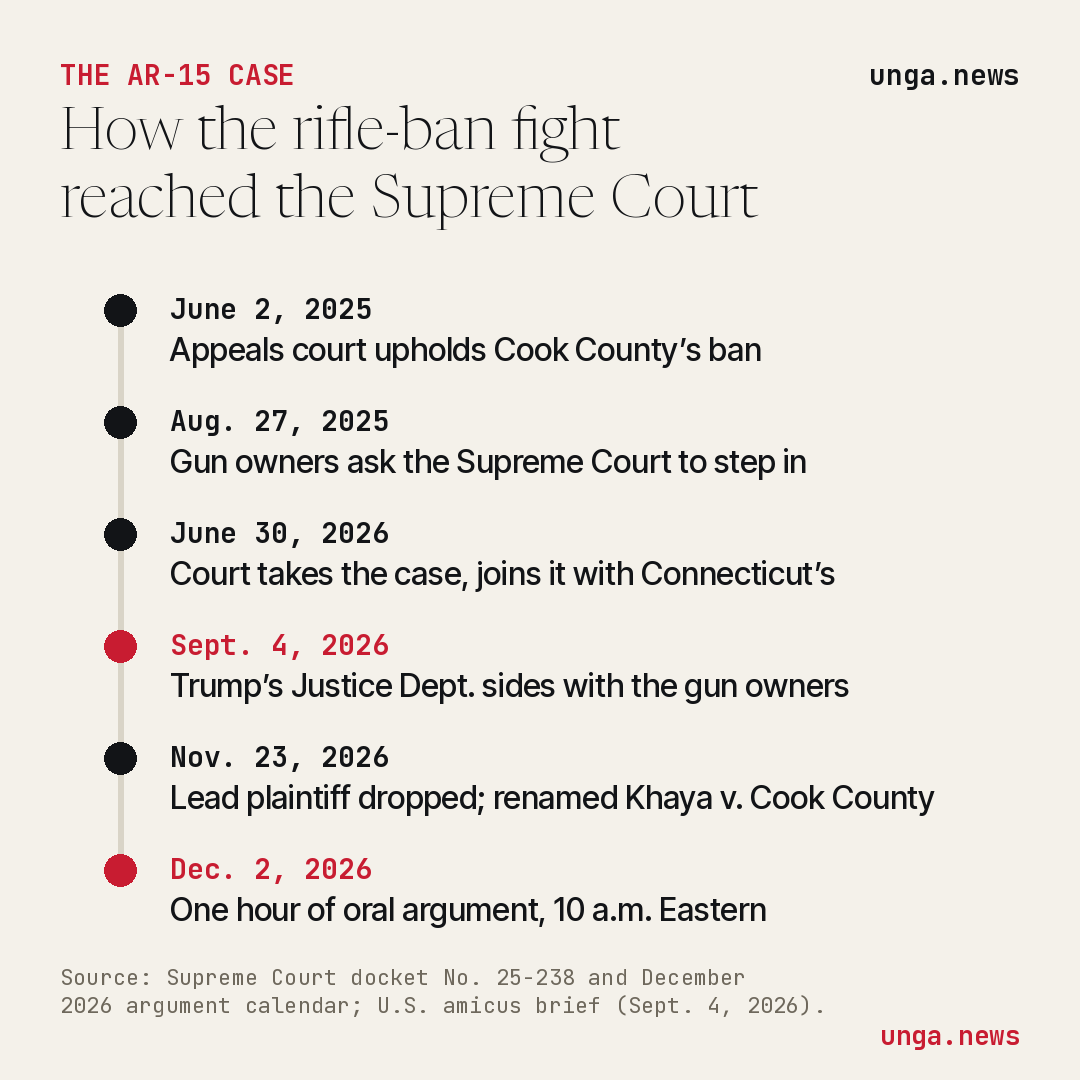
On Wednesday, Dec. 2, at 10 a.m. Eastern, the justices will hear one hour of argument in two cases joined together: a challenge to Cook County, Illinois’ ban on AR-15s and similar semiautomatic rifles, and a challenge to Connecticut’s. It’s one of the biggest gun cases to reach the Court since its 2022 ruling in *Bruen*, and it sits on the December argument calendar in the same session as a Republican National Committee voting case set for Dec. 8.
The case also got a new name this week. On Monday, Nov. 23, the Court granted a request from the lead plaintiff, Cutberto Viramontes, to drop out, according to the Supreme Court’s docket. The other gun owners and groups stay in, so the argument goes ahead as planned. What was *Viramontes v. Cook County* is now *Khaya v. Cook County*, and it will be heard alongside *Grant v. Higgins* from Connecticut.
Trump’s lawyers are on the gun owners’ side
The biggest difference from past gun fights is who’s standing with the challengers. On Sept. 4, Solicitor General D. John Sauer, the Trump administration’s top lawyer at the Supreme Court, filed a brief for the United States backing the gun owners. On Nov. 9, the Court gave him time at the lectern on Dec. 2 to argue it in person.
The brief doesn’t hedge. “Millions of Americans exercise that right by owning an AR-15 rifle, which is ‘the most popular rifle in the country,’” it says. “Yet the State of Connecticut and Cook County, Illinois, have made the possession of AR-15s a crime. Those bans are unconstitutional.”
That line about the most popular rifle isn’t a gun-lobby talking point. It comes straight from the Supreme Court itself, in a unanimous 2025 decision that tossed out Mexico’s lawsuit against American gunmakers. Now the government is asking the justices to take their own words seriously.
The test that should decide it
The legal question is simpler than the headlines make it sound. In *Heller* in 2008, the Court said the Second Amendment protects the kinds of weapons “in common use” by law-abiding people for lawful purposes. In *Bruen*, it said gun laws stand only if they fit the country’s historical tradition of regulating firearms.
The gun owners say that settles it. In their final brief, filed Nov. 20, they put it bluntly: “Because AR-15 platform and similar semiautomatic rifles are in common use, this Court must reverse the judgments below.” They added that “it is not possible for this Court to affirm without overruling the core holdings of *Heller* and *Bruen*.”
Cook County and Connecticut want a different test. They’re asking the Court to let governments ban weapons they consider “unusually dangerous,” meaning courts would weigh whether a gun is “especially dangerous and not proportional to the end of self-defense.” The gun owners say that’s just the old balancing test *Bruen* threw out, dressed up in new words. Judges who don’t like a gun would get to decide it’s too dangerous.
Who lined up against the rifle
The other side brought a crowd. On Oct. 28 alone, the docket shows more than two dozen friend-of-the-court briefs filed in the cases, including from Everytown for Gun Safety, the Giffords Law Center, the American Federation of Teachers, the Major Cities Chiefs Association and Sen. Dick Durbin of Illinois. Survivors of mass shootings at Parkland, Highland Park and the Las Vegas Route 91 festival also filed.
Those are serious stories, and nobody should brush past them. But the question in front of the Court isn’t whether a rifle can be misused. It’s whether the millions of Americans who own one, almost all of whom will never hurt anyone, can be turned into criminals by a county board in Chicago or a legislature in Hartford.
Why this one matters far beyond Illinois
Both bans were upheld by federal appeals courts, the Seventh Circuit for Cook County and the Second Circuit for Connecticut. Several other states have their own versions. A ruling that AR-15s are protected would put all of those laws in doubt at once. A ruling the other way would hand blue states and big cities a green light to ban more guns, as long as they can call them “unusually dangerous.”
That’s why gun owners have been waiting years for this one. The Court had turned away earlier petitions over rifle bans, including a challenge to Maryland’s in 2025, before agreeing on June 30 to take these two cases together.
The justices won’t rule on Dec. 2. A decision is expected by the end of the term next summer. But the argument will give the first real look at where the Court’s majority stands, and with the United States government now arguing that these bans are unconstitutional, the gun owners walk in with the strongest backing they’ve ever had.
Sources
- Supreme Court of the United States — Docket No. 25-238, Khaya v. Cook County (formerly Viramontes v. Cook County)
- Supreme Court of the United States — Monthly Argument Calendar, December 2026
- U.S. Department of Justice, Office of the Solicitor General — Brief for the United States as Amicus Curiae in Support of Petitioners (Sept. 4, 2026)
- Petitioners’ counsel — Reply Brief for Petitioners, Nos. 25-238 and 25-566 (Nov. 20, 2026)