

Thirteen States Ask the Supreme Court to Save Florida’s Stop WOKE Law for College Classrooms
Alabama and Kentucky lead a brief arguing state university professors are public employees, not a special class with First Amendment rights no other American has. Alabama’s own anti-DEI law is riding on the outcome.
A professor at a state university is a public employee. A taxpayer signs the check. Thirteen states just told the Supreme Court that this should mean something when that professor walks into a classroom.
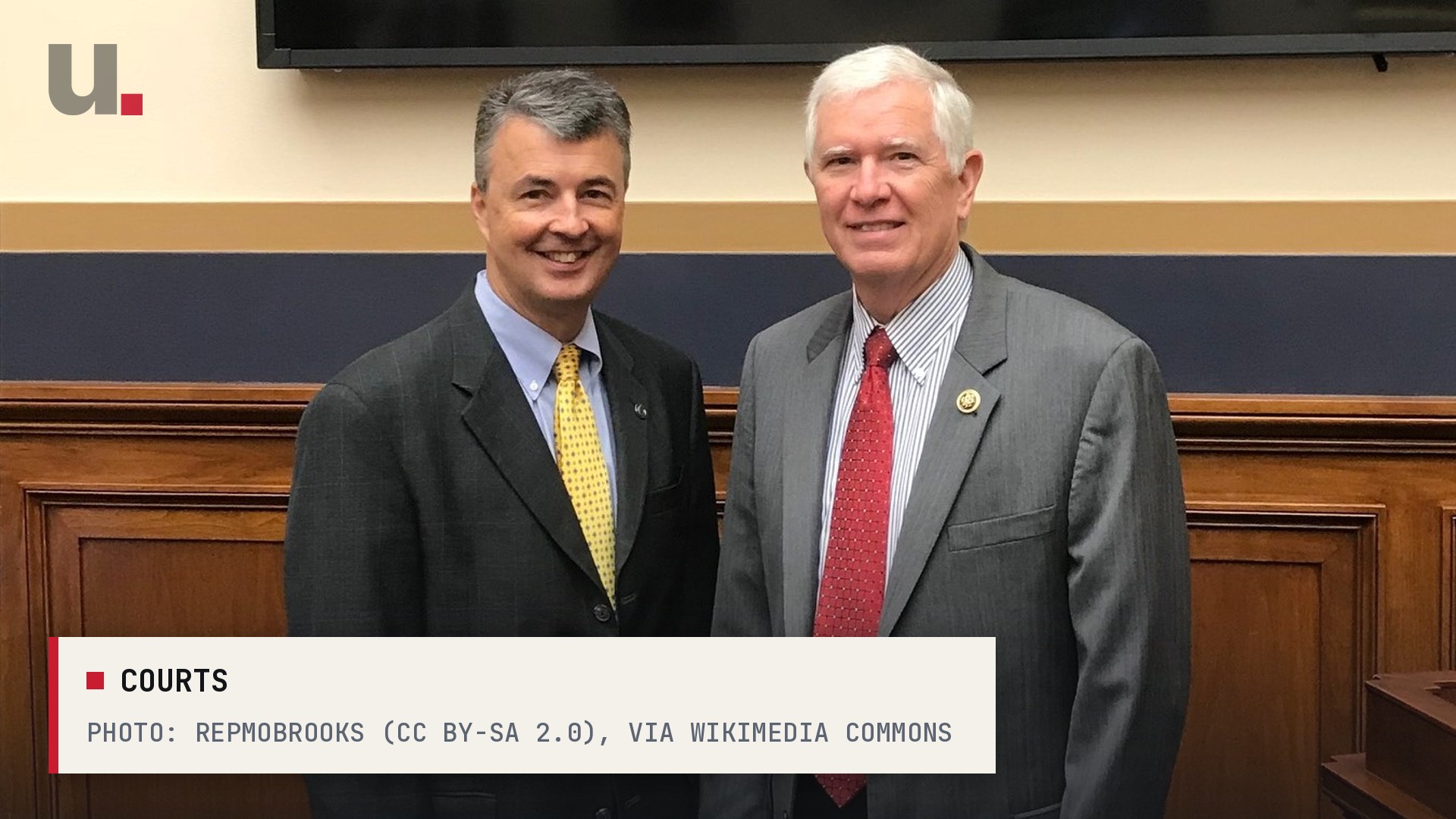
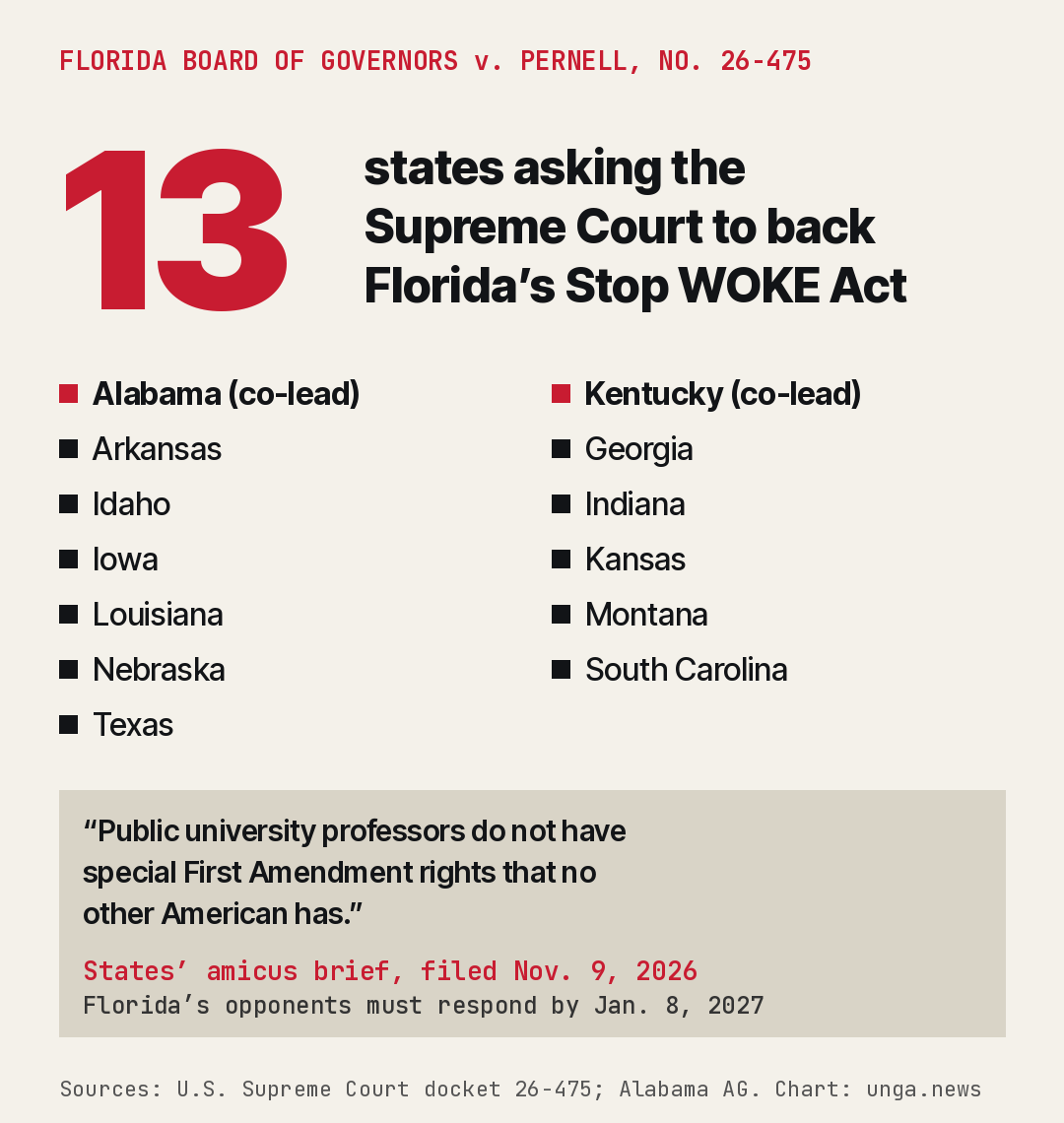
On Monday, Alabama Attorney General Steve Marshall and Kentucky Attorney General Russell Coleman filed a friend-of-the-court brief asking the justices to take up Florida’s Stop WOKE Act case and reverse the federal appeals court that blocked the law on campus. Eleven more Republican attorneys general signed on: Arkansas, Georgia, Idaho, Indiana, Iowa, Kansas, Louisiana, Montana, Nebraska, South Carolina and Texas. The case is Florida Board of Governors v. Pernell, No. 26-475.
Their argument fits in one sentence from the brief: “It is time for this Court to answer the question it left unanswered in Garcetti, and it should answer it by holding that public university professors do not have special First Amendment rights that no other American has.”
The law that started it
Florida’s Individual Freedom Act, better known as Stop WOKE, became law in 2022. The piece at issue covers public colleges and universities. It lists eight concepts that instructors can’t promote or require students to believe, including that members of one race, color, national origin or sex are “morally superior” to another, that a person is “inherently racist, sexist, or oppressive, whether consciously or unconsciously” because of race or sex, and that “merit, excellence, hard work ethics, or colorblindness” are racist or sexist.
Read that list slowly. It doesn’t stop anyone from teaching the history of slavery, civil rights or anything else. Professors can still discuss these concepts as part of a larger course of instruction. What they can’t do is stand at the front of a state-funded classroom and push students to sign on to them.
A group of public university professors, represented by the ACLU, sued in 2022. They won a preliminary injunction in district court, and on July 7 the U.S. Court of Appeals for the Eleventh Circuit upheld it, saying the law likely violates the First Amendment right to academic freedom.
The Eleventh Circuit didn’t hold back. It called Florida’s position “a breathtaking assertion of power to ban unpopular discourse” and summed up the state’s theory as “if the government pays a professor’s salary, it has total control over her classroom speech.” Florida asked the Supreme Court to step in on Oct. 5.
Every other public employee plays by these rules
The states’ brief goes straight at the idea that professors are a special class. In Garcetti v. Ceballos, decided in 2006, the Supreme Court held that the First Amendment doesn’t protect public employees from discipline over speech they make “pursuant to” their official duties. A prosecutor writing a memo speaks for his office, not himself.
But the Court left a door cracked open. It said it wasn’t deciding whether that rule applies the same way to “scholarship or teaching.” The 13 states want it closed.
“Citizens—speaking as citizens—have First Amendment rights, and they do not lose those rights by setting foot on campus,” the brief says. “But university professors are also public employees, paid by a State to teach specific classes in specific ways.”
That is the whole ballgame. A professor tweeting on a Saturday is a citizen. A professor teaching the course the state built, in the building the state owns, for the salary the state pays, is doing a job.
The brief also leans on a sharp passage from Judge Frank Easterbrook of the Seventh Circuit, who warned in a concurrence this year that schools are left “powerless” when “faculty may choose to provide tendentious screeds instead, denying their institutions the ability to provide students with a particular kind of educational experience.”
Under the appeals court’s rule, the states write, professors get “the power to decide for themselves how and what to teach as part of their official duties as public employees.” In their words: “The Constitution grants to no other public employee such a right over his employer.”
Why Alabama has skin in this
This isn’t just about Florida. Alabama passed its own law in 2024 that bars public universities from keeping DEI offices and restricts professors from promoting a list of “divisive concepts” that mirrors Florida’s. Educators sued there too. In December 2025, a federal district court in Alabama refused to block that law, and the case is now on appeal — at the same Eleventh Circuit that ruled against Florida.
If the July ruling stands, Alabama’s law is walking into a buzz saw. If the Supreme Court reverses, every state on this brief gets a clear rule to build on.
Marshall put it plainly in his statement: “Academic freedom is a vital principle, but not a trump card. No public employee, whether a professor, teacher, or a clerk, get a bigger share of the First Amendment than anyone else.” He added, “In Alabama, we protect students from DEI indoctrination, and we will defend that principle all the way to the Supreme Court.”
The states also flip the academic freedom argument: students and universities have academic freedom too. A professor who demands students accept that colorblindness is racist isn’t protecting anyone’s freedom. He’s spending someone else’s.
The professors’ case
The professors and the ACLU see it differently, and it’s worth being clear about their argument. “The Stop W.O.K.E. Act imposed restrictions based on specific viewpoints—precisely the kind of law that the First Amendment was designed to prevent,” the ACLU wrote after the July ruling. Under the law, it said, a professor could teach the views on race and gender the Legislature approved of but not a disfavored one, “even when it was foundational to their academic discipline.”
The real question: is a state university classroom the professor’s forum, or a public service the state pays for? The appeals court picked the first. Thirteen states, and Florida, are betting the Supreme Court picks the second.
The clock runs into January
Nobody should expect a ruling soon. On Oct. 30, the Court gave the professors until Jan. 8, 2027, to file their response. The American Center for Law and Justice also filed a brief backing Florida on Monday. Only after the response comes in will the justices decide in conference whether to hear the case at all.
If they pass, the Eleventh Circuit’s ruling stays on the books across Florida, Georgia and Alabama.
The line from Montgomery and Frankfort is simple. Teach the kids. Teach them everything. Just don’t make them swear to a creed on the state’s dime.
Read the full 13-state brief and Marshall’s announcement.
Sources
- Supreme Court of the United States — Brief of Alabama, Kentucky, and 11 other States as amici curiae supporting petitioners, No. 26-475
- Supreme Court of the United States — Docket No. 26-475, Florida Board of Governors v. Pernell
- Alabama Attorney General’s Office — Attorney General Marshall Co-Leads Brief Urging U.S. Supreme Court to Uphold State Anti-DEI Laws for Public Universities
- Alabama Political Reporter — Alabama asks Supreme Court to uphold Florida’s Stop WOKE Act