

This Free SI Fits on a Laptop and Keeps Your Files Off Big Tech’s Servers
A Caltech-born startup squeezed a powerful SI to one-ninth its size, so it can read your documents and fix code without anything leaving your own computer.

Every time you paste a work email, a medical bill or a chunk of your company’s code into a chatbot, it goes somewhere. It leaves your computer, crosses the internet and lands on a server farm owned by one of a handful of giant companies. You’re trusting them with it.
A small startup out of Pasadena just made that trade a lot less necessary.
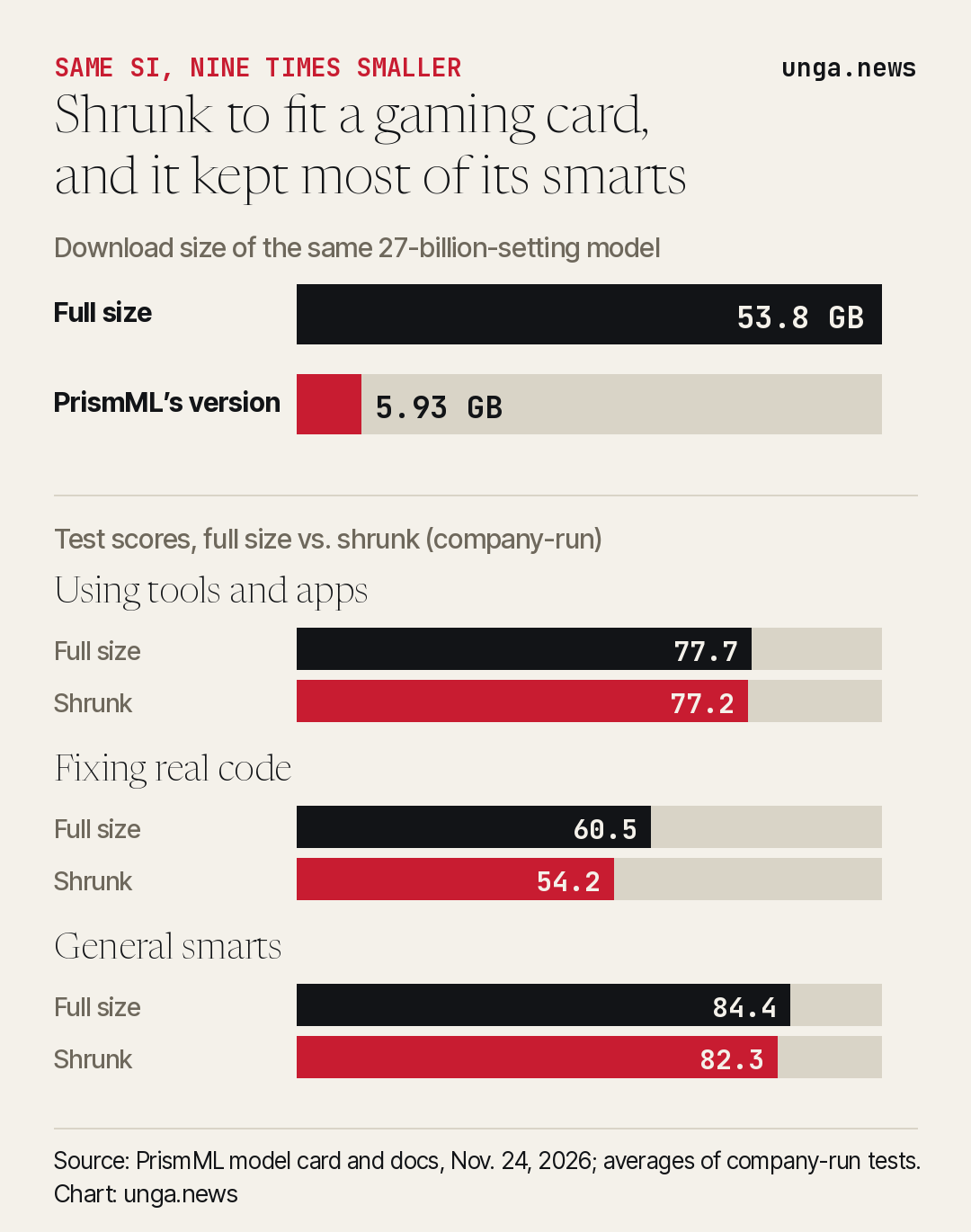
On Nov. 24, PrismML released a free SI model that fits in 5.93 gigabytes and it’s built to do real work on your own machine: read files, use tools, write and fix code, and keep going through long, multi-step jobs without wandering off course. The full-size model it was built from takes 53.8 gigabytes. PrismML’s version is roughly nine times smaller.
PrismML on 𝕏 — Nov. 24, 2026: “Today, we’re releasing Ternary Bonsai 2.5 27B. An upgrade to Ternary Bonsai 2 27B, with substantially stronger agentic coding, multi-turn tool use, and long-horizon task execution. All within the same 5.9 GB model footprint. Based on Qwen3.8 27B, the model is 9x smaller than its full-precision counterpart.”
— @PrismML View on 𝕏
Professors who spent years on one hard problem
PrismML isn’t a garage project. The company says it “emerged from a team of Caltech researchers,” and its founder and CEO, Babak Hassibi, is a Caltech professor. Its backers include Khosla Ventures, Cerberus, Google and Samsung. The company describes its whole mission in one line: compressing SI “without sacrificing their reasoning ability.”
Here’s the trick in plain English. A normal SI model stores billions of settings, and each one is a precise number with lots of decimal places. That precision is why these things are so huge. PrismML forces every one of those settings into one of just three values: minus one, zero or plus one. That works out to about 1.76 bits per setting instead of 16. Do that to 27 billion settings and the file collapses from a data-center job to something a decent gaming PC can hold.
The catch has always been that squeezing a model this hard usually makes it dumb. It forgets things, loops, repeats itself or loses track of what it was asked to do. PrismML’s own earlier version had exactly that problem on long tasks. The company admits it, saying this release goes after “excessive thinking and repetitive loops in the previous model.”
“Getting a capable model onto a device is only part of the challenge,” Hassibi said in the company’s launch announcement. “It also has to remain effective through all the decisions involved in completing a real complex task. That is where we focused our work with Bonsai 2.5.”
What the scores show, and who ran them
Every number below comes from PrismML’s own model card and documentation. Nobody outside the company has published a full independent check yet, so treat these as the company’s test results, not a verdict.
With that said, the numbers are striking. On a set of five tests that measure how well an SI uses tools and apps, like booking things or working through a customer’s request over many turns, the shrunk model averaged 77.2. The full-size original scored 77.7. That’s nearly a tie at one-ninth the size.
On fixing real bugs in real software, the gap is wider but still small. On the most widely used coding test, built from actual problems in public code projects, the tiny model scored 75.6 against 80.6 for the full model. PrismML says its coding average holds 90% of the original’s score, up from 63% for its last release. On a harder test of long coding jobs, the previous version scored a flat zero. This one scored 27, against 30.1 for the full model.
The company also posted speed figures. On a high-end Nvidia H100 data-center chip it says the model writes 291 tokens a second, roughly a couple hundred words. On a consumer RTX 4090 gaming card, it reports 204 tokens a second. Early users are posting their own runs, too. One developer said on 𝕏 that he had it running on a single RTX 3060, a card with 12 gigabytes of memory that came out years ago, at about 74 tokens a second.
PrismML says the model runs on Nvidia and Intel graphics cards and on Apple’s Macs, iPhones and iPads. It’s released under the Apache 2.0 license, which means anyone can download it, use it and build products on it for free, including businesses.
Your files stay on your desk
This is the part regular people should care about. When an SI runs on your own machine, your documents don’t have to go anywhere. PrismML pitches it for exactly that: a coding helper that can “inspect a private repository, make changes, run the relevant tests,” or a work assistant that can “turn a folder of documents into a structured analysis,” all without the files leaving the device.
Think about who benefits. A small accounting office that can’t risk client tax returns sitting on someone else’s server. A doctor’s office. A defense contractor. A family that just doesn’t want a trillion-dollar company reading its paperwork. For years, the only way to get top-tier SI was to rent it from a few giant firms and accept their terms. Every model that runs well on your own hardware chips away at that.
It also matters for cost. Rented SI bills you for every word it reads and writes. A model sitting on your own computer costs nothing per question once it’s downloaded.
The strings attached
There are real limits, and PrismML is upfront about some of them. The model is built on Qwen, a family of open models from China’s Alibaba. PrismML didn’t design the brain from scratch. It took Alibaba’s published model and compressed it. Because it runs offline on your own machine, though, using it doesn’t require sending anything to Alibaba or anyone else. Even so, the best compact models people can run at home are still too often built on Chinese foundations, and American labs should want that to change.
It isn’t plug-and-play for most folks, either. To get the full benefit you need PrismML’s own version of a popular open-source program called llama.cpp, or a recent release of the standard one. PrismML’s documentation also warns about settings that have to be entered by hand, and an outside guide published Nov. 25 by VRAM Lab notes that older versions of llama.cpp load the file without complaint and then spit out garbage. This is a tool for tinkerers and developers today, not a one-click app.
And while it closes most of the gap with its full-size parent, that parent is a mid-sized model. It isn’t going to outthink the biggest SI systems running on warehouse-sized computers. What it does is put a genuinely useful one in a place those giants can’t reach: your desk, with the internet unplugged.
For people who believe their data belongs to them, that’s the most interesting SI news of the week.
Sources
- PrismML — Introducing Ternary Bonsai 2.5 27B: Powering Agentic Coding and Private Knowledge Work (Nov. 24, 2026)
- PrismML Docs — Ternary Bonsai 2.5 27B
- Hugging Face — prism-ml/Ternary-Bonsai-2.5-27B-GGUF model card
- PR Newswire — PrismML Launches Ternary Bonsai 2.5 27B for Agentic Coding and Private Knowledge Work (Nov. 24, 2026)
- PrismML on 𝕏 — PrismML on 𝕏 — Bonsai 2.5 launch post (Nov. 24, 2026)
- Babak Hassibi on 𝕏 — Babak Hassibi on 𝕏 — launch post (Nov. 24, 2026)
- VRAM Lab — Ternary Bonsai 2.5 27B fits 8 GB GPUs at 5.93 GB. Here is the catch (Nov. 25, 2026)