

This Robot Startup Learns From Workers in Sensor Gloves. Investors Just Gave It $500 Million.
Genesis AI is now worth $3.5 billion. Its robots wear the same gloves as the workers they learn from, and mass production starts in the U.S. next year.
Robots can do backflips now. Most of them still can’t reliably fold a box, tape it shut and slap a shipping label on it. A two-year-old startup called Genesis AI says it has figured out how, and investors just handed it $500 million to prove it.
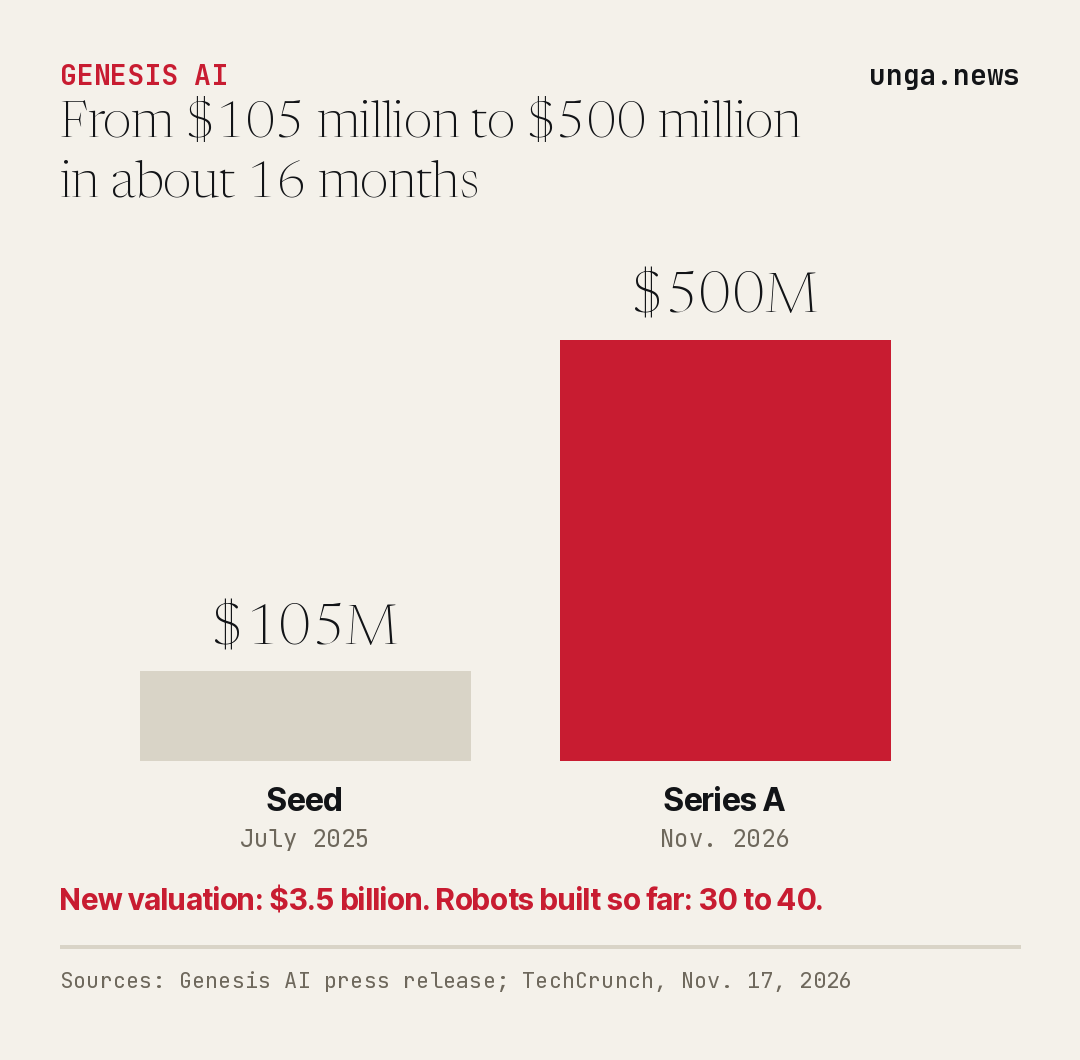
Genesis announced the Series A round Tuesday at a $3.5 billion valuation, according to the company. Khosla Ventures, Premji Invest and Eclipse led the round. Nvidia, AMD Ventures, Samsung Next, T. Rowe Price, Zoom and Ericsson also put money in, along with former Google CEO Eric Schmidt, Zoom CEO Eric Yuan, Yahoo co-founder Jerry Yang and former Tesla CFO Zach Kirkhorn.
That is a big jump. Genesis announced a $105 million seed round in July 2025. Sixteen months later, it has raised nearly five times that in a single round.
Xian and Genesis president Théophile Gervet met as graduate students in a Carnegie Mellon University lab and started the company in 2024. It is based in Paris and San Carlos, California. Instead of buying parts from other companies, Genesis builds almost everything itself: the training data, the SI model and the robot. Its focus on hands and touch is what sets it apart from better-known humanoid makers like Figure and Agility, TechCrunch reported.
The glove trick
The company’s big idea is about hands. Most robots struggle with the fiddly stuff people do without thinking: peeling a sticker, sorting small parts, handling wires. Genesis CEO and co-founder Zhou Xian told TechCrunch the company has “cracked dexterous manipulation.”
Its secret ingredient is a sensor glove. More than 100 real workers around the world wear the gloves, plus headset cameras, while they do their normal jobs, TechCrunch reported. The gloves capture how hard their fingers press and grip, and that data trains Genesis’ SI model.
Here’s the clever part. The robots wear the same gloves, and their hands are built to match the proportions of a human hand. Genesis calls it a “1:1:1 mapping” between the human hand, the glove and the robot hand, so what a worker does in the glove can be taught almost directly to the machine.
The company also leans hard on simulation. It runs a platform called Genesis World that lets robots practice skills across huge numbers of virtual scenarios before trying them for real.
A demo, then a fumble
TechCrunch got to see it in action at Genesis’ Silicon Valley facility. A pair of off-the-shelf robot arms picked up two small boxes, scanned them, packed them into a bigger box, folded it closed, taped it shut, then peeled a label off a strip of printer tape and stuck it on.
Then Genesis ran it again, and the robot fumbled a box and had a hard time peeling off the tiny label. One Genesis executive called it “hiccup data,” the kind of mistake that helps train the model.
That gap between a great demo and something a warehouse can count on all day is the whole ballgame for robot companies right now.
Meet Eno
Genesis’ own robot is called Eno, and it doesn’t look like a movie robot. TechCrunch described it as less Terminator and more “an iMac on wheels,” with clear hints of Steve Jobs-style design. Genesis says it favors “human capability over human appearance.”
The company says it has built 30 to 40 Enos so far. It has picked a contract manufacturer to start mass production in the U.S. next year and has finished the design of the mass-market version. A handful of undisclosed customers are piloting the robot now. Eno wasn’t ready to show off for TechCrunch, though Xian said the SI model works better on Eno than on the borrowed arms.
First stops are factories, warehouses and labs. After that, Genesis says, come hotels and health care, and eventually homes and outdoor jobs.
What still needs fixing
Xian was candid about the weak spot: hardware. The company’s robot hands can only handle a few weeks of regular work before they need to be replaced, he told TechCrunch.
He doesn’t think the brains are the hard part anymore. “I don’t think we expect or we need another fundamental scientific leap,” he said. “We have all the recipes. It’s just about execution.” By his estimate, the model design itself accounts for maybe 10% of the result. The rest is data and the systems behind it.
Khosla, whose firm co-led the round, put it this way in the company’s announcement: “The next generation of robotics won’t be built by improving hardware or AI models in isolation.”
Half a billion dollars says a lot of smart money agrees. Now Genesis has to make those hands last longer than a few weeks.
Sources
- TechCrunch — Genesis AI raises $500M to deploy glove-wearing robots
- Genesis AI (PR Newswire) — Genesis AI Raises $500M Series A at $3.5B Valuation
- Crunchbase News — Genesis AI Raises $500M At $3.5B Valuation To Bring Its Robots To Factories And Warehouses