

Three Russian Missiles Crashed in Poland. Its Allies Meet Today on Stopping the Next One
Poland already spends more of its economy on defense than almost any ally, well above the U.S. After Friday’s strikes landed near allied troops, it wants more spy planes and fighter jets on its eastern border.
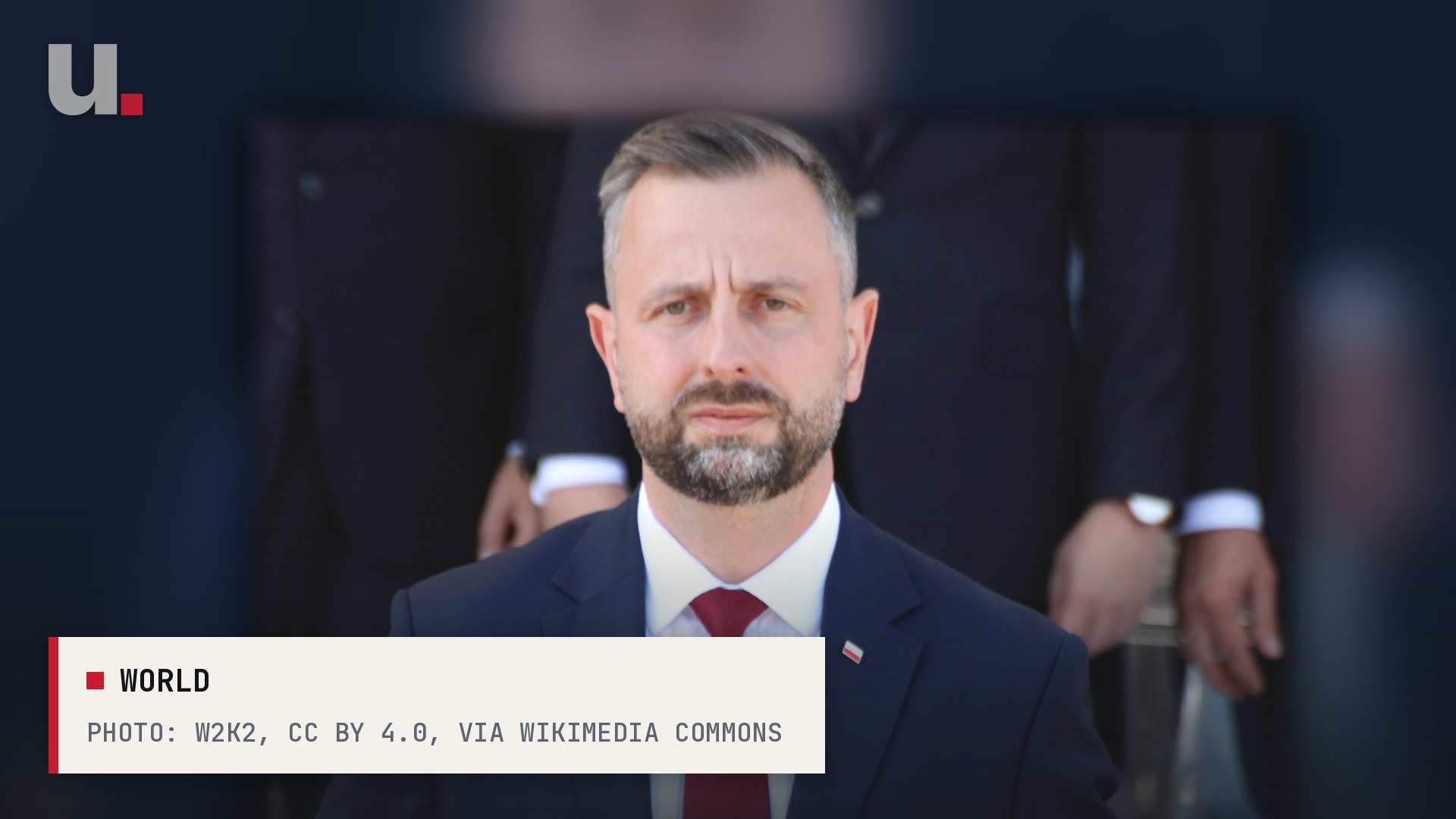
Three Russian cruise missiles came down on Polish farmland early Friday. On Monday, Poland sent its deputy defense minister to Brussels with a simple request for its allies: put more planes in the sky over the eastern border so the next one gets shot down before it lands.
The missiles fell during one of Russia’s heaviest overnight attacks on western Ukraine in months. Polish officials say they crashed near three villages in the country’s southeast: Nowy Lipowiec in Lublin province, Rudnik nad Sanem and Mołodycz. Nobody was hurt and no serious damage was reported. Polish officials first described two missiles and a jet-powered drone; by Monday they were calling all three Kh-101 cruise missiles, the long-range weapon Russia fires from its bombers.
Defense Minister Władysław Kosiniak-Kamysz laid out the timeline on 𝕏 that afternoon. The first alerts went out at 1:40 a.m. Ground-based air defenses were switched on and fighter pairs on standby took off. Polish F-16s flew alongside Swedish Gripens, a Saab surveillance plane and a Dutch refueling tanker. “As a result of these events, no one was harmed on Polish territory,” he wrote.
NATO Secretary General Mark Rutte posted that same day that allied jets had scrambled and called the strikes “grave violations” of Polish airspace.
Mark Rutte on 𝕏: “Spoke with @donaldtusk about the grave violations of Polish airspace overnight. NATO jets were scrambled in response.”
— @SecGenNATO View on 𝕏
A missile 22 miles from allied troops
What has Warsaw angry is where and when. On the same day, thousands of troops from 11 countries, Britain among them, were running drills at Nowa Dęba in southeastern Poland. Those countries call themselves the Coalition of the Willing, and they are training for a possible mission in Ukraine once the war ends. One of the missiles hit roughly 22 miles from that training ground.
Prime Minister Donald Tusk called it “an intentional provocation.” Kosiniak-Kamysz said the date was “not accidental.” Deputy Defense Minister Paweł Zalewski went further before leaving for Brussels on Monday. “This is an obvious Russian provocation aimed at undermining NATO unity and the unity of the Coalition of the Willing in order to make it more difficult to help Ukraine,” he told reporters, according to the Polish Press Agency.
President Trump sees it differently. He told Fox News that “Putin has been landing drones in Poland and a couple of little missiles, by mistake.” Trump has spent his second term trying to broker an end to the war, and treating every stray missile as an act of war is a fast way to blow up those talks. Poland’s own response, as it turns out, doesn’t depend on who is right about intent. Either way, Warsaw wants the missiles stopped in the air.
The ally that already paid its share
This is where Poland stands apart from most of Europe. For years, Trump hammered allies who leaned on American taxpayers while their own militaries shrank. At the alliance’s 2025 summit in The Hague, members agreed to a new goal of 5% of their economies, with 3.5% for core defense, by 2035. Poland didn’t wait.
NATO’s own figures, released this summer, put Poland’s core defense spending at an estimated 4.68% of its economy in 2026. That is up from 1.86% in 2014, the year Russia first grabbed Crimea. Only Lithuania, Estonia and Latvia, three small countries that also border Russia or its ally Belarus, spend a bigger share. The United States sits at 3.17%. Germany is at 2.69%, France at 2.22% and Spain at exactly 2%.
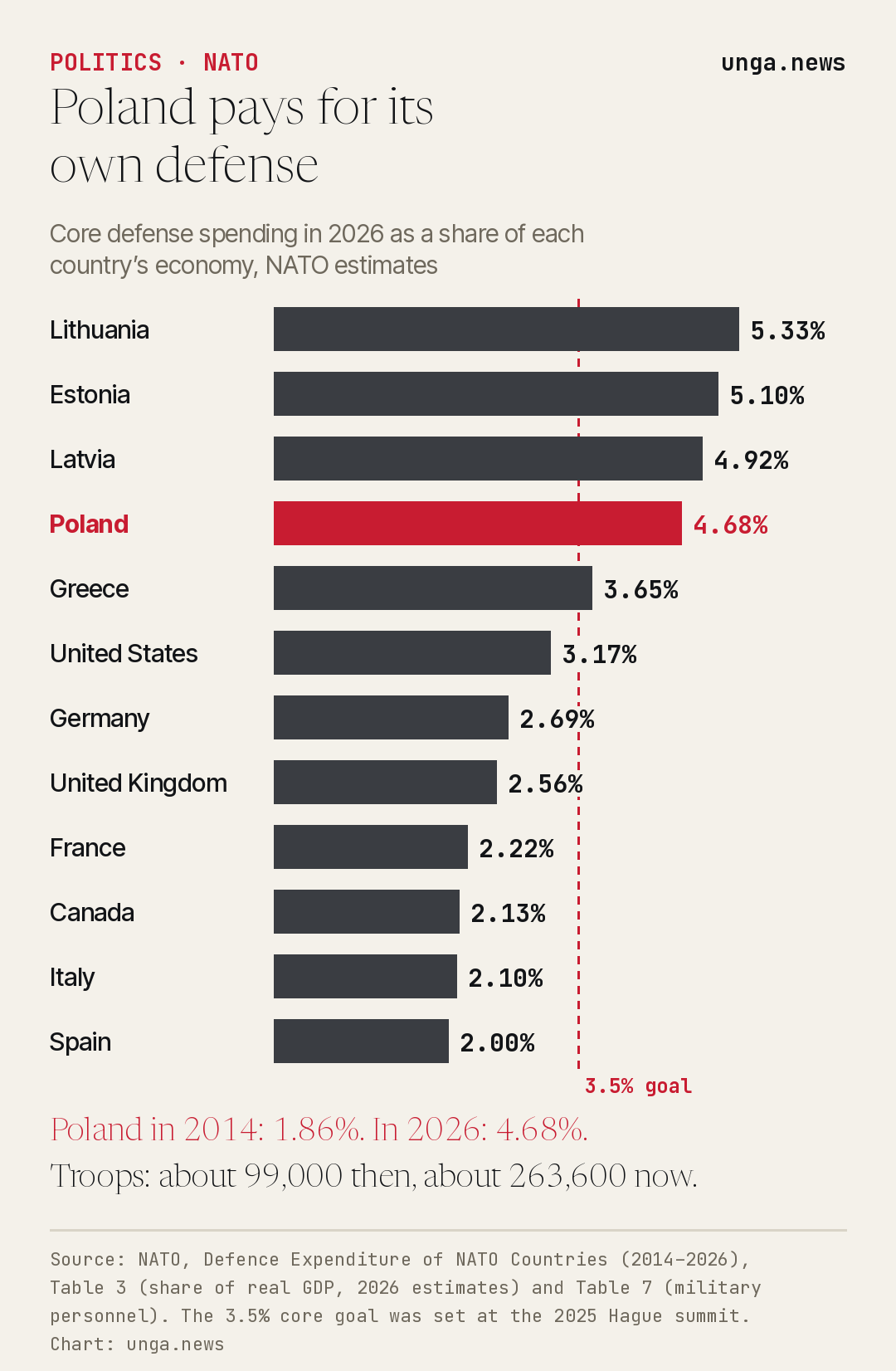
The money shows up in uniforms, too. NATO counts about 263,600 Polish military personnel this year, up from about 99,000 in 2014. Poland has bought American F-35s, Patriot missile batteries and Abrams tanks. This is the kind of ally Trump said America deserved: one that carries its own weight and then asks friends to help with the rest.
What Warsaw put on the table
Monday’s session of the North Atlantic Council, the alliance’s top decision-making body, was called at Poland’s request. Zalewski said Poland would push for stronger air defenses and better radar coverage along the eastern flank, including an additional AWACS early-warning plane. Polish officials have also asked for more F-35 fighters. No new deployments had been announced as of Monday morning.
Poland did not invoke Article 4, the treaty clause that triggers formal emergency talks when a member feels threatened. “There is no need to invoke this fourth article,” Zalewski said. Warsaw used it in September 2025, after a swarm of Russian drones crossed into the country. That episode led to Eastern Sentry, NATO’s stepped-up air-defense mission on the eastern border.
Friday’s missiles got through anyway. Polish authorities say poor weather kept their jets and air defenses from intercepting them, according to NPR. It also wasn’t the first time this year. In July, a Russian missile left a large crater in a field in eastern Poland.
Kosiniak-Kamysz said Saturday he had been in touch with Gen. Alexus Grynkewich to settle the details. Grynkewich is the American general who commands NATO forces in Europe. “In the near future, we will receive strong support from our NATO allies to bolster the protection of our eastern border,” the defense minister wrote on 𝕏. Rutte, in Warsaw that same day after talks with Tusk, put it more bluntly: “I can guarantee that NATO will defend every inch of Polish territory.”
Not one of those words came from a country asking America to do the work for it. Poland is spending its own money, training its own soldiers and flying its own jets. On Monday it asked its allies to match that with a few more planes in the sky, and to make sure the next Russian missile that crosses the border never reaches a Polish field.
Sources
- Mark Rutte on 𝕏 — “Spoke with @donaldtusk about the grave violations of Polish airspace overnight” (Nov. 20, 2026)
- Władysław Kosiniak-Kamysz on 𝕏 — Timeline of Polish air defense response, Nov. 20, 2026 (in Polish)
- Władysław Kosiniak-Kamysz on 𝕏 — Allied support and Monday’s North Atlantic Council meeting, Nov. 21, 2026 (in Polish)
- NATO — Defence Expenditure of NATO Countries (2014–2026), data tables
- Polish Press Agency (PAP) — Poland to seek stronger NATO air defences after Russian missile incursions (Nov. 23, 2026)
- Stars and Stripes — NATO emergency talks on tap as US commander assesses defenses after Russian missiles hit Poland (Nov. 22, 2026)
- UPI — Trump: ‘Little’ missiles in Poland ‘a mistake;’ PM Tusk disagrees (Nov. 21, 2026)
- The Guardian — Russian missiles and drone hit Poland during attacks on Ukraine (Nov. 20, 2026)
- NPR — Up First briefing: NATO Poland meeting (Nov. 23, 2026)
- RBC-Ukraine — Poland to urge NATO to strengthen its air defenses (Nov. 2026)