

Treasury Moves to Let Banks Ask Business Owners If They’re in the Country Legally
A new FinCEN proposal lets banks dig into immigration status and work papers when red flags point to fraud, and stops honest companies from refiling the same forms.
For years, a bank could check a business owner’s ID and Social Security number and still have no clear way to ask the obvious follow-up question when something looked off: is this person even allowed to be here and work here?
The Treasury Department wants to settle that. On Tuesday, its Financial Crimes Enforcement Network, the agency known as FinCEN, proposed a rule that spells out in black and white that banks and other financial firms can ask the owners of a business about their immigration status and work authorization when warning signs point to fraud, identity games, sanctions dodging or other dirty money.
“Financial institutions are on the front lines of protecting our financial systems from criminal organizations and cartels that target law-abiding businesses and workers,” Treasury Secretary Scott Bessent said. “This proposed rule cuts unnecessary burden, gives institutions more flexibility to effectively combat risk, and strengthens our fight against financial crime.”
Who actually owns the company
The rule targets a weak spot crooks have leaned on for decades: the business account. Cartels, fraud rings and people working off the books don’t usually open accounts in their own names. They set up a company, put someone else’s name on the paperwork and move money through it.
Since a 2016 rule, banks have had to identify the real people behind a company, the “beneficial owners,” when that company opens an account. What they collected was largely spelled out in an optional form tucked into an appendix. FinCEN’s plan moves that list into the rule itself and makes clear that a bank may dig further when the facts call for it.
The key sentence is in Treasury’s fact sheet. Where other risk indicators or supervisory concerns warrant it, a bank “may obtain additional information,” including “information relevant to whether account holders possess lawful immigration status and employment authorization in the United States,” when that’s relevant to fraud, identity misrepresentation, sanctions evasion or other illicit financial activity.
That’s targeted, not a dragnet. Nothing in the proposal makes every customer prove citizenship to open a checking account. It gives banks clear authority to ask when the red flags are already flying, and to stop guessing whether they’re allowed to.
No more swapping in a tax number
One change will hit hardest at people gaming the system. The proposal says an Individual Taxpayer Identification Number, the ITIN, is not an acceptable substitute for a Social Security number when a bank records who owns a business. The proposed rule points out that the IRS says an ITIN is “issued . . . for federal tax purposes only.” It was never meant to work as an identity card for the banking system.
Banks would also be allowed to pull information from outside sources to check who they’re dealing with, rather than relying only on what a customer hands them across the desk.
Here’s how wide the net reaches. FinCEN counts about 14,554 financial institutions that fall under the rule.
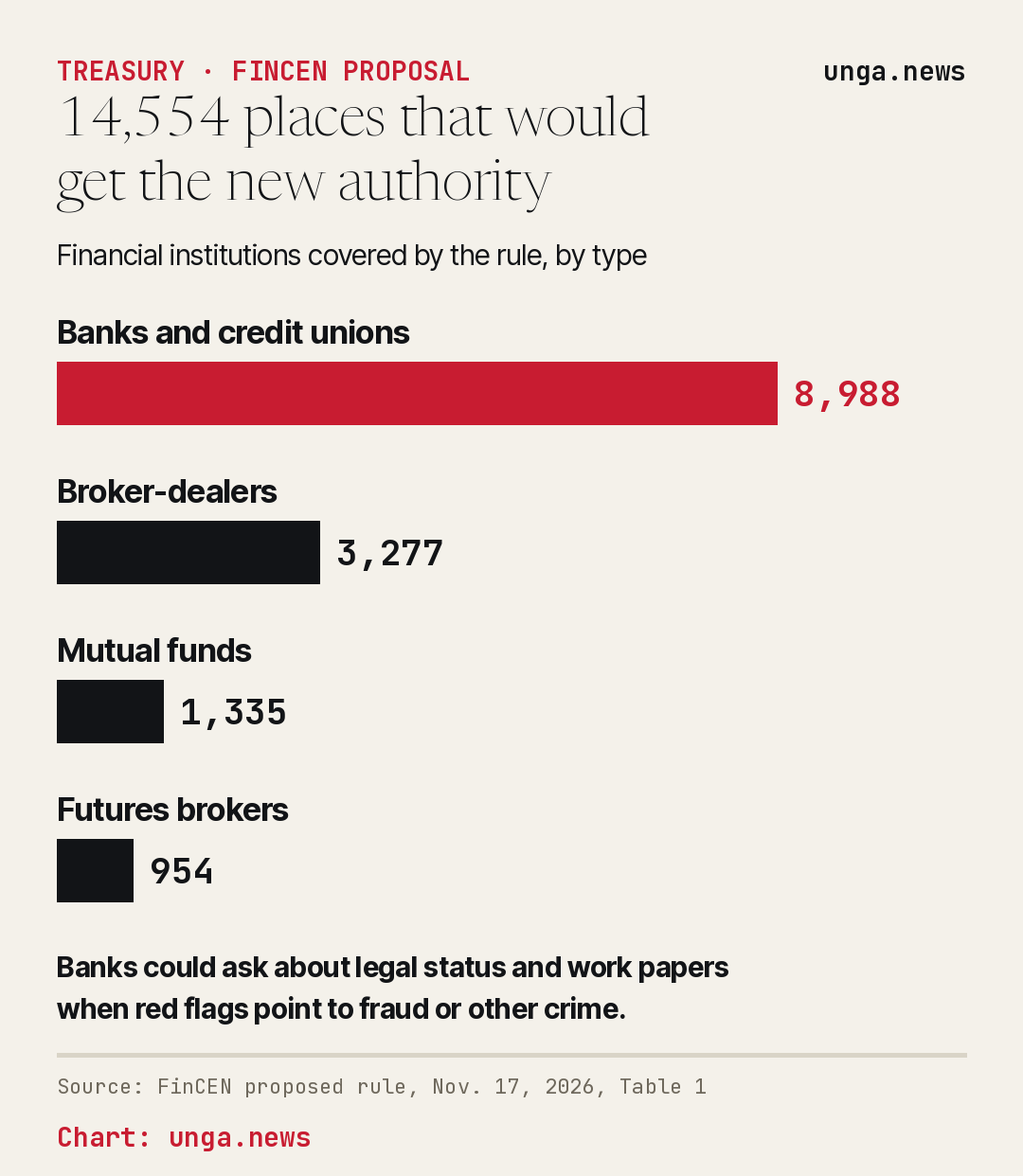
That includes 4,336 FDIC-insured banks and 4,287 credit unions, plus 365 banks without a federal regulator, 3,277 broker-dealers, 1,335 mutual funds and 954 futures brokers. FinCEN says the rule doesn’t add anybody new to that list. It sharpens the tools the same institutions already have.
Less paperwork for honest customers
The part that rarely makes headlines is the burden it lifts. Under the old rule, a bank had to identify and verify a company’s owners every single time that company opened a new account, even if it had done the same check a week earlier.
FinCEN already waived that requirement in February with an order known as FIN-2026-R001. The proposal would make the waiver permanent. Banks would check owners when a company first opens an account, again when facts “reasonably call into question” what they were told, and as their own risk procedures require.
So the honest small-business owner opening a second account for payroll stops filling out the same form twice, while the shell company with a borrowed name gets a harder look. That’s the trade Bessent is describing when he says the rule cuts burden and strengthens the fight at once.
Part of a bigger push
The proposal comes straight out of Executive Order 14406, “Restoring Integrity to America’s Financial System,” which President Trump signed May 19. The order told Treasury to tighten customer checks and flagged the risk of extending credit to “the inadmissible and removable alien population.”
Agencies have been moving on it since. On June 5, Treasury, FinCEN and the banking regulators warned financial institutions to watch for fraud schemes tied to the unlawful employment of illegal aliens. On June 8, the Consumer Financial Protection Bureau issued a statement on immigration status and a borrower’s ability to repay. On July 13, the FDIC, the comptroller of the currency and the credit union regulator put out guidance on lending to people not legally authorized to work in the United States.
This rule is the piece that reaches into business accounts, where the biggest money tends to move.
It isn’t final yet. FinCEN is taking public comments for 60 days after the proposal is published in the Federal Register, under docket FINCEN-2026-0298. Banks, credit unions and anyone else can weigh in, anonymously if they want. The fact sheet lays out how to file.
The basic idea is simple enough. A bank already has to know its customer. Now it’s allowed to ask whether that customer belongs here when the evidence says it should.
Sources
- U.S. Treasury — FinCEN Issues Proposed Rule to Strengthen Customer Due Diligence Requirements for Covered Financial Institutions
- FinCEN — Notice of proposed rulemaking: Customer Due Diligence Requirements (Docket FINCEN-2026-0298)
- FinCEN — Fact Sheet: Proposed Rule to Strengthen Customer Due Diligence Requirements
- Fox News — Trump Treasury aims to slam shut banking loopholes that could enable fraud tied to illegal immigration