

Treasury Traced $14.7 Billion in Suspected Iran Money Through Banks. Now It’s Blacklisting the Middlemen.
Scott Bessent’s Treasury hit more than two dozen Iranian money changers, Dubai front companies and the regime’s own currency exchange, as the U.S. Navy keeps Iran’s ports locked down.
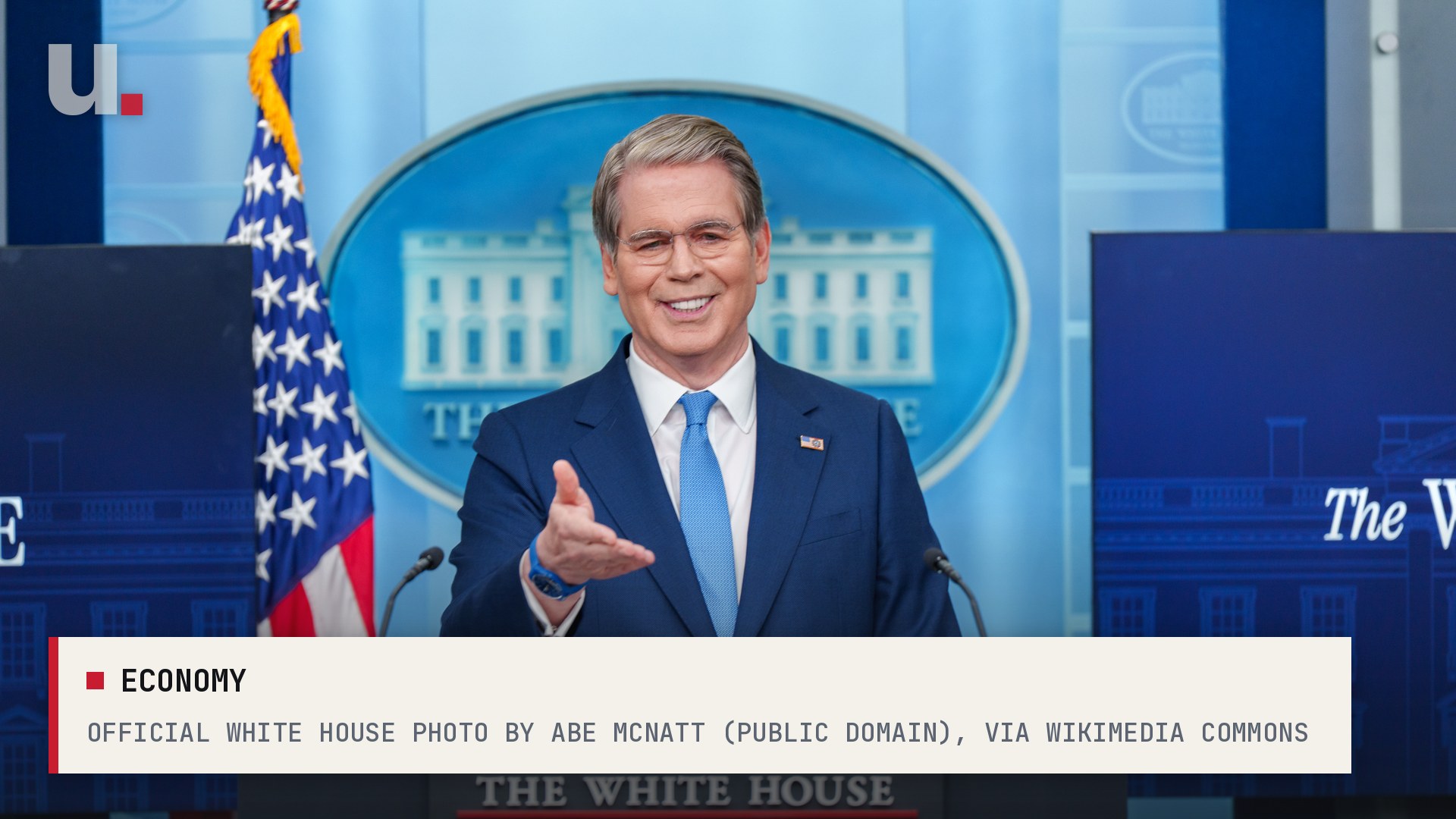
Iran’s ports are under a U.S. Navy blockade, and its oil money keeps shrinking. So the regime leans harder on the one pipeline it has left: a hidden web of money changers and shell companies, most of them in Dubai and Hong Kong, that quietly move its cash around the world. On Monday, Treasury went after that web.
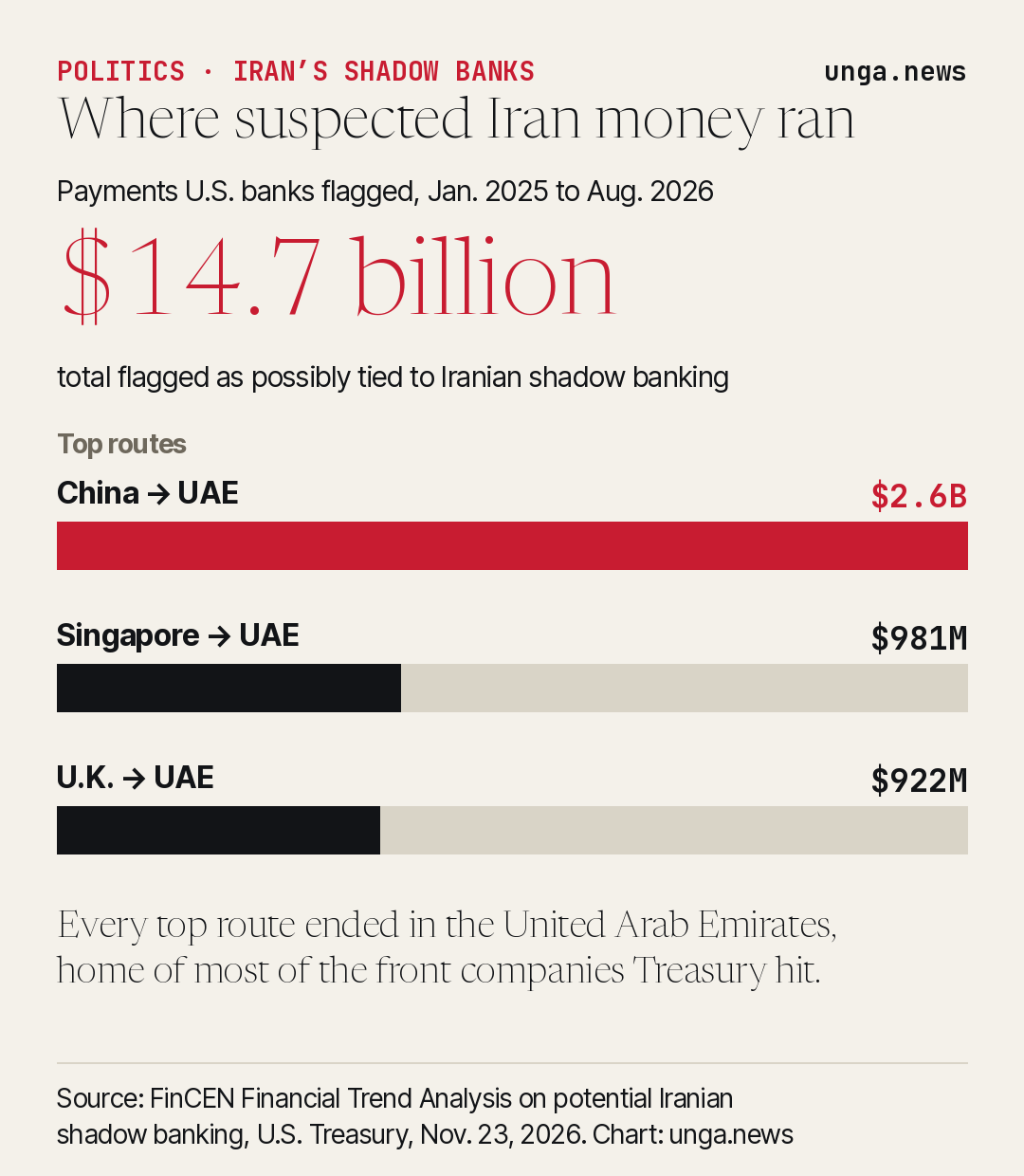
Treasury sanctioned more than two dozen Iranian exchange houses, front companies and the people running them, along with the government-backed Iran Center for Exchange of Currency and Gold, which matches Iran’s exporters with its importers for “tens of billions of dollars’ worth of trade every year,” according to the department’s announcement. On the same day, Treasury’s anti-money-laundering office, FinCEN, published a study finding about $14.7 billion in financial activity, from January 2025 through August 2026, that U.S. banks flagged as possibly tied to Iran’s shadow banking.
Treasury Secretary Scott Bessent didn’t soften it.
Treasury Secretary Scott Bessent on 𝕏, Nov. 23, 2026 — “Iran’s economy is underwater, and its leaders are panicking.”
— @SecScottBessent View on 𝕏
“Iran’s shadow banking system is the last financial lifeline of a bankrupt regime,” Bessent said. “Treasury will continue dismantling these illicit networks until we have buried the head of the snake.”
How a sanctioned country still pays its bills
Iran has been cut off from normal banking for years. It gets around that with a system Treasury says is overseen by Iran’s own central bank. Inside Iran, licensed exchange houses take orders from Iranian companies that need to pay for imports or collect for exports. They work hand in hand with what Treasury calls “rahbar companies,” arms of Iranian banks that run the evasion networks for their clients. Those companies then route the money through thousands of front firms registered abroad, so a payment that starts in Tehran looks like ordinary trade between two Dubai trading houses.
Monday’s list walks right through that chain. At the top is Nesim Baharan, the rahbar company for Iran’s Bank Sarmayeh, whose clients include major Iranian petrochemical companies, plus three people Treasury says act for it. Next come two exchange houses, Fashki Exchange and Mellat Exchange, and five people who own or run them. Then the first batch of fronts: eight Dubai firms, a Turkish customs and fuel company and a Hong Kong trading company that Treasury says carried “thousands of cross-border payments, worth billions of dollars, on behalf of Iranian clients.”
Some of the details are striking. One Dubai front, Recaz Star General Trading, sent and received hundreds of payments totaling more than $170 million tied to people linked to Sadaf Exchange. Another, OGA Global General Trading, handled millions of dollars in payments for the National Iranian Tanker Company, which runs the regime’s state oil tanker fleet. A third, Khore Al Hilal, moved millions for Iran’s Bank Sepah through two exchange houses the U.S. had already sanctioned.
Iran’s military uses the same plumbing. Treasury says a company tied to Iran’s Armed Forces General Staff paid for the charter of an oil tanker, the SERENE I, through a Dubai firm called H N B Trading, which took in hundreds of thousands of dollars from a military front company. That firm was hit under counterterrorism authority.
The $14.7 billion banks caught
The second release is the one that should get Wall Street’s attention. When American banks see a payment that smells wrong, the law requires them to report it to FinCEN. Adding up those reports, FinCEN found roughly $14.7 billion in activity over 20 months that looked like Iranian shadow banking, according to its new trend analysis.
The top flagged routes all ended in the same place. The biggest stream ran from banks in mainland China to banks in the United Arab Emirates, about $2.6 billion. Singapore to the UAE came next at about $981 million, then the United Kingdom to the UAE at about $922 million. FinCEN also warned about Iran-linked companies registered in the Marshall Islands and the British Virgin Islands, usually at addresses linked to corporate registries, in businesses like shipping, trading and oil.
That’s why the money changers matter. A drone or a missile is easy to see. The payments behind them aren’t, and Iran needs them to keep buying parts and selling oil.
Pressure from every side
This is the latest round of what Bessent calls Operation Economic Outcast, which he launched on Aug. 24 and nicknamed “Economic D-Day.” Treasury says it has mapped the networks Iran uses to smuggle oil, dodge sanctions and fund terror, and it is working with the European Union, Britain and Gulf partners to choke off the money. Anyone who handles laundering for Iran now risks losing access to the U.S. financial system, and foreign banks that knowingly push big transactions for the people on Monday’s list can be cut off from American accounts.
The financial squeeze lands while President Trump keeps the military pressure on. The U.S. is blockading Iranian ports, and Trump told Fox News on Sunday that Iran’s negotiators are “professional tap dancers” who talk without delivering. He said he is inclined to strike again after the new year if there’s no deal. Asked whether Iran might test the blockade, he said, “I hope they do, they’ll all be at the bottom of the sea like the rest of the navy,” and he told protesters inside Iran to “keep protesting.”
Put those together and the strategy is plain. The Navy keeps the tankers bottled up. Treasury goes after the back door the regime uses to get paid anyway. And the regime’s own people are back in the streets.
Treasury also says the regime is being robbed from within. Its release says the shadow bankers have “increasingly failed to repatriate dwindling export earnings while simultaneously enriching themselves by stealing state resources that rightfully belong to the Iranian people.” A government that can’t trust its own money men, while its oil money shrinks, is a government running out of room.
Under Monday’s action, any property of the listed people and companies that touches the U.S. or American hands is frozen, along with any company they own 50% or more of. Americans are barred from doing business with them. And FinCEN’s whistleblower program can pay for tips that lead to Iran sanctions penalties above $1 million, which gives every compliance officer in Dubai a reason to look twice at the next payment from a trading house he’s never heard of.
Sources
- U.S. Department of the Treasury — Operation Economic Outcast Disrupts Iran’s Global Shadow Banking Networks (Nov. 23, 2026)
- U.S. Department of the Treasury — Treasury Identifies Nearly $15 Billion in Potential Iranian Shadow Banking (Nov. 23, 2026)
- Office of Foreign Assets Control — Iran-related Designations (Nov. 23, 2026)
- Treasury Secretary Scott Bessent on 𝕏 — “Iran’s economy is underwater, and its leaders are panicking.” (Nov. 23, 2026)
- Treasury Department on 𝕏 — “Today, as part of Operation Economic Outcast, Treasury sanctioned over two dozen Iranian exchange houses…” (Nov. 23, 2026)
- Fox News — Trump warns of new strikes against Iran after new year, calls negotiators ‘professional tap dancers’ (Nov. 22, 2026)
- Iran International — Trump leaning toward new Iran strikes after new year (Nov. 22, 2026)