

Trump and Three Big Allies Strike Deals to Break China’s Grip on the Metals in Your Phone
At his first Quad summit, Trump lined up Japan, India and Australia on rare earth supplies and promised America will catch China within 10 months.
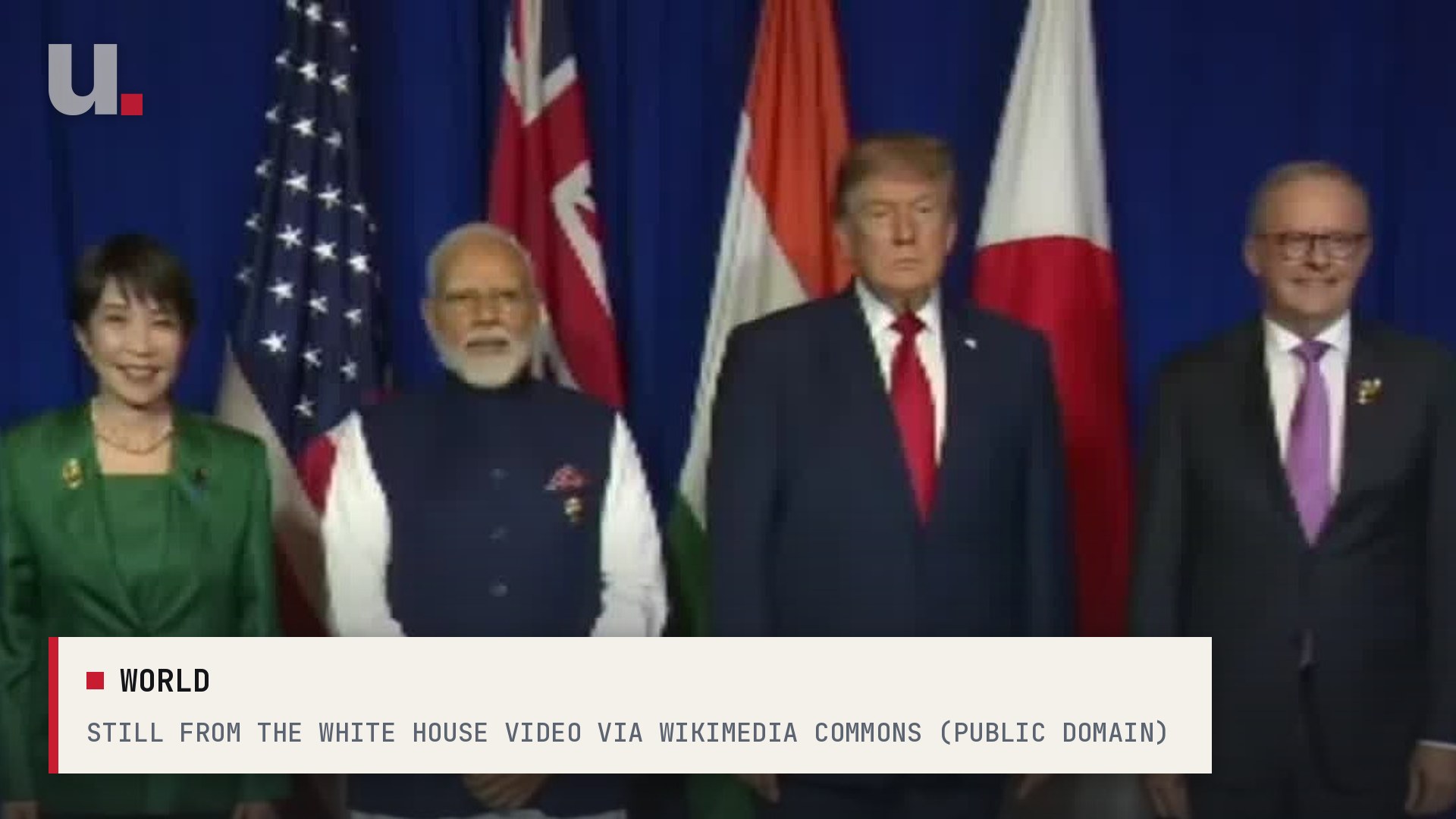
President Trump used his first Quad summit to go after the weak spot that has haunted American factories for years. Meeting in Manila on Tuesday with the prime ministers of Japan, India and Australia, Trump said the four countries reached agreements to secure supplies of critical minerals, the rare earths and metals that go into everything from fighter jets to phones to car motors.
The goal, Trump said, is to end “coercion by any single foreign supplier.” He didn’t have to say the name. China refines most of the world’s rare earths, and it has shown it’s willing to turn off the tap.
“We are making rare earth at a level that we’ve never made before. We’re going to catch them within 10 months,” Trump told reporters, according to Reuters and Al Jazeera. He said America would have “everything we need” on rare earths in that time.
Four countries, one message to Beijing
The leaders met for about 90 minutes, according to Japan’s prime minister’s office. Their joint statement, released by the White House, never names China, but it doesn’t need to. The four nations said they “strongly oppose any destabilizing or unilateral actions that seek to change the status quo, including by force or coercion,” and expressed “grave concerns about economic coercion, including through arbitrary export restrictions.”
That last line is aimed squarely at Beijing’s playbook. China restricted rare earth exports last year during its trade fight with the United States, before a June deal restored American access. It has effectively cut off key critical minerals to Japan for nearly a year as relations between the two have soured, Reuters reported. That makes Japan the country with the most to gain from a new supply line, and Prime Minister Sanae Takaichi said in Manila that “Japan will play an ever more proactive role” while pledging to work with Southeast Asian nations on mineral supply chains and export restrictions.
“Our countries are the four corners of a free, open, stable, and prosperous Indo-Pacific,” Trump said before the meeting.
The grip is already loosening
Trump’s 10-month promise sounds bold, but the trend is already moving in America’s direction. The International Energy Agency, the Paris-based energy watchdog, reported this year that the top supplier’s share of rare earth refining fell from more than 90% in 2023 to 85% in 2025. The IEA credited new refining projects in the United States and more output in Malaysia. If projects now in the pipeline get built on time, China’s share could drop to about 70% by 2035.
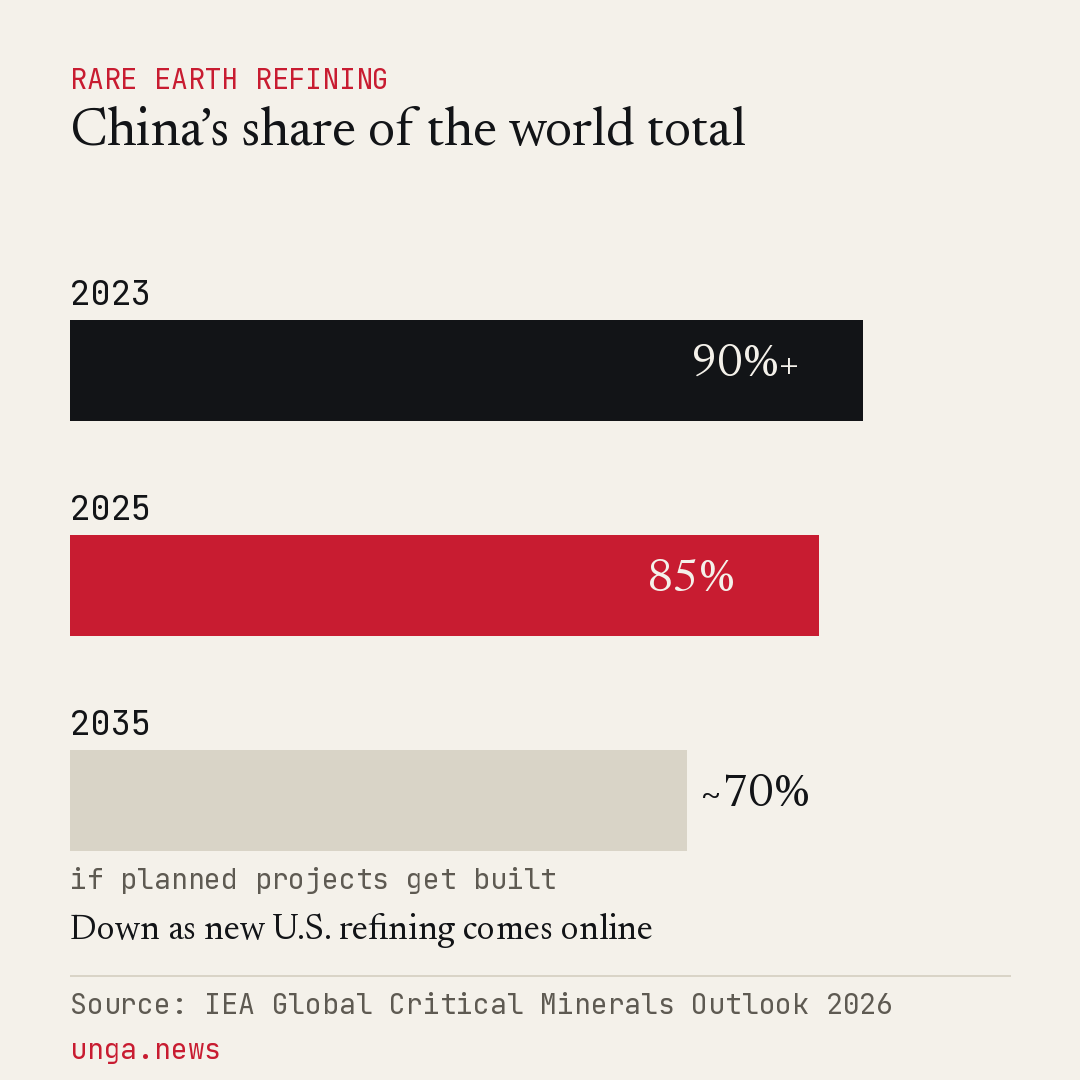
Rare earths are the exception to the IEA’s otherwise gloomy picture. For most critical minerals, the agency found supply has become more concentrated, not less. That is why the rare earth numbers matter: they show that when governments push and companies build, the chokehold can be broken.
The Manila deals build on a Quad critical minerals framework the four nations adopted on May 26. That plan covers mining, processing and recycling, and Australia’s government says the partners intend to mobilize up to $20 billion in public and private money through loans, loan guarantees, equity stakes, insurance and long-term purchase deals. The White House hasn’t yet released project names or dollar amounts for the new agreements, so the specifics are still to come.
More than minerals
The summit produced a list of other moves that tighten the four nations’ hand in the Pacific. In 2027, American, Australian, Indian and Japanese P-8 and P-3C submarine-hunting patrol planes will fly a maritime exercise together for the first time under the Quad banner, part of a new effort to share what each country sees on the water.
The leaders also announced stepped-up cooperation on cybersecurity, an expansion of undersea cable projects that Australia will now extend to electricity lines, and a first Quad Business Leaders’ Forum in early 2027 to steer private deals across the four economies. They reaffirmed a Quad accelerator, first announced by their foreign ministers in Atlanta, to fund trusted SI access and deployment across the region. The statement also condemned terrorism “in all its forms and manifestations, including cross-border terrorism,” wording India has long pushed for.
It was Trump’s first Quad leaders’ meeting of this term, and it came on day one of a three-day swing through Asia. Earlier in Manila he wrapped up a trade pact with Thailand. On Thursday he heads to Shenzhen, China, for the Asia-Pacific Economic Cooperation forum, where he is expected to sit down with Chinese President Xi Jinping and Russian President Vladimir Putin.
That sequence is the point. Trump walks into the room with Xi having just lined up Japan, India and Australia behind a plan to stop depending on Chinese minerals. Beijing’s biggest bargaining chip just got a little smaller.
Sources
- The White House — Quad Leaders’ Summit Joint Press Release, Nov. 17, 2026
- Prime Minister’s Office of Japan — Japan-Australia-India-U.S. (Quad) Leaders’ Summit (Summary), Nov. 17, 2026
- Al Jazeera / Reuters — Trump announces critical minerals agreements at Quad meeting in Manila
- IEA — Supply concentration, export restrictions and declining investment put critical mineral security at risk
- Mining.com.au — Trump, Quad leaders meet amid critical minerals supply concerns