

Trump Makes Arizona's Chiricahua the 64th National Park, His Fifth New Park Since 2018
The upgrade keeps the same land, money and rangers, costs under $500,000, and history says it could pull in tens of thousands more visitors.
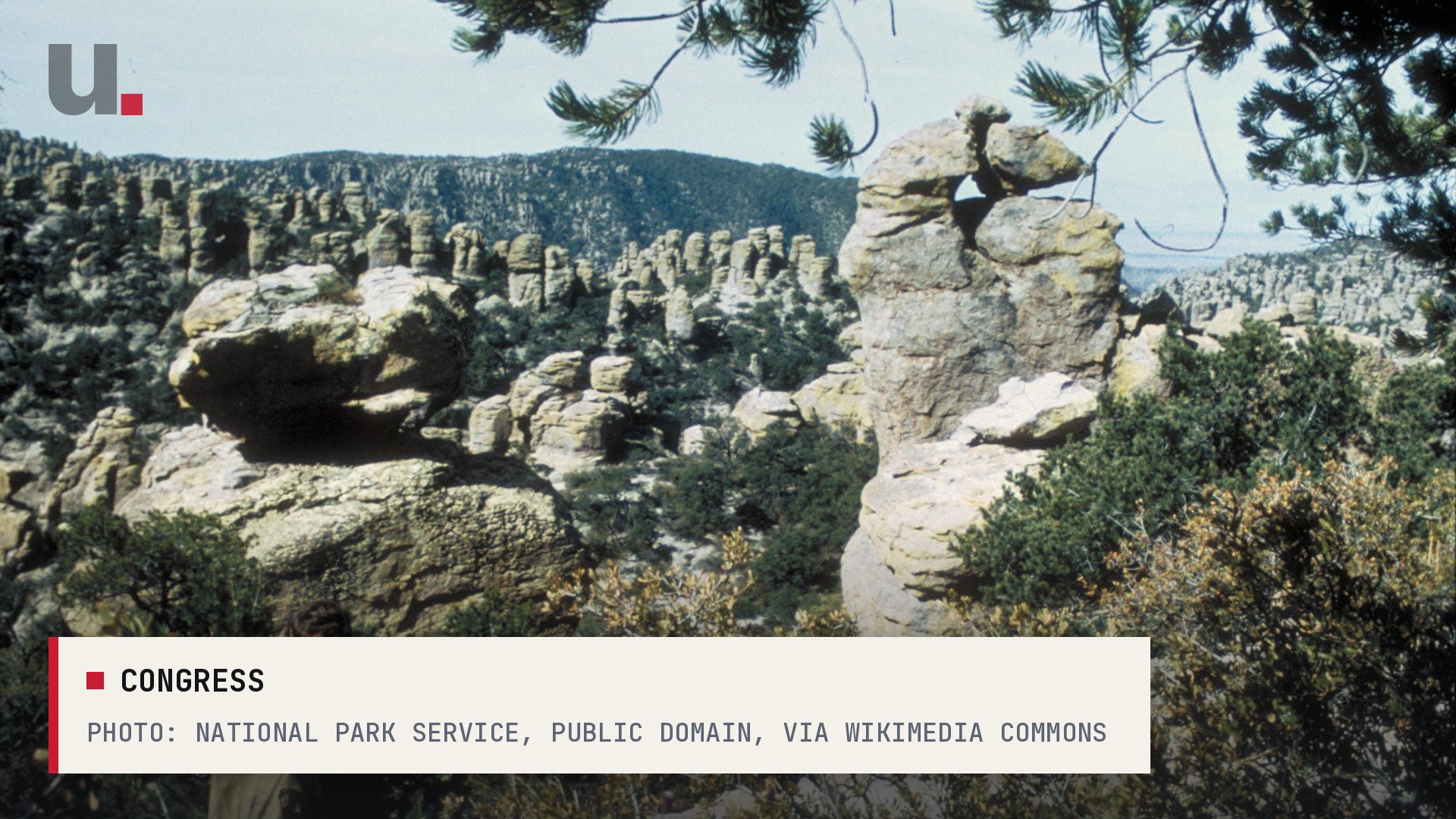
America has a new national park, and President Trump signed it. Chiricahua, a 12,000-acre maze of volcanic rock spires in the southeast corner of Arizona, is now the country's 64th national park and Arizona's fourth, joining the Grand Canyon, Petrified Forest and Saguaro.
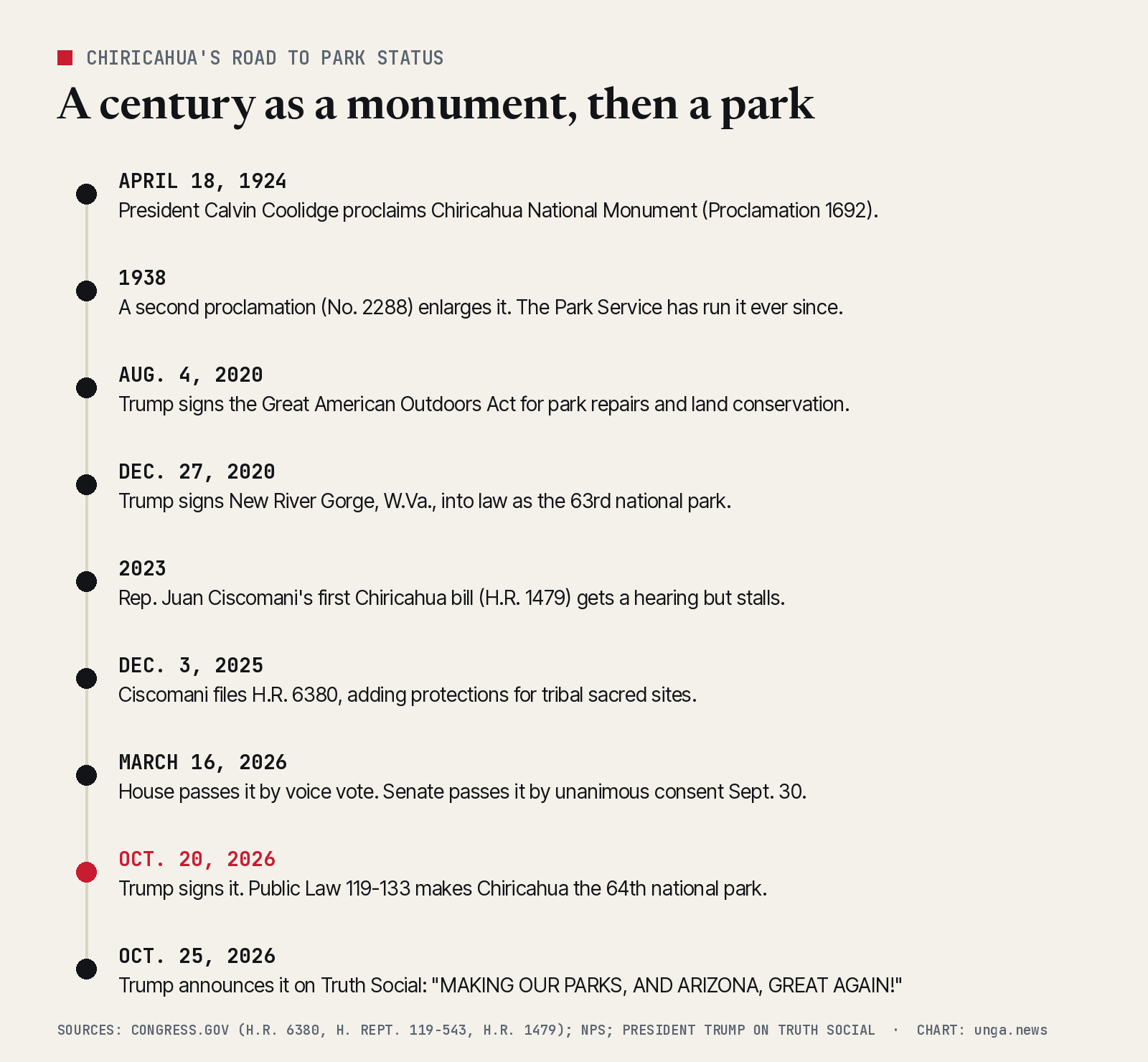
Trump signed the Chiricahua National Park Act on Oct. 20. On Sunday he told the country about it on Truth Social: "I am proud to announce the NEWEST FLAGSHIP NATIONAL PARK in the Country, CHIRICAHUA NATIONAL PARK in ARIZONA!" He reminded readers that in his first term he signed the Great American Outdoors Act and made West Virginia's New River Gorge a park, "meaning, I've now given ALL Americans their 63rd and 64th National Park."
"We are MAKING OUR PARKS, AND ARIZONA, GREAT AGAIN!" (@WhiteHouse, quoting President Trump, Oct. 25, 2026)
— @WhiteHouse View on 𝕏
He actually undersold it. Count them: Gateway Arch in 2018, Indiana Dunes and White Sands in 2019, New River Gorge in 2020, and now Chiricahua. Every national park added since 2013 has been signed by Trump. The last one before that, California's Pinnacles, came in 2013.
What actually changed
Here's the part most coverage skips: on the ground, almost nothing. The new law, Public Law 119-133, keeps the same boundaries, the same funding and the same Park Service staff. Every federal reference to "Chiricahua National Monument" now simply reads "Chiricahua National Park." The Congressional Budget Office estimated it would cost less than $500,000 over the 2026-2031 period.
Think of it as a promotion with a new title on the office door, not a new building. So why bother? Because the word "park" sells. A president can create a national monument with a pen, which is how Calvin Coolidge created this one in 1924. A national park takes an act of Congress, and that label puts a place on bucket lists, road-trip maps and passport-stamp tours.
The numbers back it up
The Park Service's own visitor counts show what the promotion tends to do. New River Gorge drew 1.20 million visits in 2019, its last full year as a "national river." In 2025 it drew 1.96 million, up 64%. Indiana Dunes went from 1.76 million visits in 2018 to 2.63 million in 2025. Over the same years, the park system as a whole went nowhere: 327.5 million visits in 2019, 323.0 million in 2025.
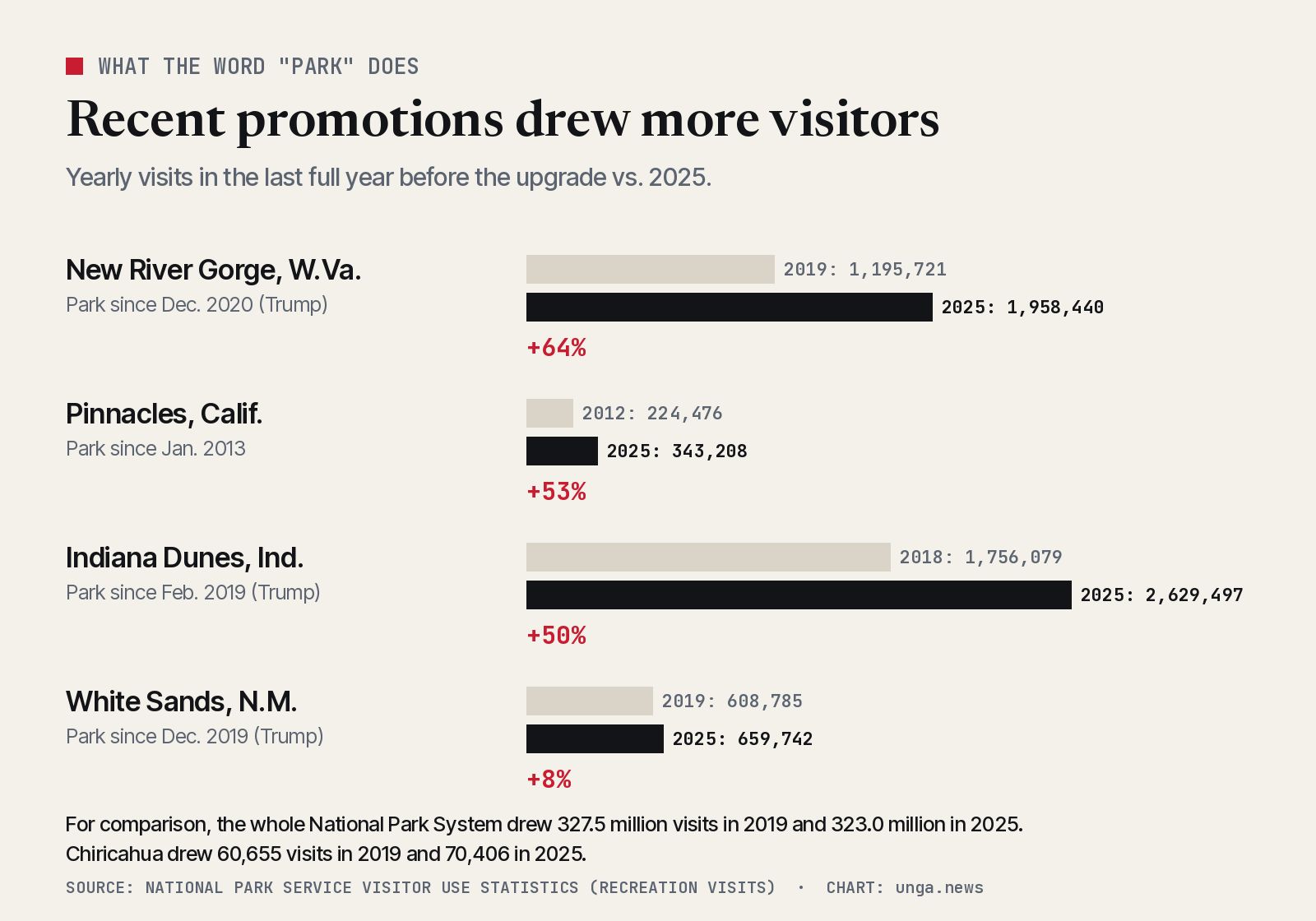
Not every promotion is a rocket. White Sands in New Mexico is up just 8%, and the pandemic scrambled everybody's numbers for a couple of years. But the pattern is clear enough that Cochise County wanted in. Chiricahua drew 70,406 visits last year. A bump like New River Gorge's would push it well past 100,000, and that's real money for the motels, gas stations and diners around Willcox.
What's out there
The Apache called it "the Land of Standing-Up Rocks," according to the House Natural Resources Committee's report on the bill. The spires are rhyolite, left behind by a volcanic eruption about 27 million years ago, the Interior Department says, and more than 85% of the land is designated wilderness. It's also history you can walk through: the homeland of the Chiricahua Apache, a chapter of Buffalo Soldier history, and Faraway Ranch, a homestead run by Swedish immigrants in the 1800s.
"Chiricahua's towering rock spires, rich Apache heritage and remarkable biodiversity make it one of America's most extraordinary landscapes," Interior Secretary Doug Burgum said in the department's announcement. He unveiled the new park sign with rangers the day Trump signed the bill.
"There's a new national park in town and a sign to prove it." (@Interior, Oct. 21, 2026)
— @Interior View on 𝕏
A decade of work
Republican Rep. Juan Ciscomani, who represents the area, made this one of his first bills. His first try, H.R. 1479 in the last Congress, got a hearing and then stalled. Before filing again in December 2025, he went back to the region's tribes, and the new bill added a section on sacred sites that most stories never mention.
That section guarantees tribal members access to traditional cultural and religious sites, and lets the Park Service close small areas for a short time when a tribe asks. The law caps any closure at "the smallest practicable area for the minimum period necessary," so hikers don't lose the park. The committee wrote that the section puts no "new, affirmative requirements" on the Park Service beyond the laws it already follows.
The bill passed the House by voice vote on March 16 and the Senate by unanimous consent on Sept. 30. Democratic Sen. Mark Kelly carried a matching Senate version and Democratic Rep. Greg Stanton co-sponsored Ciscomani's, so nobody stood in the way. It still took a Republican Congress and Trump's signature to get it done. "After nearly a decade of work, persistence has finally paid off, and this historic effort has reached the summit," Ciscomani said. Trump's post also thanked Arizona Reps. Andy Biggs, David Schweikert, Eli Crane, Abe Hamadeh and Paul Gosar.
What happens next
If you're heading down there, nothing changes this week. The Park Service says hiking, camping, the scenic drive and wildlife viewing all carry on, and current information is at nps.gov/chir. The open question is whether Congress keeps going. The same House committee that cleared Chiricahua in February also advanced a bill to make Wisconsin's Apostle Islands a national park and preserve, but that one hasn't passed the House.
For now the count stands at 64. A century after Coolidge set this rock garden aside, it finally carries the title it earned, and the president who signed it has now signed five of the last six new national parks.
Sources
- President Donald J. Trump on Truth Social — "I am proud to announce the NEWEST FLAGSHIP NATIONAL PARK in the Country..." (Oct. 25, 2026)
- Congress.gov — H.R. 6380, Chiricahua National Park Act: text, actions and Public Law 119-133
- House Committee on Natural Resources — H. Rept. 119-543 on H.R. 6380, including the CBO cost estimate
- Congressional Budget Office — H.R. 6380, Chiricahua National Park Act (Feb. 23, 2026)
- U.S. Department of the Interior — Chiricahua National Monument Becomes America's Newest National Park (Oct. 21, 2026)
- Office of Rep. Juan Ciscomani — Arizona Has a New National Park! (Oct. 20, 2026)
- National Park Service — Visitor Use Statistics (recreation visits by park and year)
- National Park Service — Chiricahua National Park: Management
- U.S. Department of the Interior on X — "There's a new national park in town and a sign to prove it." (Oct. 21, 2026)
- The White House on X — Trump quote announcing Chiricahua National Park (Oct. 25, 2026)
- Sen. Mark Kelly on X — "...it makes four for Arizona!" (Oct. 20, 2026)