

Trump Moves to Make China and 13 Others Pay for Flooding America With Cheap Factory Goods
After an eight-month investigation, Trump’s trade office found 14 economies rigged their factories against American workers and proposed tariffs of 15 to 35 percent, with lower rates for countries that sign deals.
For years, Washington’s answer to foreign countries rigging their factories against American workers was a strongly worded statement at a summit. On Wednesday, President Trump’s trade office swapped the statements for a bill.
U.S. Trade Representative Jamieson Greer ruled that 14 economies, including China, the European Union, Japan, South Korea, Taiwan, India and Vietnam, run industrial policies that are “unreasonable and burden or restrict U.S. commerce.” That finding, made under Section 301 of the Trade Act of 1974, lets the administration answer with tariffs. And it proposed them, country by country, from 15 percent on the EU and Japan up to 35 percent on Vietnam.
The case goes after what trade people call “structural excess capacity.” In plain English: governments pour cheap loans, subsidies and protected markets into their factories until those factories make far more steel, solar panels, cars, chips and clothes than the world can buy. The surplus gets dumped abroad at prices no honest competitor can match, and American plants close.
“For decades, many of our trading partners have adopted industrial strategies built on targeting manufacturing, wage and labor suppression, financial and other support, non-market economy inputs, and other market distorting practices that tilt the trade balance in their favor while eroding America’s manufacturing base,” Greer said in the official announcement.
He also made a point worth sitting with. Since 2016, he noted, leaders “ranging from Donald Trump, to Joe Biden, to Xi Jinping, to Emmanuel Macron” have all admitted that overcapacity threatens the world economy. “But where successive statements at the G7, G20, WTO and other fora have not resulted in change, President Trump is proposing to take action.”
United States Trade Representative on 𝕏 — Nov. 25, 2026: “For decades, foreign governments have created, sustained, or contributed to structural excess capacity and production by pursuing industrial strategies built on wage suppression, illegal subsidies, non-market inputs, and other market-distorting practices. Today, after lengthy…”
— @USTradeRep View on 𝕏
Who pays what
China gets the longest charge sheet. USTR lists nine separate practices, from state support for government-owned companies to “extensive forced technology transfer,” “wide-spread intellectual property theft,” forced labor and currency games. It names 22 industries hit, among them steel, aluminum, autos, batteries, semiconductors, ships, solar and robotics.
Beijing faces up to 20 percent on most goods, on top of the roughly 25 percent tariffs Trump put on Chinese imports in his first term, Reuters reported. That number was chosen to fit the truce Trump and Xi Jinping struck in Kuala Lumpur on Oct. 30, 2025. If that truce falls apart when it runs out on Jan. 10, USTR said China’s rate would jump to 40 percent. About $30 billion in Chinese goods being studied for lower tariffs under the two countries’ new Board of Trade are carved out.
Vietnam draws the highest proposed rate at 35 percent. USTR faults its state planning system, cheap capital for favored industries and, importantly, its role as a side door for Chinese goods, citing “transshipment from other non-market economies.” Sign a trade deal that fixes the problems, and the rate drops to 20 percent. India gets the same carrot: 25 percent without a deal, 17 percent with one. Singapore’s 20 percent could fall to 10.
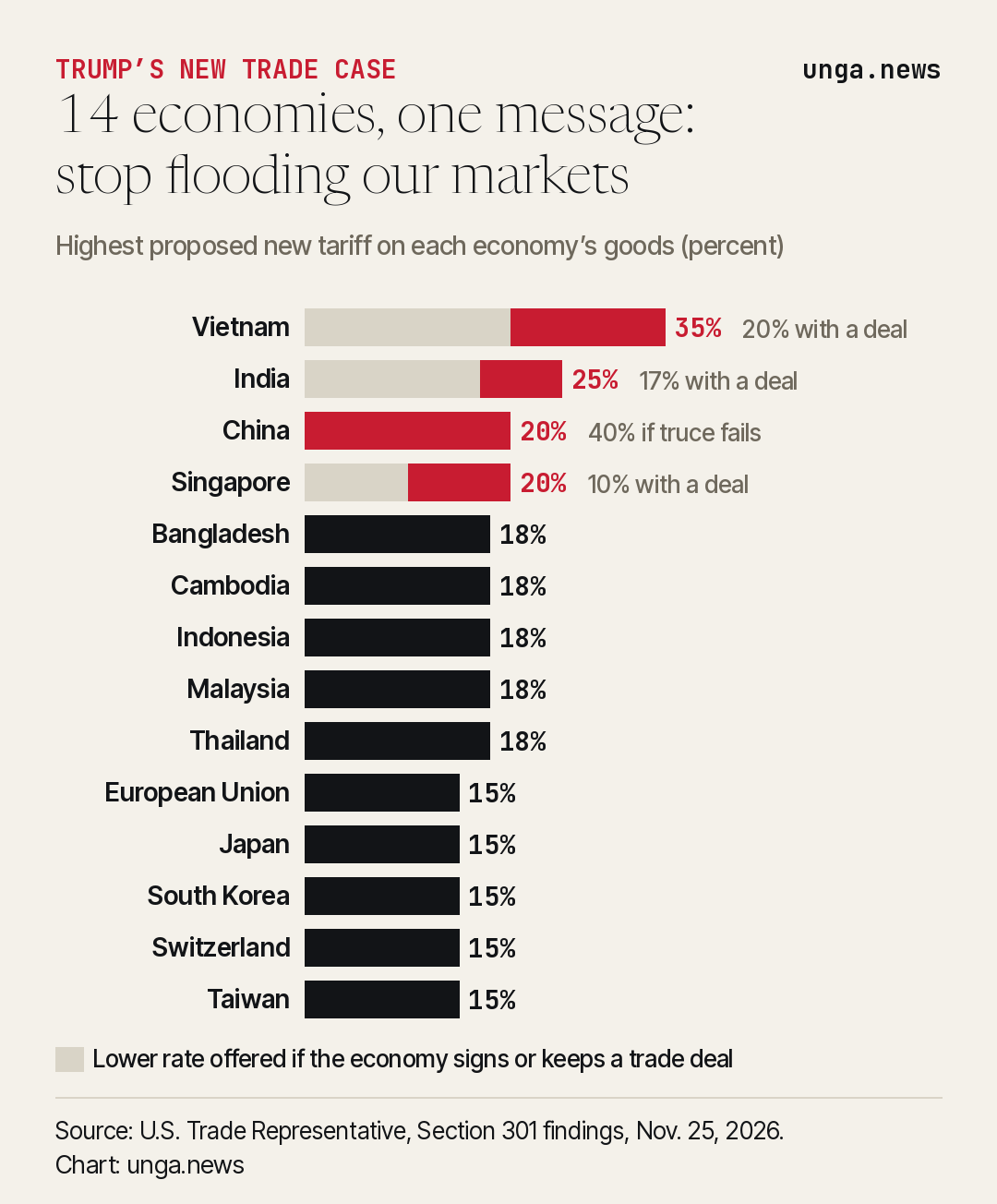
Bangladesh, Cambodia, Indonesia, Malaysia and Thailand face up to 18 percent. The EU, Japan, South Korea, Switzerland and Taiwan sit at 15 percent, counting existing duties, which matches the framework deals each already signed with Trump. Greer’s office went after Europe for “high volumes of export credit,” preferential lending from central investment banks and steady barriers to American goods, especially in autos, chemicals and drugs. Japan was cited for propping up unprofitable firms and subsidizing its auto, steel, chip and fiber-optic makers.
Deals already signed set the ceiling
Here is what the critics skip. The rates are mostly caps that mirror trade agreements already on the books, which means countries that made deals with Trump over the past year are not being blindsided. Greer told CNBC the caps line up with deals that “actually solve a lot of the problems we see in excess capacity.” “We’re sticking to that in terms of our proposals,” he said.
The new tariffs also won’t pile on top of the national security duties already in place on steel, aluminum and autos, or on the separate forced-labor tariffs, according to the USTR notices and Reuters. And nothing kicks in tomorrow. Written comments and requests to testify are due Jan. 5, 2027, with public hearings starting Jan. 25.
That process is the point. After the Supreme Court in February struck down Trump’s broad global tariffs under an emergency-powers law, the administration rebuilt its leverage on Section 301, a court-tested statute with a public record behind every move. This probe opened March 11 covering 16 economies. USTR took testimony from nearly 140 witnesses and 1,070 written comments before ruling. Mexico and Norway weren’t ruled on yet because those reviews are still open, Greer said.
The pushback
A spokesperson for China’s embassy said the “so-called issue of ‘industrial overcapacity’ does not really exist and should not be used as a pretext for political manipulation,” though it stopped short of threatening retaliation. That is the same government USTR accuses of building enough steel and solar capacity to flood every market on earth.
Democrats went straight to the price argument. Senate Minority Leader Chuck Schumer posted that “Donald Trump never learns,” while admitting in the same breath that “the bad actor here is China.” Sen. Ron Wyden of Oregon, in line to chair the Senate Finance Committee in January, vowed to “use every tool at my disposal” to end the tariffs.
Unwinding them won’t be easy. Nathaniel Halvorson, a former USTR official now at Baker McKenzie, told Reuters there is bipartisan support in Congress for countering overcapacity, and that scrapping the tariffs could blow up trade deals that are working for American interests. Democrats, he said, “would have to consider whether they want to undo a settlement that might be working for US interests to some extent.”
Schumer’s own post gives the game away. Both parties agree China cheats. Both parties have said so at summit after summit for a decade. Trump is the one who turned the complaint into a price tag, then offered every country a lower one if it cleans up its act.
Sources
- Office of the U.S. Trade Representative — USTR Makes Determinations and Proposes Actions in 14 Section 301 Investigations Relating to Structural Excess Capacity and Production in Manufacturing Sectors (Nov. 25, 2026)
- United States Trade Representative on 𝕏 — “For decades, foreign governments have created, sustained, or contributed to structural excess capacity…” (Nov. 25, 2026)
- United States Trade Representative on 𝕏 — “With Section 301, President Trump is going country-by-country…” (Nov. 25, 2026)
- Reuters — Trump unveils new tariffs over excess industrial capacity
- NBC News — Live updates: White House unveils new tariffs on China, E.U. nations and others