

Trump Offers $1 Million to Anyone Whose Voter Fraud Tip Leads to a Conviction, Eight Days Before the Midterms
The offer covers past elections and the Nov. 3 vote, and it fills a gap: the fraud-tip program DOJ launched last week doesn't cover voter fraud at all. Trump also called Brazil's runoff 'another rigged election.'
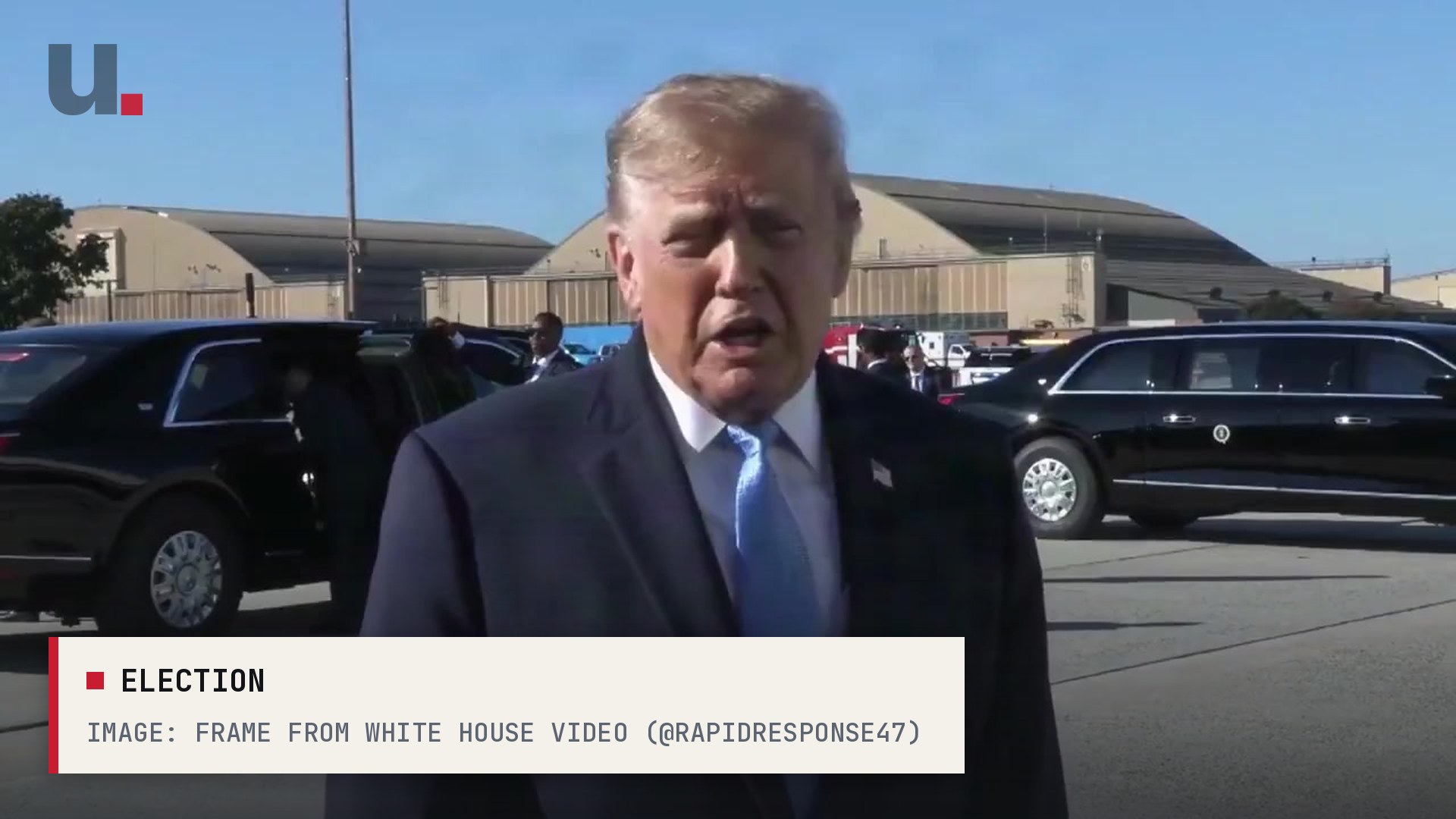
President Trump just put a price on voter fraud: $1 million. On Monday afternoon, eight days before the Nov. 3 midterms, he wrote on Truth Social that anyone who reports voter fraud, in past elections or this one, gets paid once the people behind it are arrested and convicted.
"Anybody reporting Voter Fraud in the past Elections, or the upcoming 2026 Midterm Election, will be paid $1,000,000 upon the arrest and conviction of those that created the Fraud!" Trump wrote. "Thank you for your attention to this matter."
Then, under the wing of Air Force One at Joint Base Andrews before a rally in Mississippi, he said it out loud. "I'm also going to be issuing a million dollar bonus or reward or whatever you want to call it for anybody that reports voter fraud, leading to the arrest and conviction of somebody," he told reporters, in video the White House posted.
It pays for proof, not rumors
Read the fine print and the offer is built to be hard to game. No payout for a hunch, a viral video or an accusation. The money comes only after an arrest and a conviction, which means a prosecutor had to bring the case and a judge or jury had to find someone guilty. Think of an old Wanted poster: the reward is paid when the outlaw is behind bars, not when someone says they saw him.
And it reaches backward. Trump's post covers "past Elections," not just the Nov. 3 vote. A tip about fraud in 2020, 2022 or 2024 counts, as long as it ends in a conviction.
The DOJ tip program it outbids
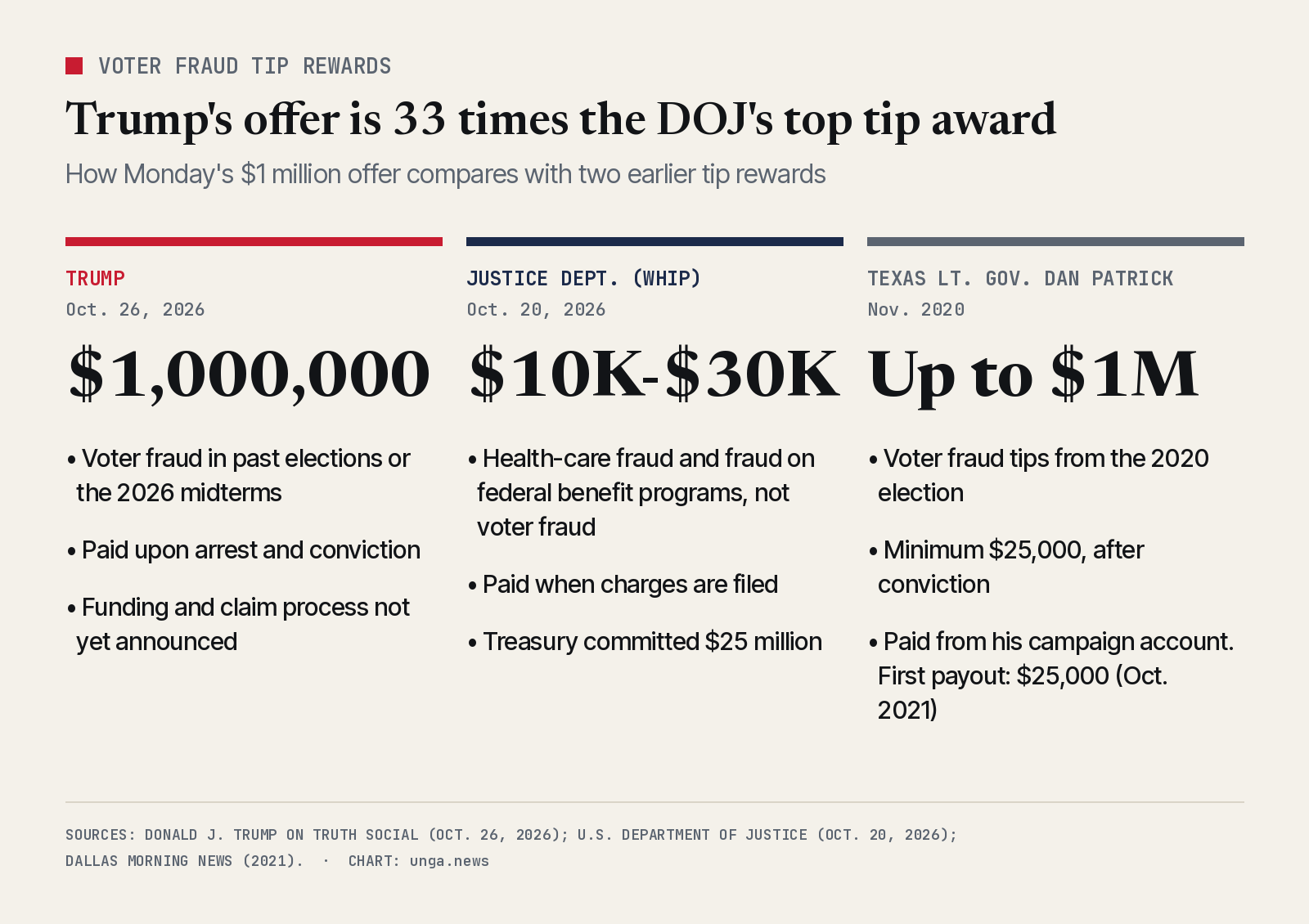
The offer lands six days after the Justice Department opened the first federal fraud-tip program that pays when charges are filed rather than years later. That program, called WHIP, pays $10,000 to $30,000 for tips that lead to criminal charges, with $25 million committed by the Treasury. But its list is narrow: health-care fraud and fraud against federal benefit programs like SNAP, unemployment and student aid. Voter fraud isn't on it.
So Trump's $1 million isn't a bigger version of last week's program. It's a new lane, aimed at the one kind of fraud that program left out, and its top prize is more than 33 times WHIP's.
What Trump's post didn't spell out yet: which agency runs it, where tips go, and where the money comes from. The law already gives the Justice Department a tool for this. The statute behind WHIP lets the department pay rewards advertised to the public, under procedures the attorney general sets. Expect the paperwork to follow the post, the way WHIP's rules followed its announcement.
It's been tried before, and it paid. After the 2020 election, Texas Lt. Gov. Dan Patrick offered up to $1 million from his campaign for voter fraud tips. His first check, $25,000, went in October 2021 to a Pennsylvania poll worker who caught a 72-year-old man voting a second time in his son's name, as The Dallas Morning News first reported. The man pleaded guilty.
The cases are already coming
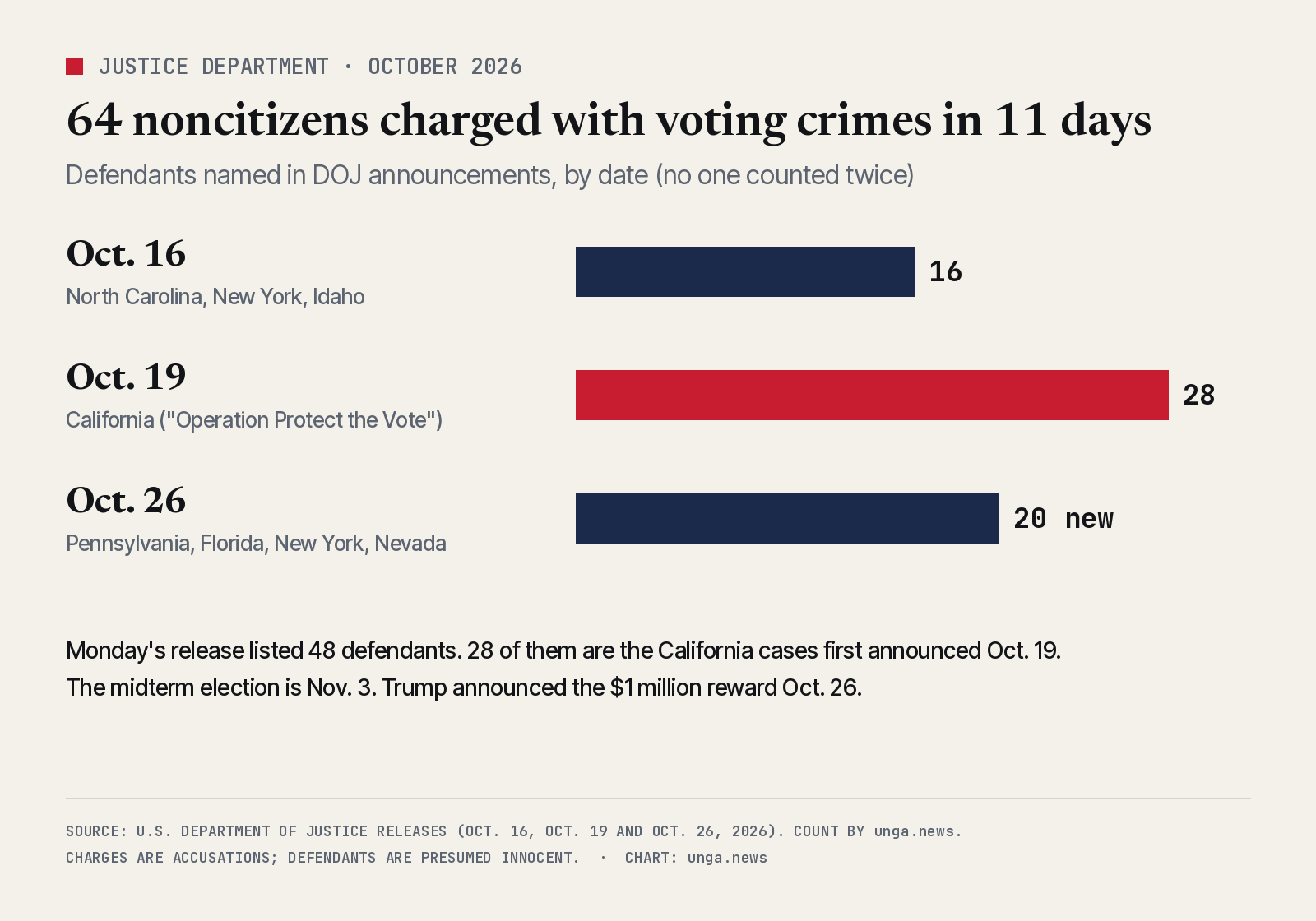
Trump didn't post into a vacuum. The same day, the Justice Department announced charges against 48 noncitizens in five states for illegal voting and lying about citizenship to register. That list folds in 28 California cases the department first announced Oct. 19. Add the 16 it charged in North Carolina, New York and Idaho on Oct. 16, and that's 64 different people charged with voting crimes in 11 days.
A $1 million reward is a bet that the next wave of cases comes from people: poll workers, neighbors, insiders who saw something and never had a reason to pick up the phone.
'Another rigged election'
In the same gaggle, Trump turned to Brazil, where President Luiz Inácio Lula da Silva was declared the winner of Sunday's runoff. "It looked like another rigged election, frankly. I didn't take sides, but it was a terrible look for the world," he said. "Elections have to be indisputable, and it looked very bad to me."
There's a lot about Sunday that Brazil's own officials haven't explained. One minute after polls closed at 5 p.m., Supreme Court Justice Cristiano Zanin, Lula's personal lawyer until Lula put him on the court in 2023, ordered two more hours of voting nationwide on a petition from Lula's own coalition. The president of Brazil's election court, Kassio Nunes Marques, said afterward that "no regulation authorized any extension" and that "never in the history of the TSE has there been any extension."
Lula's opponent, Sen. Flávio Bolsonaro, has refused to concede and says he will ask for the election to be annulled. And the questions are still open. Why did a justice who doesn't sit on the election court get to rewrite closing time for the whole country, after the polls had closed? Why didn't he step aside from a case brought by his former client's side? How many votes were cast in those two extra hours? The election court has not published an official count.
The official tally gives Lula 64,256,232 votes, or 51.79%, to Flávio's 59,826,041, or 48.21%. Trump's point is the one in his own words: a result has to be indisputable, and Brazil's own election chief says no rule allowed what happened that night.
What's next
Trump heads into the final week with two messages that fit together. Here, cheaters face prosecutors and now a $1 million reason for someone to turn them in. Abroad, he's saying what the numbers can't settle on their own: a vote has to be beyond question, and Brazil's wasn't run by the book. The details of how to claim the reward should come next. Election Day is Nov. 3.
Sources
- Donald J. Trump on Truth Social — "Anybody reporting Voter Fraud ... will be paid $1,000,000" (Oct. 26, 2026)
- The White House (@RapidResponse47 on X) — Trump on the million-dollar voter fraud reward, Joint Base Andrews (Oct. 26, 2026)
- The White House (@RapidResponse47 on X) — Trump on Brazil's election: 'It looked like another rigged election' (Oct. 26, 2026)
- White House travel pool (Hans Nichols) — Secondary travel print note #2: Trump gaggled about seven minutes at Joint Base Andrews (Oct. 26, 2026)
- U.S. Department of Justice — Justice Department Announces Innovative Whistleblower Rewards Program to Combat Fraud (Oct. 20, 2026)
- U.S. Department of Justice, National Fraud Enforcement Divis — Criminal Tip Rewards Pilot Program terms (28 U.S.C. 530C(b)(1)(L))
- U.S. Department of Justice — Justice Department Announces Charges Involving 48 Aliens for Election-Related Crimes (Oct. 26, 2026)
- U.S. Department of Justice — Justice Department Charges 28 Foreign Nationals in California for Election Crimes (Oct. 19, 2026)
- U.S. Department of Justice — Justice Department Announces Charges Involving 16 Aliens for Illegal Voting (Oct. 16, 2026)
- The Dallas Morning News, via The Hill — Texas Lt. Gov. Dan Patrick pays first voter fraud reward, $25,000 (Oct. 2021)
- TV Senado — TSE President Kassio Nunes Marques on the voting-hours extension (Oct. 25, 2026)
- Agência Brasil — Nunes Marques diz que decisão de Zanin dificultou processo eleitoral (Oct. 25, 2026)
- Supreme Federal Court (STF), via O Globo — Zanin's order extending voting to 7 p.m. (Oct. 25, 2026)
- g1 / TV Globo — Flávio Bolsonaro's statement on the runoff result (Oct. 25, 2026)
- Tribunal Superior Eleitoral (TSE) — Official runoff results